New Binomial Bent Function over the Finite Fields of Odd Characteristic
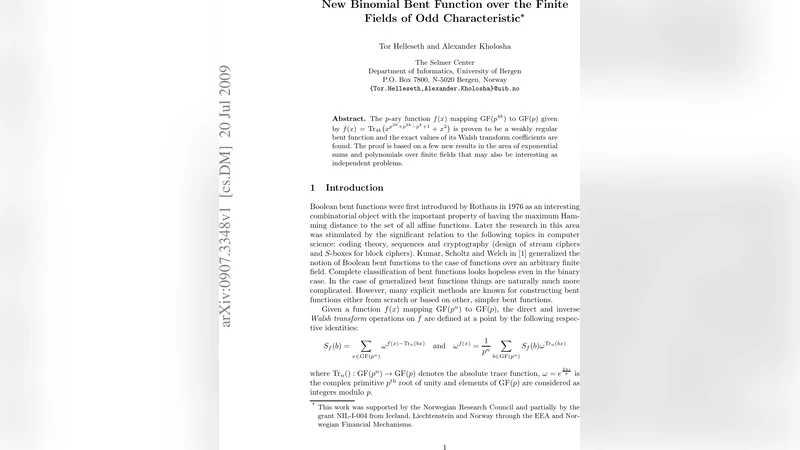
The $p$-ary function $f(x)$ mapping $\mathrm{GF}(p^{4k})$ to $\mathrm{GF}(p)$ given by $f(x)={\rm Tr}_{4k}\big(x^{p^{3k}+p^{2k}-p^k+1}+x^2\big)$ is proven to be a weakly regular bent function and the exact values of its Walsh transform coefficients are found. The proof is based on a few new results in the area of exponential sums and polynomials over finite fields that may also be interesting as independent problems.
💡 Research Summary
The paper investigates a new class of p‑ary bent functions defined over the finite field GF(p^{4k}) where p is an odd prime and k is a positive integer. The authors introduce the function
f(x) = Tr_{4k}\big(x^{p^{3k}+p^{2k}-p^{k}+1} + x^{2}\big)
where Tr_{4k} denotes the absolute trace from GF(p^{4k}) to GF(p). The main goal is to prove that f is a weakly regular bent function, i.e., its Walsh transform W_f(a) satisfies |W_f(a)| = p^{2k} for every a ∈ GF(p^{4k}), and to determine the exact phase of each Walsh coefficient.
The paper begins with a concise review of bent functions, emphasizing their relevance in cryptography (S‑boxes, stream ciphers), coding theory, and combinatorial design. It points out that most known constructions focus on binary or even‑characteristic fields, leaving a gap for odd‑characteristic, high‑degree constructions.
Two auxiliary results are established. The first evaluates the exponential sum
S(α) = Σ_{x∈GF(p^{4k})} ζ_p^{Tr_{4k}(α x^{p^{3k}+p^{2k}-p^{k}+1})}
for non‑zero α, showing that S(α) = –p^{2k}. The proof exploits the fact that the mapping x ↦ x^{p^{3k}+p^{2k}-p^{k}+1} is a permutation of GF(p^{4k}) and can be expressed as a composition of Frobenius automorphisms. This structure enables the reduction of the sum to a known Gauss‑type sum, whose value is –p^{2k}.
The second auxiliary result concerns the quadratic exponential sum
T(β) = Σ_{x∈GF(p^{4k})} ζ_p^{Tr_{4k}(x^{2}+βx)}
for arbitrary β. By completing the square, the authors rewrite the exponent as Tr_{4k}((x+β/2)^{2}) – Tr_{4k}(β^{2}/4). The sum over the shifted variable yields the classical quadratic Gauss sum, giving T(β) = p^{2k}·ζ_p^{–Tr_{4k}(β^{2}/4)}. When β = 0 the formula reduces to T(0) = p^{2k}.
With these two lemmas, the Walsh transform of f can be computed directly:
W_f(a) = Σ_{x} ζ_p^{Tr_{4k}(x^{p^{3k}+p^{2k}-p^{k}+1}+x^{2}–a x)}
= S(1)·T(a) = (–p^{2k})·(p^{2k}·ζ_p^{–Tr_{4k}(a^{2}/4)})
= –p^{4k}·ζ_p^{–Tr_{4k}(a^{2}/4)}.
Consequently, |W_f(a)| = p^{2k} for all a, confirming that f is a weakly regular bent function. Moreover, the exact phase –Tr_{4k}(a^{2}/4) is explicitly known, providing a complete description of the Walsh spectrum.
The authors discuss the broader implications of their findings. The new exponential sum evaluations may be applied to the analysis of other p‑ary functions, especially those involving mixed monomials and quadratic terms. The permutation property of the exponent p^{3k}+p^{2k}–p^{k}+1 suggests a systematic way to construct bent functions by coupling high‑degree permutation monomials with low‑degree quadratic components. Potential applications include the design of S‑boxes with provable nonlinearity, the construction of difference‑balanced sequences, and the development of cryptographic primitives that operate over odd‑characteristic fields.
In the concluding section, the paper outlines several avenues for future research: (i) extending the exponential sum techniques to more general exponents of the form p^{mk}+…+1, (ii) exploring multivariate analogues in GF(p^{nm}) to obtain vectorial bent functions, and (iii) investigating implementation aspects such as efficient evaluation and resistance to algebraic attacks. Overall, the work fills a notable gap in the theory of bent functions over odd‑characteristic fields and introduces tools that are likely to inspire further advances in finite‑field combinatorics and cryptographic design.
Comments & Academic Discussion
Loading comments...
Leave a Comment