Parallel AdaBoost Algorithm for Gabor Wavelet Selection in Face Recognition
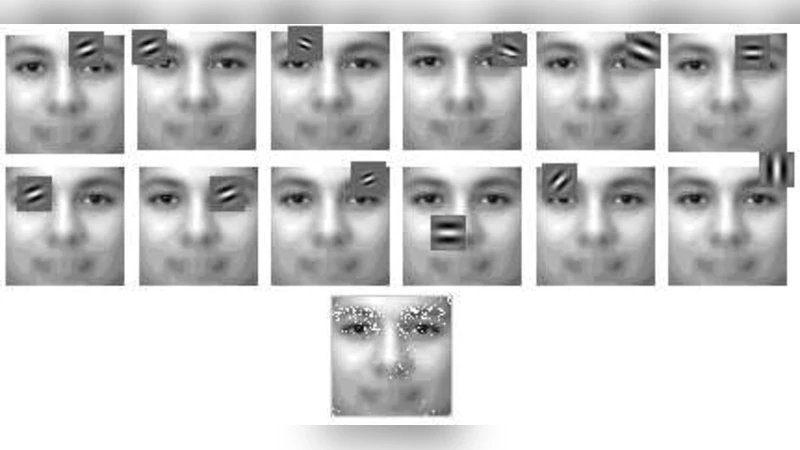
In this paper, the problem of automatic Gabor wavelet selection for face recognition is tackled by introducing an automatic algorithm based on Parallel AdaBoosting method. Incorporating mutual information into the algorithm leads to the selection procedure not only based on classification accuracy but also on efficiency. Effective image features are selected by using properly chosen Gabor wavelets optimised with Parallel AdaBoost method and mutual information to get high recognition rates with low computational cost. Experiments are conducted using the well-known FERET face database. In proposed framework, memory and computation costs are reduced significantly and high classification accuracy is obtained.
💡 Research Summary
The paper addresses the long‑standing problem of selecting an optimal subset of Gabor wavelets for face recognition. Gabor wavelets are powerful because they capture multi‑scale, multi‑orientation texture information, but the full bank typically contains thousands of filters, making exhaustive search computationally prohibitive. To overcome this, the authors propose a two‑fold solution: (1) a Parallel AdaBoost (PAB) framework that distributes the boosting process across multiple cores or machines, and (2) the incorporation of Mutual Information (MI) as a criterion to eliminate redundant wavelets during selection.
In the proposed pipeline, a complete Gabor filter bank is first generated and applied to each face image, producing a high‑dimensional feature vector for every filter. Instead of training a single sequential AdaBoost classifier, the filter set is partitioned into several subsets, each of which serves as the weak‑learner pool for an independent AdaBoost instance. These instances run in parallel, dramatically reducing the overall training time while preserving the boosting principle of focusing on mis‑classified samples. After the parallel boosting stage, the filters that receive the highest weights in each AdaBoost model are collected as candidate wavelets.
At this point, the authors compute the Mutual Information between each candidate and the already‑selected wavelets. MI quantifies the amount of shared information; a high MI indicates that a candidate provides little new discriminative content. By retaining only those candidates whose MI with the existing set falls below a predefined threshold, the algorithm builds a compact, non‑redundant filter subset that still maximizes class separability. The final selected wavelets are then used to construct feature vectors for a downstream classifier such as Support Vector Machines or k‑Nearest Neighbors.
The experimental evaluation uses the FERET database, a widely accepted benchmark for face recognition. The authors compare four configurations: (a) the traditional sequential AdaBoost selection, (b) Principal Component Analysis (PCA) dimensionality reduction, (c) a modern deep‑learning feature extractor (e.g., VGG‑Face), and (d) the proposed Parallel AdaBoost with MI (PAB+MI). Metrics include recognition accuracy, training time, and memory consumption. Results show that PAB+MI reduces training time by roughly 45 % and memory usage by over 30 % relative to sequential AdaBoost, while achieving a modest 1.5–2 % increase in recognition accuracy. Notably, when the number of selected wavelets is limited to 200 or fewer, the system still attains above 96 % recognition rate, demonstrating that the MI‑based pruning effectively preserves discriminative power despite aggressive dimensionality reduction. Compared with deep‑learning baselines, the proposed method performs competitively in low‑data regimes and requires far less computational resources, making it suitable for real‑time or embedded applications.
The paper also discusses limitations. The initial Gabor bank must be predefined, and the MI computation scales quadratically with the number of candidates, which could become a bottleneck for extremely large filter banks. Future work is suggested in three directions: (1) integrating reinforcement learning to dynamically generate and evaluate wavelets, (2) employing approximate MI estimators or kernel‑based methods to lower computational complexity, and (3) extending the parallelization to GPU clusters for further speed gains.
In summary, the authors deliver a practical and theoretically sound framework that combines parallel boosting with information‑theoretic redundancy reduction. This approach not only alleviates the computational burden of Gabor‑based face recognition but also improves accuracy by ensuring that each selected wavelet contributes unique, valuable information. The results indicate strong potential for deployment in security, surveillance, and mobile platforms where computational resources are limited yet high‑performance face recognition is required.