Three Crossed Modules
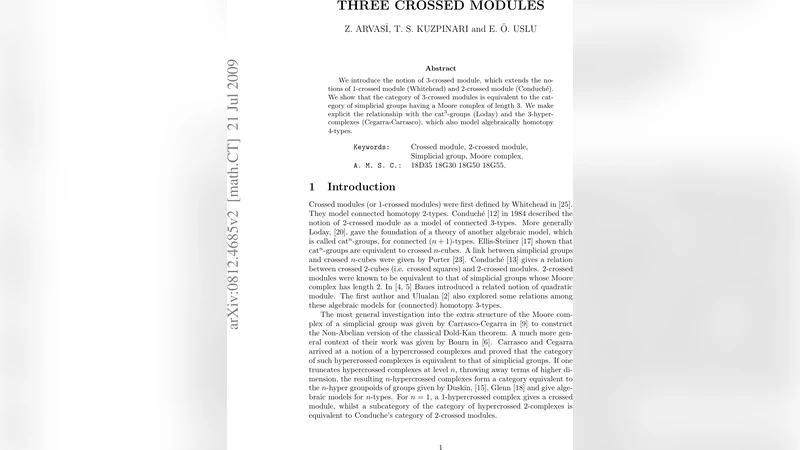
We introduce the notion of 3-crossed module, which extends the notions of 1-crossed module (Whitehead) and 2-crossed module (Conduch'e). We show that the category of 3-crossed modules is equivalent to the category of simplicial groups having a Moore complex of length 3. We make explicit the relationship with the cat$^{3}$-groups (Loday) and the 3-hyper-complexes (Cegarra-Carrasco), which also model algebraically homotopy 4-types.
💡 Research Summary
The paper introduces a new algebraic structure called a 3‑crossed module, which extends the classical notions of 1‑crossed modules (due to Whitehead) and 2‑crossed modules (due to Conduché). A 1‑crossed module consists of a group G, a G‑module M, and a boundary map ∂: M → G satisfying the usual Peiffer identity; it models homotopy 2‑types. A 2‑crossed module adds a further group L together with a second boundary ∂₂: L → M and a ternary “Peiffer lifting” that encodes the interaction among π₁, π₂ and π₃, thereby modeling homotopy 3‑types.
The authors define a 3‑crossed module as a quadruple of groups (N, L, M, G) equipped with three boundary maps
∂₃ : N → L, ∂₂ : L → M, ∂₁ : M → G
and a hierarchy of actions: G acts on M, M on L, and L on N. In addition to the compatibility conditions that make each ∂i a morphism of G‑modules, they impose a set of seven higher‑dimensional Peiffer identities. These identities guarantee that the “crossed” behavior persists at the next level: for example, ∂₂(l)·l′ = l l′ l⁻¹, ∂₃(n)·n′ = n n′ n⁻¹, and mixed relations such as ∂₁(m)·l = m l m⁻¹. The new ternary operation (the 3‑crossed lifting) involves four elements (n₁,n₂,m,g) and satisfies coherence laws that generalise the 2‑crossed Peiffer lifting.
A central result is the equivalence of categories between 3‑crossed modules and simplicial groups whose Moore complex has length three. Starting from a 3‑crossed module, one builds a simplicial group by placing N, L, M, G in simplicial degrees 3,2,1,0 respectively, using the boundary maps as Moore differentials and the actions to define degeneracies and faces. Conversely, given a simplicial group with a Moore complex N₃ → N₂ → N₁ → N₀, the authors extract the four groups and reconstruct the higher Peiffer liftings from the simplicial structure. The proof shows that the two constructions are mutually inverse up to natural isomorphism, thereby establishing a categorical equivalence.
The paper then relates this new structure to two previously known algebraic models of 4‑types. Loday’s cat³‑groups are internal categories of depth three; their objects, arrows, 2‑arrows and 3‑arrows correspond precisely to G, M, L and N. The composition laws in a cat³‑group translate into the three boundary maps and the higher Peiffer identities of a 3‑crossed module. The authors give an explicit dictionary, proving that the category of cat³‑groups is also equivalent to the category of 3‑crossed modules.
Similarly, Cegarra‑Carrasco’s 3‑hyper‑complexes are chain complexes equipped with higher “hyper‑crossed” operations. By interpreting the hyper‑operations as the 3‑crossed liftings and the chain differentials as the boundaries ∂₁, ∂₂, ∂₃, the authors show that a 3‑hyper‑complex is exactly a 3‑crossed module in disguise. This yields a third equivalence of categories.
Because a 3‑crossed module encodes the groups π₁, π₂, π₃ and π₄ together with all the actions and k‑invariants that relate them, it provides a complete algebraic model for homotopy 4‑types. The paper demonstrates this by working out explicit examples: the trivial 4‑sphere yields the zero 3‑crossed module, while a non‑trivial 4‑dimensional CW‑complex with non‑zero π₁ and π₂ produces a non‑trivial N‑L‑M‑G diagram whose Peiffer identities recover the usual Postnikov k‑invariants in degree four.
In the concluding section the authors discuss future directions. They suggest developing a homotopy theory of 3‑crossed modules (e.g., notions of weak equivalence, fibrations, and cofibrations), extending the construction to non‑abelian coefficients, and investigating computational tools for extracting the 3‑crossed structure from a given CW‑complex. Moreover, they hint at possible generalisations to n‑crossed modules for modeling (n + 1)‑types, pointing out that the pattern of adding one more group, one more boundary map, and a new higher Peiffer identity should continue indefinitely.
Overall, the paper unifies three previously disparate algebraic frameworks—Moore‑complex simplicial groups, cat³‑groups, and 3‑hyper‑complexes—under the single notion of a 3‑crossed module, thereby providing a robust and flexible algebraic language for the study of 4‑dimensional homotopy theory.
Comments & Academic Discussion
Loading comments...
Leave a Comment