Occupational Health Problem Network : the Exposome
We present a thinking on the concept of relational networks applied to the french national occupational disease surveillance and prevention network (R\'eseau National de Vigilance et de Pr\'evention des Pathologies Professionnelles, RNV3P). This appr…
Authors: Laurie Fais, ier, Régis De Gaudemaris
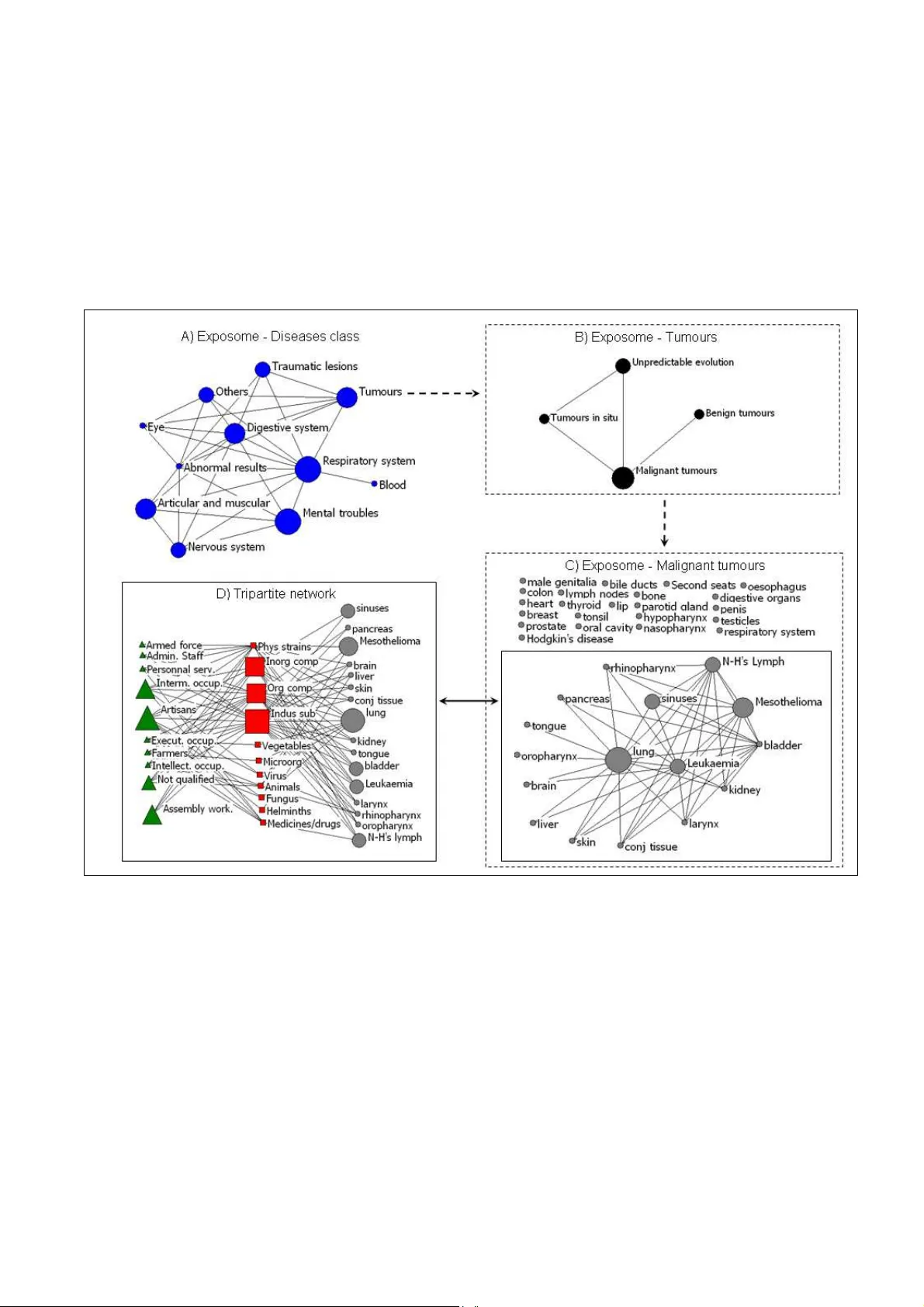
Occupational He alth Proble m Netw ork : the Exposo me Laurie Faisandier 1 , Régis De Gaudemaris 1,2 , Dominique J Bicout 3 1 Laboratoire E nvironne ment et Pr édiction de la Santé d es Population s-TIMC, Uni versité Jo seph Fourier, Gr enoble, Domaine de la Mer ci, 387 06 La Tronche, Fr ance 2 Service de Mé decine et Sant é au Tr avail, CHU Grenoble, B P 217, 3 8043 Grenob le cedex 09 France 3 Bio mathématiques et Epid émiologie, Labora toire En vironnement et P rédiction de la Santé d es P opulations-T IMC, UMR CNRS 552 5 Université Joseph Fourie r, Ecole N ationale Véterinaire de Lyon, 692 80 Marcy l’Etoile, Fra nce Corresponding authors: LFaisandier@chu-grenoble.fr , d.bicout@vet-l yon.fr In the past two de cades, industrialisation, urbanis ation, the booming development of the transport industry and intensive farming have all r esulted i n considerable changes at both an individual and societal level. The professional environment has i n particular undergone technological advances with the discovery of new substances and the modernisation of manufacturin g processes. With an increase in the incidence of path ologies whose root causes are poorl y understoo d and som etimes not even known, and a growing demand b y the public for the improvement of working conditions, thes e developments and ch anges rais e ge neral questions about the relationship between the environment (professional) and health. Initiated in 2001, the Réseau National de Vigilance et de prevention des P athologies P rofessionelles (RNV3P) is a computer-based network which collates information on he alth problems in the work place, issued by th e cent res of occup ational di seases throu ghout France. The observatio ns are reported b y doctors – ex pert database findings grow each year b y, on average, 5,000 occupational health problems. The objectives of the RNV3P a re based on two main principals: the identification of professional situations that expose people to risk and the aetiolog y of emerging medical events associated wit h problems of health at work. With a substantial num ber of observations r eported, t he RNV3P constitutes an e ssential resource in the prospective epidem iological surveillance of occupational diseases. An occupational-health problem (OHP) is s een in the situation where a patient presents with a principal patholog y associated with a cascade o f up to 5 noxious agents t hat are related to the pla ce of work, t he profession (or job) and the patient’ s particular a ctivity . A d egree of responsibility is attributed to each nox ious substance and reflects the i ntensity of the causal-effect relationship of the substance on the presentation of disease. Thus two OHPs may differ either b y principle pathology and/or an occupational e xposure defined b y noxious agent, profession or sector of activit y. Likewise, several patients can present with exactl y the same OHP. In the face of so man y i ndividual factors and com plex professional situations where exposures o f diverse origins and variable intensity combine over time to have an ef fect on h ealth, it may b e helpful t o investi gate characteristics or traits which gather or separate OHPs. In effect, man y diseases are of mul tifactorial origin due to a prol onged and regular exposure to a r ange of noxious products. Because of this, several distinct OHPs are likel y to have in comm on similar professional situations. Consequently, i t would be convenient to develop approaches capable of analysing all OHPs in a global manner for the st udy of p athology-exposure r elationships. For this reason, we have developed the con cept o f “expos ome”, defined as a relational network of OHPs having in common an element at l east of an occupational exposure: the noxious s ubstances , job or s ector o f activity [1] . Thus, the R NV3P database is structured b y groups of OHP s sharing characteristi cs in common. I n t his way, exposomes represent a tripartite occupa tional exposure – pathology netw ork, founded upon presentation of disease. Figure 1 illustrates the s tructure encased in the network with the exposomes at different levels o f organisation, indicating the relational complexity between OHPs. Each link in the exposome represents an OHP and the size of the link is proportional to the number of identical OHPs. Two links are connected when the y h ave at least one element of occupational ex posure in common. The number of conne ctions between links indicates both the number of different exposures (multi- exposures) and the diversit y o f connections from t he number of different neighbouring OHPS. In this way, the organisation of OHPs in the exposome allows identification of groups of OHPs that share similar occupational exposures and inter-connected or linked O HPs belonging to several groups. This exposome network is t hen used to conduct an epide miological survey b y the programmed prospective surveillance of OHP gr oups ( or associations pathology x oc cupational exposures) identified and of a prospe ctive surveillance by the detection of emerging ev ents as new links and/or new connect ions appear [2]. B y definition, these exposomes should also enable stud y of synergistic relationships of occupational exposures on the OHPs and to construct h ypotheses on th e aetiology of pathologies. The term expos ome has alread y been us ed in the li terature. In effect, just as for health risk anal ysis, where the toxi cological reference values are established from lifetime exposure, C P Wild defines exposome as the collection and succession of indivi dual and environmental ex posures encountered by an individual during his/her lifetime [3]. This author proposes reconst ructing an individual’s given network of exposures in order to better understand the role of each ex posure and thus generate research hypotheses as for the aetiol ogy of diseases. In a similar w ay, Barabasi has constru cted a "diseasome" in order to illustrate under the form of a network t he environmental and social factors which would have a potential role in the origins of obesity [ 4]; and Goh et al. have ex plored a network of human diseases that implicate similar genetic mutation s [5] . What all these analyses have in common is the research of similar characteristi cs for the understanding of mechanisms and the identification of key factors in the development and manifestation of diseases. The exposome approach that we ar e i n the process of developin g has also an im mediate appli cation in health surveillance and the dete ction of emerging events fo r the RNV3 P. This approach could b e applied to a global analysis of he alth problems that would include in the RNV3P database other types of findings, variables and descriptors such as those used in the diseasome and ex posome of the Wild type. A s tep or enterprise such as this greatl y exceeds the simple framework, alread y complex in itself, of the RNV3P and necessitates going into and/or combining other databases. Figure 1: Structure of the disease exposome. Each tie re presents a pathology for which the size is pro portional to the number of related OHPs. The inter-connecte d links have a t least one oc cupa tional expos ure in co mmon, s uch as the noxio us subst ance. A) Exposo me of disease categories o f tu mours, r eported in t he RNV3P database. B) Exposo me of tumours. This c ategor y of diseases represents 4 sub-groups: m alignant tu mours, tumours o f an unpredictab le evolution, in-situ t umours and benign tu mours. C) 38 diseases are distinguis hed a mongst the malignant t umours, of which 22 isolate d link s do not have a ny noxio us age nts in common and the remaining 16 inter-connected links form a network as shown in fig. 1D. D) T he tripartite network: disease–noxious agent–occupa tion is the origin of the expo some for med b y 16 malignant tum ours. The circ les, squares and triangles r epresent mali gnant tu mours, noxio us agents and occupation, resp ectively, r elative to eac h observat ion. Th e links bet ween square s and triangles indicate noxious a gents associated with the occupatio n for the OH P co nsidered, a nd the links bet ween squares and circles indicate noxious agents associated with the pathology . References : 1. Faisandier L, Bonne terre V, De Gaudem aris R et al. Elaboration d’une méthode statistique pour la détection d’événem ents émergents: appl ication au Rés eau National de Vigilance et de Prév ention des Pathologies Professionn elles (RNV3P). Ep idémiol. et s anté anim. 2007;51:111- 8. 2. Bonneterre V, B icout DJ, Larabi L et a l. Detection o f emerging diseases in occupational he alth : usefulness and limitations of app lication of pharm acovigilance method s to the database o f the French nati onal occupational disease s urveillance and p revention netw ork (RNV3P). Occup Env iron Med. 2008 ;65:32-7. 3. Wild CP Com plementing the Genom e with an “exposom e”: the outstanding challeng e of environm ental exposure measurem ent in molecular epidem iology. Cancer Epidem iol Biomarker s Prev 2005;14:184- 8. 4. Barabasi A- L Network Medecine – From Obesity to the « Diseasome » . N. Engl. J. Med. 2007 ;357:404-7. 5. Goh K-I, C usick ME, Valle D et al. The human dise ase network. Proc. Na tl. Acad. Sci. U.S.A. 2007;104:8685- 90.
Original Paper
Loading high-quality paper...
Comments & Academic Discussion
Loading comments...
Leave a Comment