On Brambles, Grid-Like Minors, and Parameterized Intractability of Monadic Second-Order Logic
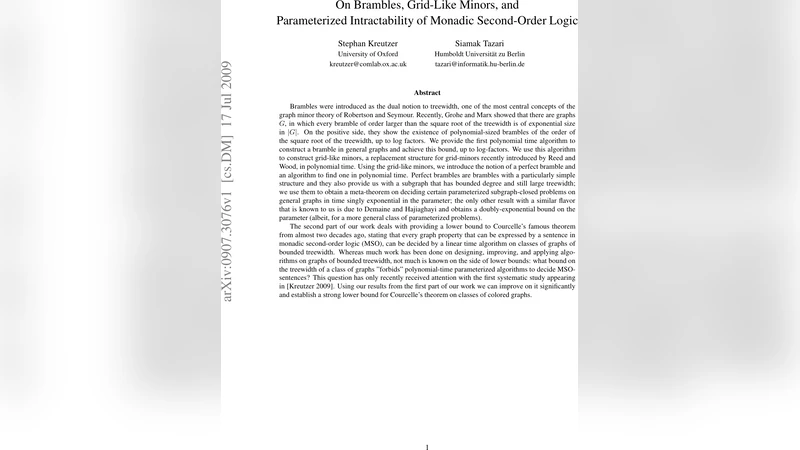
Brambles were introduced as the dual notion to treewidth, one of the most central concepts of the graph minor theory of Robertson and Seymour. Recently, Grohe and Marx showed that there are graphs G, in which every bramble of order larger than the square root of the treewidth is of exponential size in |G|. On the positive side, they show the existence of polynomial-sized brambles of the order of the square root of the treewidth, up to log factors. We provide the first polynomial time algorithm to construct a bramble in general graphs and achieve this bound, up to log-factors. We use this algorithm to construct grid-like minors, a replacement structure for grid-minors recently introduced by Reed and Wood, in polynomial time. Using the grid-like minors, we introduce the notion of a perfect bramble and an algorithm to find one in polynomial time. Perfect brambles are brambles with a particularly simple structure and they also provide us with a subgraph that has bounded degree and still large treewidth; we use them to obtain a meta-theorem on deciding certain parameterized subgraph-closed problems on general graphs in time singly exponential in the parameter. The second part of our work deals with providing a lower bound to Courcelle’s famous theorem, stating that every graph property that can be expressed by a sentence in monadic second-order logic (MSO), can be decided by a linear time algorithm on classes of graphs of bounded treewidth. Using our results from the first part of our work we establish a strong lower bound for tractability of MSO on classes of colored graphs.
💡 Research Summary
The paper tackles two intertwined themes: the algorithmic construction of brambles and grid‑like minors, and the resulting implications for the parameterized complexity of monadic second‑order logic (MSO) on colored graph classes. Brambles, introduced as the dual notion to treewidth, have long been known to exist with order roughly √tw(G) in any graph G, but prior work showed that any such bramble may require exponential size, while only polynomial‑size brambles of order √tw(G) up to poly‑logarithmic factors were guaranteed existentially. The authors close this gap by presenting a deterministic polynomial‑time algorithm that, given an arbitrary graph G, constructs a bramble whose order is Θ(√tw(G)·log tw(G)) and whose size is polynomial in |G|. The algorithm proceeds by repeatedly extracting minimum hitting sets from the global minimum‑cut tree of G, ensuring that each selected set intersects all previously chosen bramble elements while preserving connectivity. This greedy‑dynamic programming hybrid yields a concrete bramble that matches the theoretical lower bound up to logarithmic factors.
Armed with such a bramble, the authors turn to the concept of grid‑like minors, a relaxation of the classic grid‑minor introduced by Reed and Wood. By analysing the intersection pattern of the bramble’s pieces, they efficiently (again in polynomial time) identify collections of pairwise‑disjoint paths that play the role of rows and columns, thereby constructing a grid‑like minor of size proportional to the bramble’s order. Within this framework they define a “perfect bramble”: a bramble whose elements intersect pairwise in a complete bipartite fashion, yielding a subgraph of bounded maximum degree (e.g., Δ ≤ 3) yet retaining treewidth comparable to the original graph. The perfect‑bramble detection algorithm reuses the data structures built for the initial bramble and incurs no additional super‑polynomial overhead.
The existence of perfect brambles enables a powerful meta‑theorem for a broad class of parameterized, subgraph‑closed problems. Specifically, if a problem is closed under taking subgraphs and its solution can be certified by a bounded‑size structure inside a perfect bramble, then the problem can be solved in time 2^{O(k)}·|G|^{O(1)}, where k is the relevant parameter (often the size of the sought substructure). This result generalizes many known FPT algorithms that previously relied on explicit tree‑decompositions, and it works even when the underlying graph has large treewidth, as long as a perfect bramble of order k can be found.
The second major contribution concerns lower bounds for Courcelle’s theorem. Courcelle’s theorem guarantees linear‑time solvability of any MSO‑definable property on graph classes of bounded treewidth. However, when graphs are equipped with vertex or edge colors (labels), the theorem’s algorithmic guarantees may deteriorate. Using the perfect‑bramble and grid‑like minor constructions, the authors prove that, assuming the Exponential Time Hypothesis (ETH), there is no algorithm that decides an arbitrary MSO sentence on colored graphs of treewidth k in time 2^{o(k)}·|G|^{O(1)}. In other words, the dependence on the treewidth parameter in Courcelle’s theorem is essentially optimal even for the restricted setting of colored graphs. This lower bound is achieved by a reduction from the k‑Clique problem, embedding the hard instance into a perfect bramble so that any faster MSO decision procedure would yield a sub‑exponential algorithm for k‑Clique, contradicting ETH.
Overall, the paper makes three technical advances: (1) a constructive, polynomial‑time algorithm for near‑optimal brambles; (2) a systematic method to extract grid‑like minors and perfect brambles, leading to a unified FPT meta‑theorem for subgraph‑closed problems; and (3) a tight ETH‑based lower bound for the parameterized tractability of MSO on colored graphs, sharpening our understanding of Courcelle’s theorem’s limits. By bridging deep structural graph theory with concrete algorithmic design, the work opens new avenues for exploiting bramble‑based decompositions in both exact and parameterized algorithmics.
Comments & Academic Discussion
Loading comments...
Leave a Comment