The von Mises transformation: order reduction and construction of Backlund transformations and new integrable equations
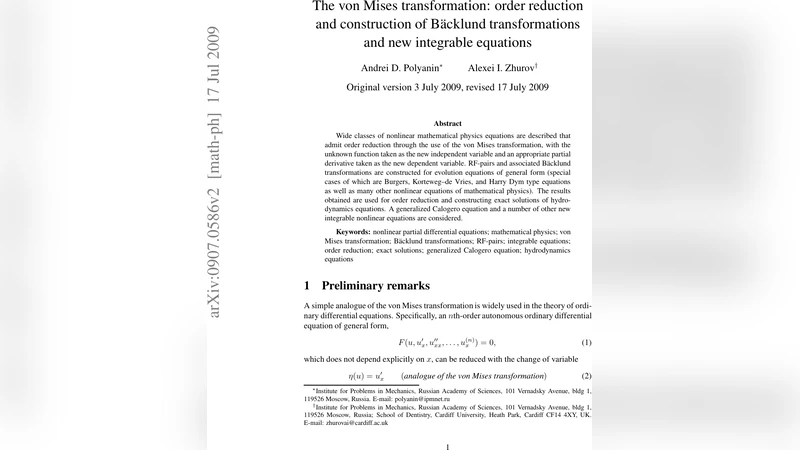
Wide classes of nonlinear mathematical physics equations are described that admit order reduction through the use of the von Mises transformation, with the unknown function taken as the new independent variable and an appropriate partial derivative taken as the new dependent variable. RF-pairs and associated B"acklund transformations are constructed for evolution equations of general form (special cases of which are Burgers, Korteweg–de Vries, and Harry Dym type equations as well as many other nonlinear equations of mathematical physics). The results obtained are used for order reduction and constructing exact solutions of hydrodynamics equations. A generalized Calogero equation and a number of other new integrable nonlinear equations are considered.
💡 Research Summary
The paper presents a unified framework for reducing the order of a broad class of nonlinear partial differential equations (PDEs) by employing the von Mises transformation in a novel way. Traditionally used in fluid mechanics to interchange dependent and independent variables, the von Mises transformation is here generalized: the unknown function u(x,t) is taken as a new independent variable η, while a selected partial derivative of u (most often u_x or u_t) becomes the new dependent variable v(η,t). By applying the chain rule, all spatial and temporal derivatives in the original equation can be expressed solely in terms of η and v, leading to a reduced‑order equation that is typically first‑ or second‑order and often linear or semi‑linear.
The authors first formalize the transformation for a generic evolution equation
u_t = F(u, u_x, u_{xx}, …) .
After the change of variables η = u, v = u_x, the equation becomes
v_t = ∂_η
Comments & Academic Discussion
Loading comments...
Leave a Comment