Codimension Two Bifurcations and Rythms in Neural Mass Models
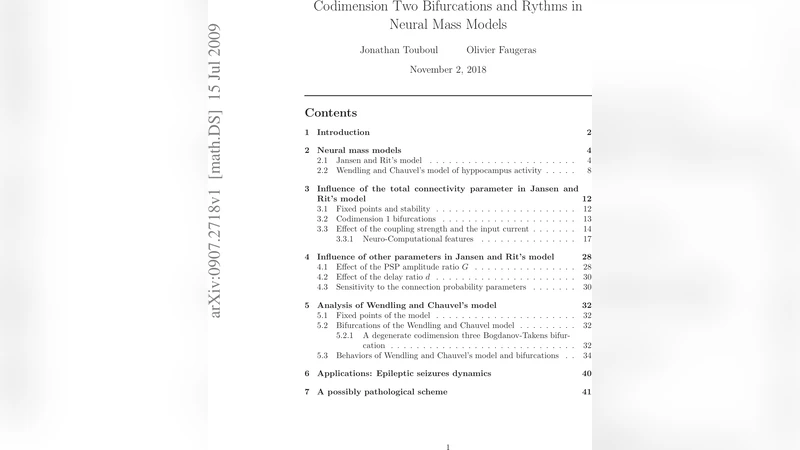
Temporal lobe epilepsy is one of the most common chronic neurological disorder characterized by the occurrence of spontaneous recurrent seizures which can be observed at the level of populations through electroencephalogram (EEG) recordings. This paper summarizes some preliminary works aimed to understand from a theoretical viewpoint the occurrence of this type of seizures and the origin of the oscillatory activity in some classical cortical column models. We relate these rhythmic activities to the structure of the set of periodic orbits in the models, and therefore to their bifurcations. We will be mainly interested Jansen and Rit model, and study the codimension one, two and a codimension three bifurcations of equilibria and cycles of this model. We can therefore understand the effect of the different biological parameters of the system of the apparition of epileptiform activity and observe the emergence of alpha, delta and theta sleep waves in a certain range of parameter. We then present a very quick study of Wendling and Chauvel’s model which takes into account GABA A inhibitory postsynaptic currents.
💡 Research Summary
This paper investigates how rhythmic EEG activity and epileptic seizures emerge from the dynamics of two classic neural mass models: the Jansen‑Rit cortical column model and the Wendling‑Chauvel extension that incorporates GABA_A inhibitory currents. Using bifurcation theory, the authors systematically explore codimension‑one, ‑two, and ‑three bifurcations of equilibria and limit cycles as key biological parameters (synaptic gains, time constants, external drive) are varied.
In the Jansen‑Rit model, the three state variables represent average membrane potentials of pyramidal cells, excitatory interneurons, and inhibitory interneurons. Continuation methods reveal Hopf and saddle‑node on invariant circle (SNIC) bifurcations that mark the onset of oscillatory activity. More importantly, Bogdanov‑Takens and cusp points (codimension‑two) are identified, where a Hopf branch and a homoclinic branch intersect. Near these points, tiny parameter changes cause a stable fixed point to give way to large‑amplitude periodic orbits. The frequency of these orbits sweeps through the alpha (8‑12 Hz), theta (4‑7 Hz) and delta (0.5‑4 Hz) bands, reproducing sleep‑related EEG rhythms observed in vivo. Extending the analysis to codimension‑three reveals subcritical Hopf scenarios that generate abrupt amplitude jumps and chaotic‑like bursting, providing a mechanistic explanation for the transition from normal rhythms to epileptiform discharges.
The Wendling‑Chauvel model adds a separate variable for GABA_A‑mediated inhibition, allowing a finer control of inhibitory feedback. By increasing the inhibitory gain, the Hopf bifurcation curve shifts, and a subcritical Hopf emerges that produces high‑amplitude, seizure‑like oscillations. The comparative study shows that the location of codimension‑two bifurcations is highly sensitive to the balance between excitation and inhibition, suggesting that pharmacological modulation of GABAergic transmission can move the system away from pathological bifurcation regimes.
Overall, the work demonstrates that the structure of the bifurcation set—particularly codimension‑two points—organizes the repertoire of EEG rhythms and delineates the pathways by which normal sleep waves transform into epileptic seizures. This theoretical framework not only clarifies the dynamical origins of alpha, theta, and delta waves but also offers a quantitative basis for designing patient‑specific interventions, such as targeted drug dosing or neuromodulation, that aim to steer the neural mass system away from dangerous bifurcation zones.
Comments & Academic Discussion
Loading comments...
Leave a Comment