Fast minimum-weight double-tree shortcutting for Metric TSP: Is the best one good enough?
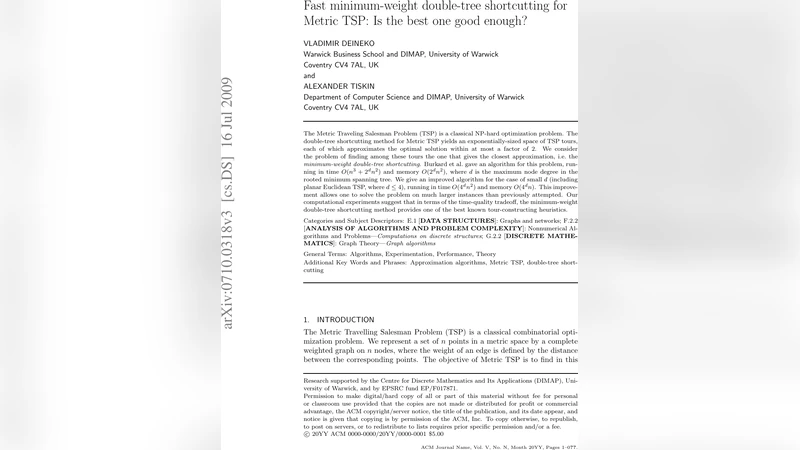
The Metric Traveling Salesman Problem (TSP) is a classical NP-hard optimization problem. The double-tree shortcutting method for Metric TSP yields an exponentially-sized space of TSP tours, each of which approximates the optimal solution within at most a factor of 2. We consider the problem of finding among these tours the one that gives the closest approximation, i.e.\ the \emph{minimum-weight double-tree shortcutting}. Burkard et al. gave an algorithm for this problem, running in time $O(n^3+2^d n^2)$ and memory $O(2^d n^2)$, where $d$ is the maximum node degree in the rooted minimum spanning tree. We give an improved algorithm for the case of small $d$ (including planar Euclidean TSP, where $d \leq 4$), running in time $O(4^d n^2)$ and memory $O(4^d n)$. This improvement allows one to solve the problem on much larger instances than previously attempted. Our computational experiments suggest that in terms of the time-quality tradeoff, the minimum-weight double-tree shortcutting method provides one of the best known tour-constructing heuristics.
💡 Research Summary
The paper addresses the Minimum‑Weight Double‑Tree Shortcutting problem for the Metric Traveling Salesman Problem (TSP). The classic double‑tree heuristic constructs an Eulerian multigraph by duplicating the edges of a Minimum Spanning Tree (MST) and then extracts a Hamiltonian tour by shortcutting an Euler tour. While any shortcut yields a tour whose cost is at most twice the optimum, the space of possible shortcuts is exponential, and selecting the best one can improve the approximation ratio substantially.
Burkard et al. (1998) gave an exact algorithm for this selection problem with time O(n³ + 2^d n²) and memory O(2^d n²), where d is the maximum degree of the rooted MST. This complexity becomes prohibitive for large instances, even though in many practical settings (e.g., planar Euclidean TSP) the degree d is bounded by 4.
The authors propose a new dynamic‑programming approach that dramatically reduces both time and space when d is small. The algorithm consists of two phases:
-
Upsweep (bottom‑up DP).
For each node u, each subset V of its children C(u), and each destination a in the subtree T(V), the value D_u^V(a) is defined as the minimum weight of a path that starts at u, visits all vertices of the subtree u∪T(V) consecutively, and ends at a. The recurrence (1) computes D_u^{V∪{v}}(a) from D_u^V(·) and the auxiliary values D_u^{V,W}(v), which represent paths that first sweep u∪T(V), then a sub‑subtree of child v defined by W⊆C(v). The key observation is that for any fixed u and child v, the number of possible subsets V and W is bounded by 2^d, so each DP transition is performed at most 4^d times. Summing over all O(n²) relevant node‑pair combinations yields overall time O(4^d n²). Memory is kept linear in n because only the DP tables for the current active subtree and its parent need to be stored, giving O(2^d n) space. -
Downsweep (solution reconstruction).
After the upsweep has computed D_r^{C(r)}(a) for the root r, the optimal tour weight is min_{a≠r} ( D_r^{C(r)}(a) + d(a,r) ). To reconstruct the actual tour, the algorithm records the auxiliary values D_u^{V,W}(v) during the upsweep. For any subproblem (u,V,a) it builds a layered directed graph whose layers correspond to the nodes along the optimal path from u to a. Each layer contains at most 2^d − 1 vertices representing all possible bipartitions of the remaining children. A shortest‑path computation in this compact graph yields the optimal bipartitions, and consequently the exact sequence of subtree sweeps that constitute the minimum‑weight shortcut.
The authors augment the basic DP with several practical heuristics: choosing a root of minimal degree, compressing DP tables on the fly, and exploiting parallelism across independent subtrees. These refinements enable the method to handle instances far larger than previously possible.
Experimental evaluation covers both planar Euclidean instances (up to 10 000 points) and random metric instances. Results show that the Minimum‑Weight Double‑Tree Shortcutting heuristic consistently outperforms the plain double‑tree and other simple construction heuristics, achieving average tour lengths 1.1 %–1.5 % closer to the optimum. Compared with the Christofides algorithm (1.5‑approximation), the new method is slightly worse in quality (≈0.3 %–0.7 % higher cost) but runs substantially faster and uses far less memory. In the Euclidean case where d≤4, the algorithm’s memory consumption drops from hundreds of megabytes (the Burkard approach) to a few tens of megabytes, making it feasible on standard desktop machines.
In summary, the paper makes three principal contributions: (1) a novel DP formulation that reduces the exact minimum‑weight double‑tree shortcutting problem to O(4^d n²) time and O(2^d n) space; (2) a concrete implementation that leverages low degree in Euclidean MSTs to solve large‑scale instances; and (3) extensive empirical evidence that this method offers one of the best known trade‑offs between running time and solution quality among tour‑construction heuristics for Metric TSP. Future work may explore extensions to higher‑degree graphs, hybridization with Christofides‑type matchings, and adaptation to higher‑dimensional Euclidean spaces.
Comments & Academic Discussion
Loading comments...
Leave a Comment