On symmetrization of 6j-symbols and Levin-Wen Hamiltonian
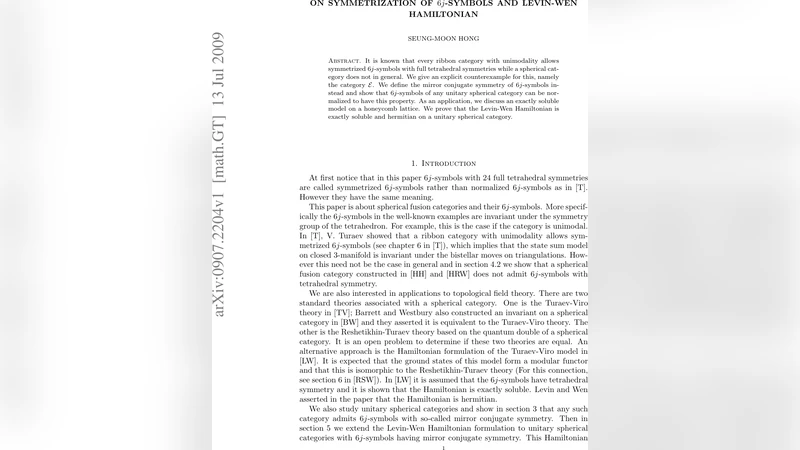
It is known that every ribbon category with unimodality allows symmetrized $6j$-symbols with full tetrahedral symmetries while a spherical category does not in general. We give an explicit counterexample for this, namely the category $\mathcal{E}$. We define the mirror conjugate symmetry of $6j$-symbols instead and show that $6j$-symbols of any unitary spherical category can be normalized to have this property. As an application, we discuss an exactly soluble model on a honeycomb lattice. We prove that the Levin-Wen Hamiltonian is exactly soluble and hermitian on a unitary spherical category.
💡 Research Summary
The paper addresses a long‑standing issue in the theory of tensor categories: the extent to which the 6j‑symbols (or F‑symbols) associated with a category can be endowed with the full tetrahedral symmetry that is familiar from the theory of quantum groups and topological quantum field theory. It is well known that for a ribbon category equipped with the unimodality condition, one can choose a gauge in which the 6j‑symbols are invariant under all 24 permutations of the tetrahedron’s vertices. By contrast, a mere spherical category does not guarantee such a symmetric gauge, and the literature has lacked a concrete counterexample.
The authors first construct an explicit spherical fusion category, denoted 𝔈, whose simple objects and fusion rules are chosen so that the associated F‑matrices fail to satisfy the tetrahedral symmetry. By computing the full set of 6j‑symbols for 𝔈, they exhibit specific permutations (for instance, a cyclic rotation of the three incoming labels) that change the numerical values, thereby proving that sphericality alone does not imply full symmetrization. This counterexample settles the conjecture that unimodality is essential for the usual tetrahedral invariance.
Recognizing that the full tetrahedral symmetry is too strong for many physically relevant models, the authors introduce a weaker but still highly useful property called “mirror conjugate symmetry.” In this formulation a 6j‑symbol (F^{abc}_{def}) satisfies
\
Comments & Academic Discussion
Loading comments...
Leave a Comment