A De Vries-type Duality Theorem for Locally Compact Spaces -- III
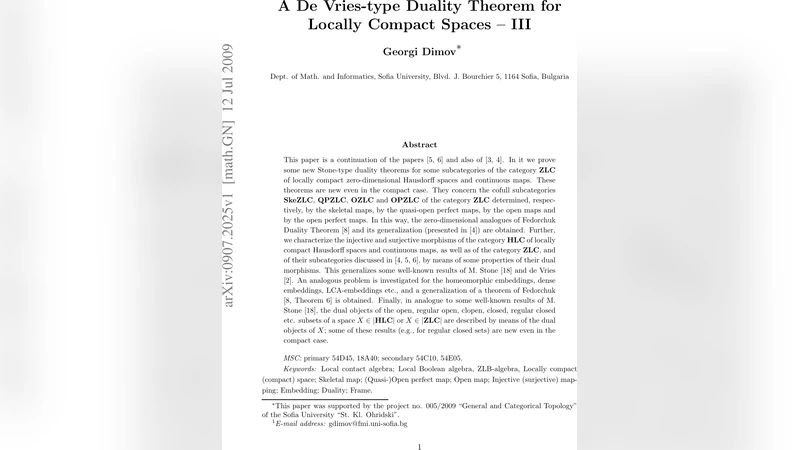
In this paper we prove some new Stone-type duality theorems for some subcategories of the category $\ZLC$ of locally compact zero-dimensional Hausdorff spaces and continuous maps. These theorems are new even in the compact case. They concern the cofull subcategories $\SkeZLC$, $\QPZLC$, $\OZLC$ and $\OPZLC$ of the category $\ZLC$ determined, respectively, by the skeletal maps, by the quasi-open perfect maps, by the open maps and by the open perfect maps. In this way, the zero-dimensional analogues of Fedorchuk Duality Theorem and its generalization are obtained. Further, we characterize the injective and surjective morphisms of the category $\HLC$ of locally compact Hausdorff spaces and continuous maps, as well as of the category $\ZLC$, and of some their subcategories, by means of some properties of their dual morphisms. This generalizes some well-known results of M. Stone and de Vries. An analogous problem is investigated for the homeomorphic embeddings, dense embeddings, LCA-embeddings etc., and a generalization of a theorem of Fedorchuk is obtained. Finally, in analogue to some well-known results of M. Stone, the dual objects of the open, regular open, clopen, closed, regular closed etc. subsets of a space $X\in\card{\HLC}$ or $X\in\card{\ZLC}$ are described by means of the dual objects of $X$; some of these results (e.g., for regular closed sets) are new even in the compact case.
💡 Research Summary
This paper continues a series of works on de Vries‑type dualities for locally compact spaces, focusing on the third installment, which deals with zero‑dimensional locally compact Hausdorff spaces (the category ZLC) and several natural subcategories determined by special classes of continuous maps. The authors first recall the classical Stone duality between Boolean algebras and zero‑dimensional compact Hausdorff spaces, and de Vries duality between compact Hausdorff spaces and complete normal contact algebras. They then observe that these dualities can be extended to the non‑compact, locally compact setting by working with the category HLC of all locally compact Hausdorff spaces and, more restrictively, with its zero‑dimensional subcategory ZLC.
The central technical contribution is the introduction of four co‑full subcategories of ZLC:
1. SkeZLC – objects are zero‑dimensional locally compact spaces and morphisms are skeletal maps (maps whose images are dense in the closure of the image of any open set).
2. QPZLC – morphisms are quasi‑open perfect maps (continuous, closed, quasi‑open, and with compact fibres).
3. OZLC – morphisms are open maps.
4. OPZLC – morphisms are open perfect maps (open, closed, and fibre‑compact).
For each subcategory the authors construct a dual algebraic category consisting of complete Boolean algebras equipped with a local contact relation (LCA). The dual objects are precisely the local contact algebras that arise as the regular closed algebra of a space together with the natural contact relation “two regular closed sets intersect”. The dual morphisms are Boolean homomorphisms preserving the contact relation in a way that mirrors the topological property of the original map.
The paper proves that each of the four subcategories is dually equivalent to its corresponding algebraic category. These equivalences are zero‑dimensional analogues of Fedorchuk’s duality theorem, which originally related compact Hausdorff spaces and complete normal contact algebras. By restricting to the co‑full subcategories, the authors obtain a finer classification: skeletal maps correspond to dense‑preserving homomorphisms, quasi‑open perfect maps correspond to regular complete homomorphisms, open maps correspond to open homomorphisms (those that send interior elements to interior elements), and open perfect maps correspond to open complete homomorphisms.
Beyond the dualities, the authors give a complete description of injective and surjective morphisms in HLC and ZLC in terms of their dual homomorphisms. A continuous map is surjective precisely when its dual homomorphism is a complete Boolean homomorphism that is onto the underlying Boolean algebra; a map is injective exactly when the dual homomorphism is an embedding of LCAs that preserves contact and reflects non‑contact. These characterizations generalize classical results of M. Stone (who identified embeddings with Boolean monomorphisms) and de Vries (who identified surjections with complete homomorphisms).
The paper also investigates several embedding notions: homeomorphic embeddings, dense embeddings, and LCA‑embeddings (embeddings that preserve the local contact structure). It shows that a map is a dense embedding iff its dual is a dense embedding of LCAs, and that a map is an LCA‑embedding iff the induced Boolean homomorphism is an embedding that reflects the contact relation. As a consequence, a generalized version of Fedorchuk’s theorem is obtained: every LCA‑embedding arises from a dense open perfect map between zero‑dimensional locally compact spaces.
Finally, the authors turn to the dual representation of subsets of a space. For a space X in HLC or ZLC they describe the dual objects of various families of subsets—open, regular open, clopen, closed, regular closed—by means of the dual LCA of X. For instance, a regular closed subset corresponds to a regular closed element of the LCA, i.e., an element a such that a = cl(int(a)). The paper proves that the Boolean subalgebra generated by such elements is isomorphic to the regular closed algebra of the subset, and that the induced contact relation coincides with the restriction of the original contact. Similar results are given for open and regular open subsets (interior elements), and for clopen subsets (clopen elements). Some of these subset dualities, especially those concerning regular closed sets, are new even in the compact case.
In summary, the paper achieves three major goals: (1) it extends Stone‑type dualities to four natural subcategories of zero‑dimensional locally compact spaces, providing precise algebraic counterparts for skeletal, quasi‑open perfect, open, and open perfect maps; (2) it gives categorical characterizations of injective, surjective, and various embedding morphisms in terms of LCA homomorphisms, thereby generalizing classical Stone and de Vries results; and (3) it supplies a systematic dual description of important families of subsets of a space via its dual LCA, yielding new insights even for compact spaces. These contributions deepen the interplay between topology, Boolean/contact algebra, and category theory, and open avenues for further research on non‑compact dualities and their applications.
Comments & Academic Discussion
Loading comments...
Leave a Comment