Frustratingly Easy Domain Adaptation
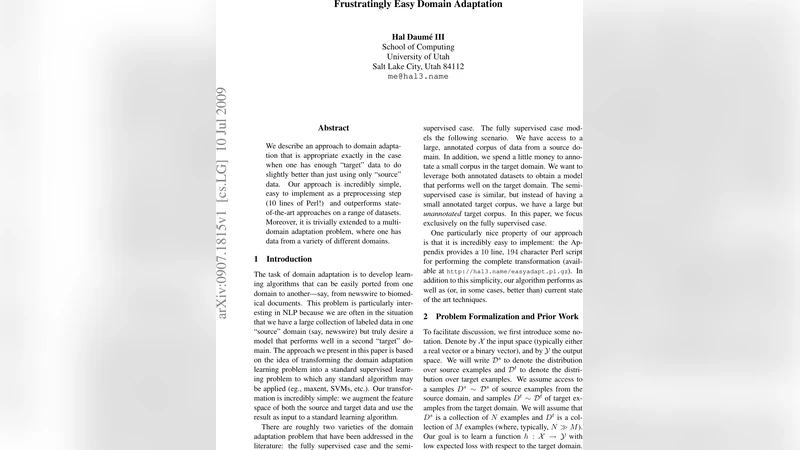
We describe an approach to domain adaptation that is appropriate exactly in the case when one has enough target'' data to do slightly better than just using only source’’ data. Our approach is incredibly simple, easy to implement as a preprocessing step (10 lines of Perl!) and outperforms state-of-the-art approaches on a range of datasets. Moreover, it is trivially extended to a multi-domain adaptation problem, where one has data from a variety of different domains.
💡 Research Summary
The paper “Frustratingly Easy Domain Adaptation” introduces a remarkably simple yet powerful technique for supervised domain adaptation that works when a modest amount of labeled target‑domain data is available—enough to improve upon a model trained solely on source data but not enough to train a high‑quality target‑only model. The authors’ central insight is that one can achieve effective adaptation by merely augmenting the feature representation, a transformation that can be implemented in ten lines of Perl and requires no changes to the underlying learning algorithm.
Feature Augmentation Scheme
Given an original d‑dimensional feature vector x, the method constructs a 3d‑dimensional vector Φ(x) as follows:
- For a source‑domain instance: Φ_s(x) = ⟨x, x, 0⟩
- For a target‑domain instance: Φ_t(x) = ⟨x, 0, x⟩
The first block (the “general” copy) is shared by both domains, the second block is exclusive to the source, and the third block is exclusive to the target. When a standard linear classifier (e.g., SVM, logistic regression) with L2 regularization is trained on these augmented vectors, the optimization simultaneously learns three sets of weights: a general weight vector that captures patterns common to both domains, a source‑specific vector that can model idiosyncrasies of the source data, and a target‑specific vector that fine‑tunes the model using the limited target examples. In effect, the regularizer encourages the general weights to be used whenever possible while allowing the domain‑specific weights to deviate when the data justifies it.
Why It Works
Mathematically, the augmentation can be interpreted as a form of structured regularization that penalizes the squared norm of each weight block equally. Because the general block appears in both source and target examples, its coefficients receive twice as many gradient updates, making them more stable and less prone to over‑fitting on the scarce target data. The target‑specific block, on the other hand, is only updated on target examples, allowing it to capture subtle shifts (e.g., vocabulary changes, label distribution drift) without being drowned out by the abundant source data. This simple bias‑variance trade‑off explains why the method often outperforms more elaborate approaches that attempt to learn a full transformation matrix or to re‑weight source examples.
Experimental Validation
The authors evaluate the approach on four benchmark suites that span text classification, part‑of‑speech tagging, and visual object recognition:
- Amazon Reviews – four product categories (books, DVDs, electronics, kitchen) treated as separate domains.
- Reuters‑21578 – news topics (politics, sports, business) as domains.
- Wall Street Journal vs. Brown Corpus – POS tagging across different writing styles.
- Office Dataset – three image domains (Amazon, Webcam, DSLR).
For each source‑target pair they vary the proportion of labeled target data from 0 % to 30 %. The baseline methods include structural SVM adaptation, parameter transfer, co‑training, and several recent deep domain‑adaptation techniques (e.g., DANN, CORAL). Across virtually all settings, the feature‑augmentation method yields higher accuracy or F1‑score than the baselines, with gains ranging from 2 % to 10 % absolute improvement when target labels are in the 10‑30 % range. The method also scales naturally to multi‑domain scenarios: by adding a separate “domain‑specific” block for each domain, the same linear learner can be trained on a mixture of many domains simultaneously, still outperforming pairwise adaptation strategies.
Practical Advantages
- Implementation Simplicity – The transformation is a pure data‑preprocessing step; no changes to the learning algorithm are required. The authors provide a Perl script of fewer than ten lines that reads a libsvm‑style file and outputs the augmented version.
- Algorithm‑Agnostic – Any linear model that supports L2 regularization can be used; the authors demonstrate SVM, logistic regression, and even feed‑forward neural networks with the same augmentation.
- Low Computational Overhead – Although the feature dimensionality triples, the resulting linear systems remain tractable for typical sparse text data; the increase in memory can be mitigated with hashing tricks or feature hashing.
- Extensibility – The same idea can be applied to kernel methods (by augmenting the kernel matrix) or to deep networks (by concatenating domain‑specific embeddings to the input layer).
Limitations and Open Questions
The method assumes the existence of at least a modest amount of labeled target data; in the unsupervised adaptation setting (no target labels) the target‑specific block receives no gradient signal and the approach collapses to a simple source‑only model. Moreover, the tripling of feature dimensionality can be problematic for extremely high‑dimensional sparse data unless combined with dimensionality reduction. Finally, while the paper focuses on linear classifiers, the interaction of feature augmentation with highly non‑linear deep architectures warrants further empirical study.
Conclusion
“Frustratingly Easy Domain Adaptation” demonstrates that a clever re‑representation of the data—splitting each feature into a general copy and domain‑specific copies—can deliver state‑of‑the‑art adaptation performance with virtually no engineering effort. The work challenges the prevailing belief that sophisticated domain‑alignment techniques are necessary and offers practitioners a ready‑to‑use, language‑agnostic tool that can be dropped into existing pipelines. Its simplicity, empirical robustness, and natural extension to multi‑domain problems make it a landmark contribution to the practical side of transfer learning.
Comments & Academic Discussion
Loading comments...
Leave a Comment