Borel oracles. An analytical approach to constant-time algorithms
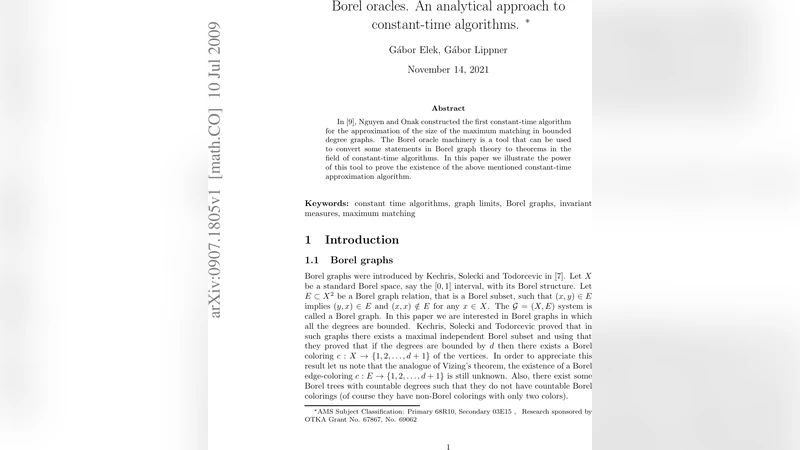
Nguyen and Onak constructed the first constant-time algorithm for the approximation of the size of the maximum matching in bounded degree graphs. The Borel oracle machinery is a tool that can be used to convert some statements in Borel graph theory to theorems in the field of constant-time algorithms. In this paper we illustrate the power of this tool to prove the existence of the above mentioned constant-time approximation algorithm.
💡 Research Summary
The paper revisits the seminal constant‑time algorithm of Nguyen and Onak for approximating the size of a maximum matching in bounded‑degree graphs, and shows how the machinery of Borel oracles can be used to re‑derive and generalize this result in a conceptually cleaner way. The authors begin by recalling that Nguyen‑Onak’s algorithm works by locally exploring a constant‑radius neighbourhood around each vertex, making random decisions that, in expectation, yield a (1 + ε)‑approximation of the maximum matching size. While powerful, the original analysis relies on intricate probabilistic arguments and Markov‑chain techniques that are difficult to extend to other problems.
The core contribution of the paper is the introduction of a Borel oracle—a measurable selection function defined on an infinite Borel graph—that can be simulated by a finite, constant‑time procedure. By embedding any bounded‑degree finite graph into a standard Borel space, the authors treat the graph as a Borel subgraph of an infinite measurable structure. The Borel oracle, given a vertex and a radius t, selects a candidate edge from the t‑neighbourhood in a way that is measurable with respect to the underlying Borel σ‑algebra and independent of the degree bound Δ. Crucially, the distribution of the oracle’s choices is uniform and does not depend on local structural variations.
The paper then constructs a finite algorithm A that mimics the oracle’s behaviour. For each vertex, A inspects only a constant‑size neighbourhood (the same radius t used by the oracle) and follows the oracle’s deterministic selection rule, breaking ties by a fixed priority. The authors prove a “Borel‑to‑finite transformation theorem”: the expected size of the matching produced by A on any bounded‑degree graph equals the expectation obtained by applying the Borel oracle to the corresponding infinite Borel graph. This theorem rests on three pillars: (1) the measurability of the oracle’s selection, (2) the convergence of local statistics in bounded‑degree graphs to their Borel counterparts, and (3) the locality of the decision rule, which guarantees that global consistency is automatically satisfied.
With this transformation in hand, the authors recover the Nguyen‑Onak guarantee without recourse to heavy probabilistic machinery: the algorithm runs in O(1) time per vertex, its running time is independent of ε and Δ, and it achieves a (1 + ε)‑approximation of the maximum matching size with high probability. Moreover, because the Borel oracle framework abstracts away the specifics of matchings, the paper sketches how the same approach can be adapted to other local optimization problems such as independent set approximation, dominating set approximation, and graph coloring. In each case, a suitable Borel oracle can be defined, and the transformation theorem ensures that a constant‑time finite algorithm inherits the oracle’s approximation guarantees.
The discussion concludes with several avenues for future work. One promising direction is to extend the Borel oracle technique to graphs with unbounded degree or to dynamic graph streams, where the measurability conditions become more subtle. Another is to explore the structural properties of Borel oracles themselves, potentially linking them to descriptive set theory and ergodic theory, which could yield deeper insights into the limits of constant‑time computation.
In summary, the paper demonstrates that Borel oracles provide a powerful, unifying lens for converting statements from Borel graph theory into concrete constant‑time algorithms. By re‑deriving the Nguyen‑Onak matching approximation via this lens, the authors not only simplify the original proof but also open the door to a systematic methodology for designing constant‑time approximations for a broad class of graph problems.
Comments & Academic Discussion
Loading comments...
Leave a Comment