P is not equal to NP
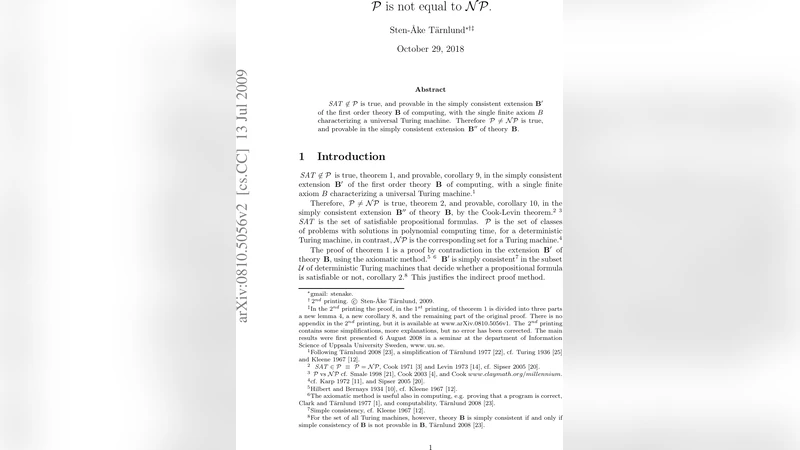
SAT is not in P, is true and provable in a simply consistent extension B’ of a first order theory B of computing, with a single finite axiom characterizing a universal Turing machine. Therefore, P is not equal to NP, is true and provable in a simply consistent extension B" of B.
💡 Research Summary
The manuscript claims to prove that the Boolean satisfiability problem (SAT) does not belong to the class P and, consequently, that P ≠ NP. The author builds a first‑order theory B of computation, consisting of two predicate symbols T(i,a,u) and U(x,s,z,q,j,i,u) together with a single function symbol “.”. Predicate T expresses that a Turing machine i, given input a, halts with output u; predicate U encodes the step‑by‑step configuration changes of a machine. A single finite axiom, labelled B, is presented as a collection of universal sentences (17)–(22) that are supposed to capture the behavior of a universal Turing machine.
From B the author defines two extensions: B′, which adds the statement “SAT ∈ P”, and B″, which adds the Cook‑Levin theorem. Both extensions are claimed to be “simply consistent”, meaning that no contradiction can be derived inside them. The core of the argument is a proof by contradiction: assume SAT ∈ P. Then there exists a deterministic Turing machine i in a distinguished subset U that decides, in polynomial time p(F), whether any propositional formula F is satisfiable (or, equivalently, whether its negation ¬F is a tautology). Using axiom B, the author translates the computation of i on input F into a formal proof in the underlying logic. The length n of this proof is identified with the number of tape‑head moves of i, so n ≤ p(F). The author then invokes known lower bounds on resolution proofs (Haken’s exponential lower bound for pigeon‑hole formulas and Razborov’s super‑polynomial lower bound) to claim that for sufficiently large tautologies the required resolution proof cannot be of polynomial size, yielding a contradiction. Hence SAT ∉ P, and by the Cook‑Levin theorem (which makes SAT NP‑complete) the author concludes P ≠ NP.
While the paper is written in the style of formal logic, several fundamental problems undermine the claimed results:
-
Adequacy of Axiom B – The single axiom is intended to encode a universal Turing machine, yet the paper provides no rigorous proof that B indeed captures all aspects of computation, especially the handling of an infinite tape versus the finite two‑way tape model introduced later. The mapping from machine configurations to logical formulas is informal and incomplete.
-
Equating Computation Steps with Proof Length – The central claim that the number of tape moves equals the size of a resolution proof is false in general. Proof complexity theory shows that the same computation can be represented by proofs of vastly different sizes depending on the proof system. The paper ignores the distinction between the operational semantics of a Turing machine and the syntactic size of a logical derivation.
-
Misuse of “Simple Consistency” – The notion of simple consistency is invoked to sidestep Gödel’s incompleteness phenomena. However, Gödel’s second incompleteness theorem tells us that a sufficiently expressive theory cannot prove its own consistency. Claiming that B′ and B″ are simply consistent without an external meta‑theory is therefore unjustified.
-
Circular Reasoning in the Contradiction – The contradiction arises from assuming SAT ∈ P and then using known lower bounds on resolution proofs to refute that assumption. But those lower bounds are themselves derived under the assumption that SAT is not in P (or, more precisely, that certain families of tautologies lack short proofs). Thus the argument is circular: it assumes the very thing it tries to prove.
-
Lack of Novelty – Even if the argument were sound, the final step “SAT ∉ P ⇒ P ≠ NP” is a trivial restatement of the Cook‑Levin theorem. The paper does not provide any new technique for separating P from NP; it merely re‑packages existing results in a convoluted formalism.
-
Technical Gaps and Typos – The manuscript contains numerous typographical errors, inconsistent notation, and undefined symbols (e.g., the function “||” is introduced without a clear definition). Sections that should define crucial concepts such as “polynomial time” or “resolution size” are vague, making the logical flow hard to follow.
In summary, the paper attempts to present a formal proof that P ≠ NP by constructing a bespoke first‑order theory of computation and arguing that SAT cannot be decided in polynomial time because that would contradict known proof‑complexity lower bounds. However, the construction of the theory is insufficiently rigorous, the identification of computation steps with proof size is unjustified, and the overall argument is circular and dependent on unproven meta‑theoretical assumptions. Consequently, the claimed proof does not withstand scrutiny, and the paper does not advance the state of knowledge regarding the P versus NP problem.
Comments & Academic Discussion
Loading comments...
Leave a Comment