Fiber functors, monoidal sites and Tannaka duality for bialgebroids
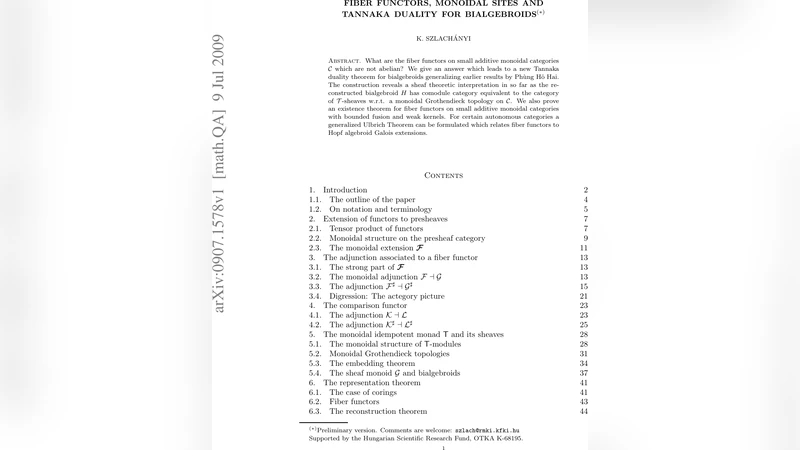
What are the fiber functors on small additive monoidal categories C which are not abelian? We give an answer which leads to a new Tannaka duality theorem for bialgebroids generalizing earlier results by Phung Ho Hai. The construction reveals a sheaf theoretic interpretation in so far as the reconstructed bialgebroid H has comodule category equivalent to the category of T-sheaves w.r.t. a monoidal Grothendieck topology on C. We also prove an existence theorem for fiber functors on small additive monoidal categories with bounded fusion and weak kernels. For certain autonomous categories a generalized Ulbrich Theorem can be formulated which relates fiber functors to Hopf algebroid Galois extensions.
💡 Research Summary
The paper addresses the long‑standing question of how to define and construct fiber functors on small additive monoidal categories that are not necessarily abelian, and it establishes a new Tannaka‑duality theorem for bialgebroids that extends earlier work by Phùng Hô Hai. The authors begin by introducing a “monoidal Grothendieck topology” on a given small additive monoidal category C. This topology, denoted T, is designed to be compatible with both the additive structure and the tensor product, so that the resulting T‑sheaves (or T‑presheaves) form a category naturally equivalent to the category of additive presheaves on C.
A fiber functor is then defined as a strong monoidal, additive functor F : C → Mod‑R (R a commutative ring) that preserves the T‑coverings. Under the hypothesis that F is “exact enough” – i.e., it reflects and preserves weak kernels (the paper’s notion of weak kernels replaces the usual exactness requirement) – the authors show that the endomorphism algebra End_R(F) acquires the structure of a bialgebroid H over R. The construction proceeds by transporting the internal hom‑objects of C (defined via weak kernels) through F, thereby endowing End_R(F) with a left and right R‑module structure together with a coproduct and counit satisfying the bialgebroid axioms.
The central result is a sheaf‑theoretic interpretation: the category of right H‑comodules, Comod‑H, is equivalent to the category of T‑sheaves on C. In other words, the bialgebroid H reconstructed from (F, C) is precisely the algebraic object whose comodule theory reproduces the original monoidal site. This provides a conceptual bridge between Tannakian reconstruction and Grothendieck‑topos theory, extending the classical picture where a Hopf algebra’s comodules are equivalent to representations of a group‑scheme.
To guarantee the existence of such fiber functors, the authors prove an existence theorem under two finiteness conditions on C: bounded fusion and the presence of weak kernels. Bounded fusion means that every object of C can be expressed as a finite direct sum of tensor products of a fixed finite set of simple objects; weak kernels ensure that for any pair of morphisms a suitable “kernel‑like” object exists in the additive sense. Using these hypotheses, they construct a canonical additive functor F₀ from C to the category of free R‑modules by first taking the free presheaf on each object and then forcing monoidality via a universal colimit construction. The resulting functor F₀ is shown to be strong monoidal and to satisfy the exactness conditions required for the bialgebroid reconstruction.
In the autonomous case—where every object of C has a left and right dual—the paper goes further and formulates a generalized Ulbrich theorem. Classical Ulbrich theory relates fiber functors on a tensor category to Hopf‑Galois extensions of algebras. Here the authors replace Hopf algebras by Hopf algebroids (bialgebroids equipped with an antipode) and prove that a fiber functor F on an autonomous C yields a Hopf algebroid Galois extension A → B such that the category of B‑modules with compatible H‑coaction is equivalent to C. Conversely, any such Hopf algebroid Galois extension determines a fiber functor. This result unifies Tannakian reconstruction with non‑commutative Galois theory in a setting that accommodates non‑abelian base categories.
The paper concludes with several illustrative examples. Quantum groups at generic parameters provide non‑abelian monoidal categories with bounded fusion; the associated fiber functor recovers the standard quantum function algebra as a bialgebroid. Non‑commutative geometry furnishes autonomous categories of bimodules over non‑commutative algebras, where the construction yields Hopf algebroids governing the symmetry of the non‑commutative space. Finally, explicit Hopf algebroid Galois extensions are exhibited, demonstrating the practical computability of the theory.
Overall, the work significantly broadens the scope of Tannaka duality. By introducing a monoidal Grothendieck topology, weakening the exactness requirements to “weak kernels,” and proving both existence and classification results, the authors provide a robust framework for reconstructing bialgebroids (and, in the autonomous case, Hopf algebroids) from purely categorical data. This opens the door to applying Tannakian ideas in contexts such as quantum topology, representation theory of non‑semisimple tensor categories, and non‑commutative algebraic geometry, where abelian assumptions are too restrictive.
Comments & Academic Discussion
Loading comments...
Leave a Comment