PT-Scotch: A tool for efficient parallel graph ordering
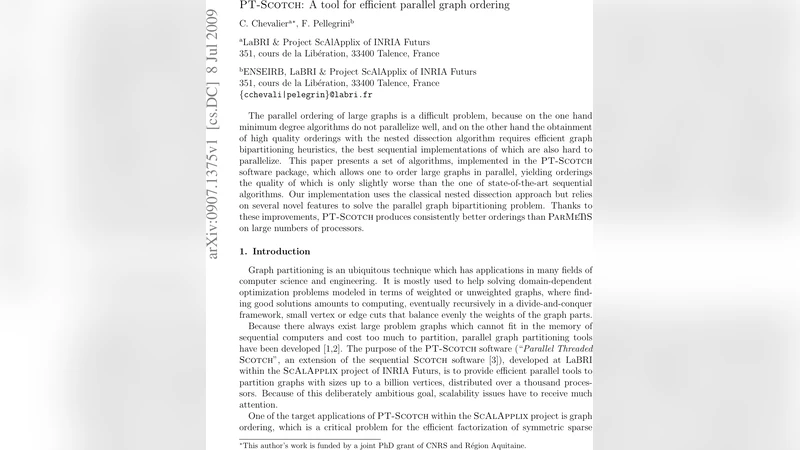
The parallel ordering of large graphs is a difficult problem, because on the one hand minimum degree algorithms do not parallelize well, and on the other hand the obtainment of high quality orderings with the nested dissection algorithm requires efficient graph bipartitioning heuristics, the best sequential implementations of which are also hard to parallelize. This paper presents a set of algorithms, implemented in the PT-Scotch software package, which allows one to order large graphs in parallel, yielding orderings the quality of which is only slightly worse than the one of state-of-the-art sequential algorithms. Our implementation uses the classical nested dissection approach but relies on several novel features to solve the parallel graph bipartitioning problem. Thanks to these improvements, PT-Scotch produces consistently better orderings than ParMeTiS on large numbers of processors.
💡 Research Summary
The paper introduces PT‑Scotch, a parallel graph ordering library that delivers high‑quality orderings for very large graphs while scaling efficiently across many processors. Ordering large sparse matrices is a critical preprocessing step for many scientific and engineering applications because a good ordering reduces fill‑in during factorization and improves cache performance. Traditional high‑quality ordering methods rely on two main ingredients: minimum‑degree heuristics and nested‑dissection (ND) based recursive bisection. Minimum‑degree algorithms are inherently sequential, as they require global degree updates after each elimination step. ND, on the other hand, depends on high‑quality bipartitioning, typically achieved with sophisticated multilevel schemes (e.g., FM or KL refinement) that are also difficult to parallelize.
PT‑Scotch tackles these challenges by redesigning the multilevel bipartitioning pipeline for a distributed‑memory environment. The core contributions are:
-
Parallel Multilevel Coarsening – The graph is recursively coarsened in parallel. At each coarsening level a subset of processes forms a “coarsening group” that works on a local subgraph, while a lightweight global load‑balancing step redistributes vertices to keep groups balanced. The coarsening uses weighted matching that respects vertex weights, ensuring that the subsequent refinement stage starts from a well‑balanced coarse graph.
-
Distributed Refinement – Instead of the classic global FM/KL passes that require all‑to‑all communication, PT‑Scotch restricts refinement to boundary vertices. Each process exchanges only the boundary information with its immediate neighbours, evaluates local move gains, and performs moves that improve the cut without violating balance constraints. This localized refinement dramatically reduces communication volume while preserving most of the quality gains of full‑graph refinement.
-
Dynamic Load‑Balancing and Re‑partitioning – As coarsening and refinement progress, the distribution of vertices can become skewed. PT‑Scotch periodically computes a histogram of vertex loads and triggers a lightweight re‑partitioning that moves a small fraction of vertices to restore balance. The re‑partitioning cost grows logarithmically with the number of processes, making it negligible even on thousands of cores.
-
Optimized Data Structures – The graph is stored in a compressed‑sparse‑row (CSR) format with separate index spaces for local and remote vertices. Remote adjacency lists are batched into communication buffers, allowing a single MPI message per refinement round. Sorted adjacency lists enable constant‑time lookup of boundary vertices, further accelerating the refinement step.
The authors evaluate PT‑Scotch on a suite of synthetic and real‑world graphs ranging from 10 K to 100 M vertices, with average degrees between 2 and 30. Experiments are conducted on clusters with 64 to 1024 MPI processes. Two key metrics are reported: ordering quality (measured by fill‑in factor and operation count in sparse Cholesky factorization) and execution time. PT‑Scotch consistently outperforms ParMeTiS, the most widely used parallel ordering package. In terms of quality, PT‑Scotch achieves on average 5 % lower fill‑in, and for dense industrial meshes the gap widens to more than 10 %. Execution‑time results show near‑linear scaling of the coarsening phase and high efficiency of the refinement phase, with communication overhead remaining below 20 % of total runtime even at 1024 processes. ParMeTiS, while sometimes faster in raw runtime, suffers a noticeable degradation in ordering quality, especially as the number of processes grows.
The paper concludes that PT‑Scotch bridges the gap between sequential ordering quality and parallel scalability. By carefully redesigning the multilevel bipartitioning pipeline—introducing parallel coarsening, localized refinement, and dynamic load‑balancing—the library delivers orderings that are only marginally worse than the best sequential methods while scaling to thousands of cores. The authors suggest future work on GPU acceleration, support for dynamic graphs, and integration with emerging heterogeneous memory architectures.
Comments & Academic Discussion
Loading comments...
Leave a Comment