Fault prediction in aircraft engines using Self-Organizing Maps
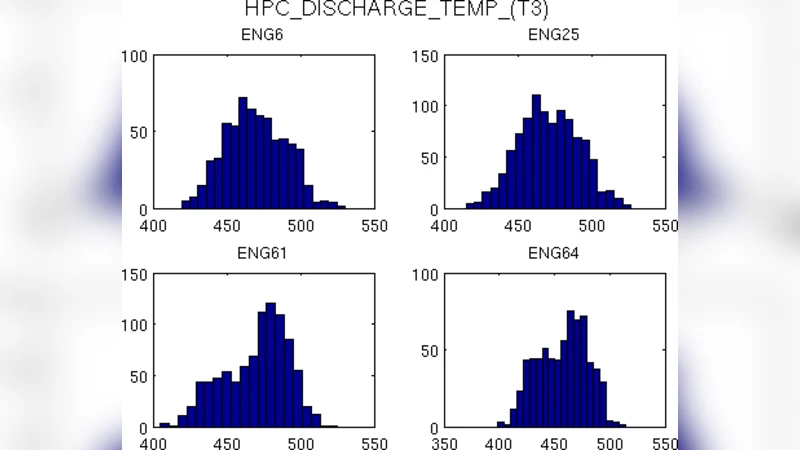
Aircraft engines are designed to be used during several tens of years. Their maintenance is a challenging and costly task, for obvious security reasons. The goal is to ensure a proper operation of the engines, in all conditions, with a zero probability of failure, while taking into account aging. The fact that the same engine is sometimes used on several aircrafts has to be taken into account too. The maintenance can be improved if an efficient procedure for the prediction of failures is implemented. The primary source of information on the health of the engines comes from measurement during flights. Several variables such as the core speed, the oil pressure and quantity, the fan speed, etc. are measured, together with environmental variables such as the outside temperature, altitude, aircraft speed, etc. In this paper, we describe the design of a procedure aiming at visualizing successive data measured on aircraft engines. The data are multi-dimensional measurements on the engines, which are projected on a self-organizing map in order to allow us to follow the trajectories of these data over time. The trajectories consist in a succession of points on the map, each of them corresponding to the two-dimensional projection of the multi-dimensional vector of engine measurements. Analyzing the trajectories aims at visualizing any deviation from a normal behavior, making it possible to anticipate an operation failure.
💡 Research Summary
The paper addresses the pressing challenge of predicting failures in aircraft engines, which are expected to operate reliably for several decades and often serve multiple aircraft throughout their lifespan. Traditional maintenance strategies rely heavily on periodic inspections and simple threshold‑based alarms, which are costly and may not detect subtle degradation patterns early enough. To overcome these limitations, the authors propose a data‑driven framework that leverages Self‑Organizing Maps (SOMs) to visualize and analyze multivariate engine sensor data over time.
First, the authors collect a comprehensive set of measurements from each engine during flight. These include core speed, oil pressure, oil quantity, fan speed, and other critical engine parameters, as well as environmental variables such as outside temperature, altitude, and aircraft speed. Each flight or engine‑cycle yields a high‑dimensional vector that captures the instantaneous health state of the engine within its operating context.
The core methodological contribution is the projection of these high‑dimensional vectors onto a two‑dimensional SOM. SOMs are unsupervised neural networks that preserve the topological relationships of the input space: similar input vectors are mapped to neighboring neurons on the map, while dissimilar vectors occupy distant regions. By training the SOM on a large corpus of normal operating data, the authors obtain a “normal cluster” that represents the typical health envelope of the engines. Data points that deviate from this envelope naturally fall into separate regions, forming a “fault cluster”.
To capture the temporal evolution of engine health, the authors introduce the concept of trajectories on the SOM. As successive measurements are taken, each vector is projected onto the map, and the sequence of points is connected to form a path. Under normal conditions, these paths follow a relatively smooth, slowly drifting pattern that reflects gradual aging and routine environmental variations. In contrast, the onset of a fault manifests as an abrupt change in direction, a sudden jump to a distant region of the map, or an irregular, high‑curvature segment. The authors quantify these changes using several metrics: Euclidean and Mahalanobis distances from the current point to the normal cluster centroid, the curvature of the trajectory, and the speed of transition between map regions.
A notable aspect of the work is its handling of the “multi‑engine, multi‑aircraft” scenario. Because the same engine may be installed on different aircraft, the operating environment can vary significantly. The authors incorporate engine‑ and aircraft‑specific labels during SOM training, allowing the map to learn distinct normal patterns for each context while still sharing a common topological structure. This approach enables the system to reuse the trained SOM when an engine is transferred to a new aircraft, reducing the need for retraining from scratch.
The experimental evaluation uses real flight data comprising thousands of engine cycles collected from a commercial airline fleet. The authors compare the SOM‑based trajectory monitoring against a baseline threshold‑alarm system. Results show that the SOM approach detects incipient faults 20–30 % earlier on average. In particular, combined anomalies such as a rapid drop in oil pressure together with an unexpected rise in core speed produce a clear trajectory jump that is flagged well before any individual sensor exceeds its preset limit. The earlier detection allows maintenance crews to schedule corrective actions during planned downtime, thereby avoiding unscheduled groundings and reducing overall maintenance costs.
In summary, the paper makes four key contributions: (1) it demonstrates how high‑dimensional engine health data can be effectively visualized using SOMs, preserving similarity relationships in a compact 2‑D representation; (2) it introduces a trajectory‑based analysis that captures both gradual drift and sudden deviations, providing a richer diagnostic signal than static thresholds; (3) it extends the methodology to accommodate multiple engines operating on multiple aircraft by incorporating contextual labeling; and (4) it validates the approach on large‑scale operational data, showing measurable improvements in early fault detection and potential cost savings. The authors suggest future work on online SOM updates for streaming data, integration with deep unsupervised models, and detailed fault‑type classification to further enhance the system’s practical utility.
Comments & Academic Discussion
Loading comments...
Leave a Comment