Butterflies I: morphisms of 2-group stacks
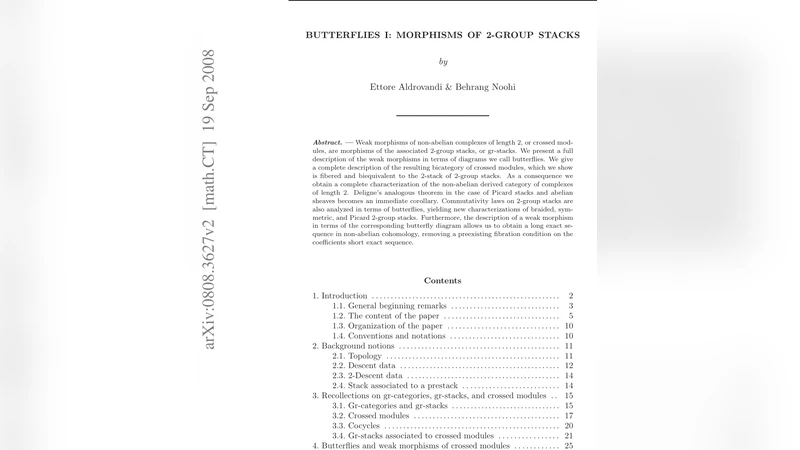
Weak morphisms of non-abelian complexes of length 2, or crossed modules, are morphisms of the associated 2-group stacks, or gr-stacks. We present a full description of the weak morphisms in terms of diagrams we call butterflies. We give a complete description of the resulting bicategory of crossed modules, which we show is fibered and biequivalent to the 2-stack of 2-group stacks. As a consequence we obtain a complete characterization of the non-abelian derived category of complexes of length 2. Deligne’s analogous theorem in the case of Picard stacks and abelian sheaves becomes an immediate corollary. Commutativity laws on 2-group stacks are also analyzed in terms of butterflies, yielding new characterizations of braided, symmetric, and Picard 2-group stacks. Furthermore, the description of a weak morphism in terms of the corresponding butterfly diagram allows us to obtain a long exact sequence in non-abelian cohomology, removing a preexisting fibration condition on the coefficients short exact sequence.
💡 Research Summary
The paper develops a comprehensive framework for describing weak morphisms between crossed modules—non‑abelian complexes of length 2—by means of a diagrammatic device called a “butterfly.” A crossed module ((G_1 \to G_0)) can be viewed as a 2‑group (or gr‑stack) and its weak morphisms are precisely the morphisms of the associated 2‑group stacks. The authors introduce butterflies as a square consisting of a middle group (E) together with two exact maps (i\colon G_1 \to E) and (p\colon E \to H_0) together with compatible actions of (G_0) and (H_0) on (E). This data encodes a weak morphism ((G_1 \to G_0) \Rightarrow (H_1 \to H_0)) and, crucially, provides a concrete way to compose such morphisms, to invert equivalences, and to describe 2‑cells between them.
Using butterflies as 1‑morphisms and morphisms of butterflies as 2‑cells, the authors construct a bicategory (\mathbf{Bfly}) whose objects are crossed modules. They prove that (\mathbf{Bfly}) is fibered over the underlying site and that it is biequivalent to the 2‑stack (\mathbf{GrStack}) of 2‑group stacks. In other words, every 2‑group stack is represented (up to equivalence) by a crossed module, and the butterfly bicategory captures exactly the homotopy‑theoretic data of morphisms between such stacks. This biequivalence yields a clean description of the non‑abelian derived category of length‑2 complexes: objects are crossed modules, morphisms are butterflies, and distinguished triangles correspond to exact sequences of butterflies.
The paper then shows how Deligne’s theorem for Picard stacks—stacks of abelian sheaves—appears as a special case when the crossed modules are abelian. In that situation butterflies reduce to ordinary short exact sequences, and the derived category coincides with the classical derived category of complexes of sheaves.
A substantial part of the work is devoted to commutativity structures on 2‑group stacks. By examining the symmetry constraints inside a butterfly, the authors give new characterizations of braided, symmetric, and Picard 2‑group stacks. For a braided 2‑group stack the butterfly must admit a “braiding 2‑cell” satisfying the usual hexagon identities; symmetry requires this 2‑cell to be its own inverse, and the Picard condition demands a global symmetric braiding.
Finally, the butterfly description eliminates the need for a fibration hypothesis in the construction of long exact sequences in non‑abelian cohomology. Given a short exact sequence of coefficient crossed modules (1\to A\to B\to C\to1), one can associate butterflies to the induced maps on classifying stacks and directly derive a long exact sequence \
Comments & Academic Discussion
Loading comments...
Leave a Comment