Sensitivity on Earth Core and Mantle densities using Atmospheric Neutrinos
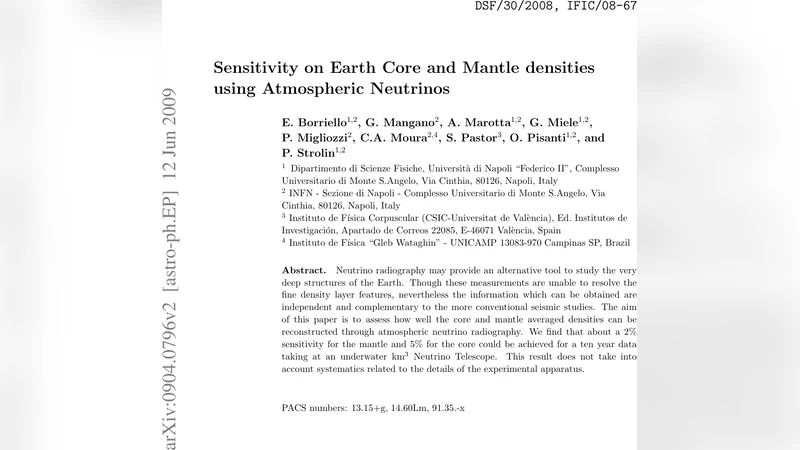
Neutrino radiography may provide an alternative tool to study the very deep structures of the Earth. Though these measurements are unable to resolve the fine density layer features, nevertheless the information which can be obtained are independent and complementary to the more conventional seismic studies. The aim of this paper is to assess how well the core and mantle averaged densities can be reconstructed through atmospheric neutrino radiography. We find that about a 2% sensitivity for the mantle and 5% for the core could be achieved for a ten year data taking at an underwater km^3 Neutrino Telescope. This result does not take into account systematics related to the details of the experimental apparatus.
💡 Research Summary
The paper investigates the feasibility of using atmospheric neutrinos as probes to measure the average densities of the Earth’s mantle and core, a technique often referred to as neutrino radiography. Because neutrinos interact only via the weak force, they can traverse the entire planet with a probability of interaction that depends on the integrated column density along their path. By measuring the attenuation of high‑energy (GeV–TeV) atmospheric neutrinos that have crossed the Earth, one can infer the average density of the material they have passed through.
The authors adopt a simplified Earth model in which the mantle and the core are each represented by a single uniform density parameter (ρ_mantle and ρ_core). They generate an atmospheric neutrino flux using standard models (e.g., Honda et al.) that provide the energy and zenith‑angle distribution of ν_μ and ν̄_μ up to several TeV. The neutrino propagation through the Earth is simulated with a GEANT‑4‑based code that includes charged‑current (CC) and neutral‑current (NC) interactions with nucleons, taking into account the energy‑dependent cross sections and the resulting muon tracks.
For the detector, the study assumes a km³‑scale underwater neutrino telescope similar to KM3NeT or IceCube, with idealized performance: perfect optical module efficiency, realistic angular and energy resolution, and a ten‑year exposure yielding roughly one million detected events. The observable is a two‑dimensional histogram of reconstructed muon energy versus zenith angle. A Poisson likelihood is constructed for each bin, and the parameters ρ_mantle and ρ_core are fitted by maximizing the total likelihood. The Fisher information matrix provides the expected 1σ uncertainties.
The main result is that, under these optimistic assumptions, the mantle’s average density could be determined with about a 2 % relative precision, while the core’s average density could be measured to roughly 5 % precision after ten years of data taking. These uncertainties are comparable to, and independent from, those obtained by seismic tomography, offering a complementary probe that does not rely on seismic wave propagation.
The authors explicitly note that systematic uncertainties related to detector response (optical module calibration, water absorption and scattering, background atmospheric muons, and neutrino flux normalization) are not included in the quoted sensitivities. Moreover, the two‑parameter model (single density for mantle, single density for core) cannot resolve finer structures such as the inner‑outer core boundary, the Dʹʹ transition zone, or lateral heterogeneities. Consequently, the study represents a best‑case scenario that demonstrates the principle rather than a definitive measurement strategy.
In the discussion, the paper outlines several avenues for future work: (1) incorporating realistic detector systematics and performing a full Monte‑Carlo study, (2) extending the Earth model to multiple layers or spherical harmonic perturbations to capture lateral variations, (3) exploring the synergy with other neutrino detectors (e.g., deep‑sea optical arrays, radio‑based detectors) to increase statistics and reduce systematic biases, and (4) investigating the impact of longer exposure times or larger instrumented volumes. The authors argue that, if these improvements are realized, atmospheric neutrino radiography could become a powerful, independent tool for probing the deep Earth, complementing traditional seismology and providing cross‑validation for Earth‑model parameters.
Comments & Academic Discussion
Loading comments...
Leave a Comment