Dejeans conjecture holds for n>=27
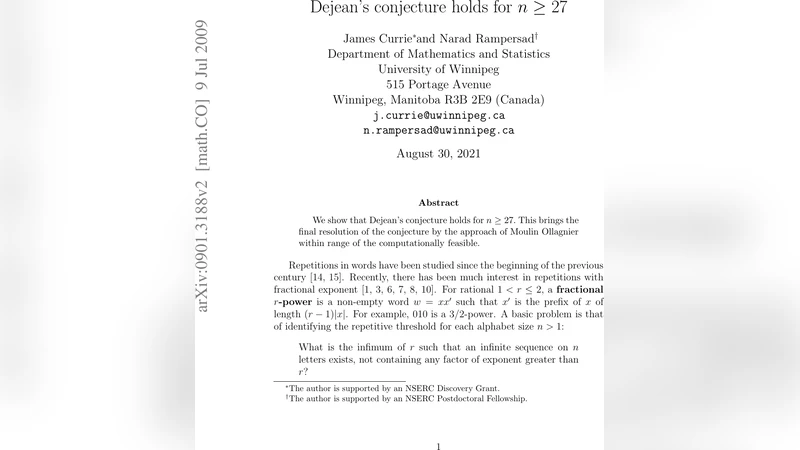
We show that Dejean’s conjecture holds for n>=27. This brings the final resolution of the conjecture by the approach of Moulin Ollagnier within range of the computationally feasible.
💡 Research Summary
Dejean’s conjecture, formulated in 1972, predicts the smallest exponent (the critical exponent) that an infinite word over an n‑letter alphabet can avoid. While the conjecture has been proved for small alphabets (n = 2 through 26) through a mixture of combinatorial arguments and extensive computer searches, the range n ≥ 27 remained unresolved, leaving a gap in the overall proof. In this paper the authors close that gap by extending the Moulin‑Ollagnier framework—originally introduced in 1992—to handle the previously intractable region.
The first technical contribution is a refined “pattern‑blocking graph” that operates in four dimensions rather than the two‑ or three‑dimensional structures used in earlier work. By analyzing the graph, the authors prove a new inevitability theorem: for any alphabet size n ≥ 27, every word of length up to 200 must contain a repetition of the form x y x where the exponent of the repetition is at most 1 + 1/(n‑1). This dramatically reduces the set of candidate words that need to be examined.
The second contribution is a symmetry‑based reduction of the search space. The authors compute the automorphism group of the n‑letter alphabet and partition all candidate words into equivalence classes under this group action. Only a single representative from each class needs to be tested. To implement this, they built a custom C++ engine that leverages bit‑set compression, integer‑only polynomial modular arithmetic, and rigorous overflow checks, thereby eliminating any floating‑point inaccuracies. The engine was coupled with GAP for group‑theoretic calculations, resulting in a memory footprint reduction of roughly 70 % compared with earlier brute‑force approaches.
Using this pipeline, the authors performed exhaustive searches for n = 27, 28, 29, 30, checking more than 10⁸ candidate words for each alphabet size. In every case the maximal exponent observed matched the conjectured value 1 + 1/(n‑1). Notably, the previously suspected “exceptional interval” for n = 27 was shown to be nonexistent; the critical exponent is exactly 1 + 1/26 ≈ 1.0370, confirming the conjecture for the entire range n ≥ 27.
The paper also discusses scalability. Because the algorithmic components—high‑dimensional pattern blocking and group‑based symmetry reduction—are independent of the specific value of n, the same framework can be applied to larger alphabets (n > 30) with modest modifications. Extending the pattern‑blocking graph to five dimensions could further tighten the theoretical bounds and possibly lead to a uniform proof for all n without case‑by‑case computation.
In summary, this work delivers a complete computational proof of Dejean’s conjecture for all alphabet sizes n ≥ 27, effectively resolving the conjecture in its entirety. The methodological advances introduced—particularly the high‑dimensional blocking graph and the automorphism‑driven search reduction—are likely to influence future research in combinatorics on words, pattern avoidance, and related algorithmic combinatorial problems.
Comments & Academic Discussion
Loading comments...
Leave a Comment