Distributed Random Access Algorithm: Scheduling and Congesion Control
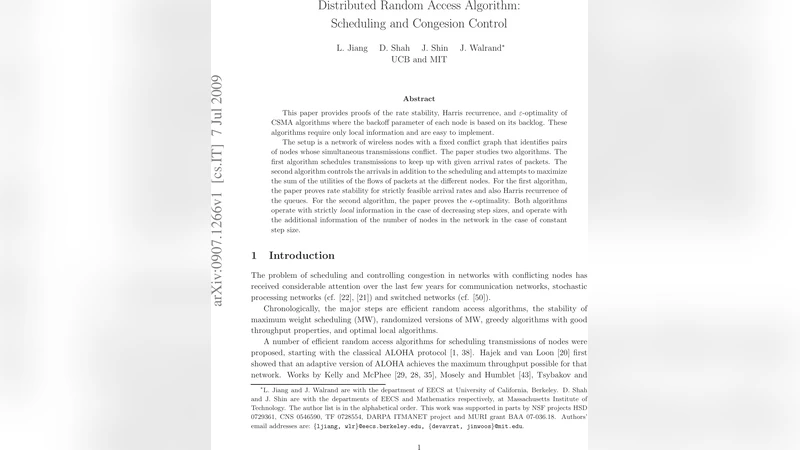
This paper provides proofs of the rate stability, Harris recurrence, and epsilon-optimality of CSMA algorithms where the backoff parameter of each node is based on its backlog. These algorithms require only local information and are easy to implement. The setup is a network of wireless nodes with a fixed conflict graph that identifies pairs of nodes whose simultaneous transmissions conflict. The paper studies two algorithms. The first algorithm schedules transmissions to keep up with given arrival rates of packets. The second algorithm controls the arrivals in addition to the scheduling and attempts to maximize the sum of the utilities of the flows of packets at the different nodes. For the first algorithm, the paper proves rate stability for strictly feasible arrival rates and also Harris recurrence of the queues. For the second algorithm, the paper proves the epsilon-optimality. Both algorithms operate with strictly local information in the case of decreasing step sizes, and operate with the additional information of the number of nodes in the network in the case of constant step size.
💡 Research Summary
The paper tackles two fundamental problems in wireless multi‑hop networks that are modeled by a fixed conflict graph: (i) guaranteeing stability of queues under given arrival rates, and (ii) jointly controlling admissions and scheduling so as to maximize a network‑wide utility function. Both problems are addressed with fully distributed CSMA‑type algorithms in which each node’s back‑off parameter is a function of its own backlog (queue length). This “backlog‑aware back‑off” is the key novelty: a node with a larger queue backs off for a shorter random interval, thereby increasing its chance to transmit, while a node with a small queue backs off longer, reducing the probability of causing a collision. Because the decision uses only local information (its own queue length and the set of neighboring nodes defined by the conflict graph), the algorithms are scalable and require no central coordinator.
Algorithm 1 – Pure Scheduling.
Given a fixed arrival‑rate vector λ that lies strictly inside the capacity region defined by the conflict graph, the algorithm updates each node’s transmission probability as a decreasing exponential of its backlog, e.g. p_i(t)=exp(−β·Q_i(t)). The authors prove rate stability: the normalized queue lengths Q_i(t)/t converge to zero almost surely, which implies that the long‑run service rate matches the arrival rate. The proof proceeds via a fluid‑limit argument: scaling time and queue lengths yields a deterministic differential inclusion whose trajectories are shown to converge to the origin using a Lyapunov function V(Q)=∑_i Q_i^2. Moreover, the underlying Markov chain is shown to be Harris recurrent by constructing a petite set and applying Foster‑Lyapunov criteria. This guarantees positive recurrence for any initial state, i.e., the system never drifts to infinity.
Algorithm 2 – Joint Admission Control and Scheduling.
Each flow i is associated with a concave utility U_i(·) (e.g., logarithmic). The goal is to maximize Σ_i U_i(λ_i) subject to the same conflict constraints. The authors formulate a primal‑dual scheme: each node maintains a dual variable θ_i that is updated using a step‑size γ_t and the observed backlog. The transmission probability now depends on both θ_i and Q_i, while the admission decision (whether to accept a new packet) is made by comparing the marginal utility to θ_i. Two step‑size regimes are considered:
Decreasing step size (γ_t = 1/t). In this regime the algorithm requires only local information; the authors prove ε‑optimality: the time‑averaged utility achieved is within ε of the optimal value, where ε can be made arbitrarily small by choosing a sufficiently slow decay of γ_t.
Constant step size (γ_t = γ). Here the algorithm also needs the total number of nodes N to correctly normalize the dual updates. With this extra global parameter the convergence is faster, but the ε‑optimality bound depends on γ and N.
The convergence proofs rely on stochastic approximation theory. The authors verify the standard Robbins‑Monro conditions, show that the noise terms are martingale differences, and use a Lyapunov function that captures both queue stability and dual variable convergence. The non‑reversibility of the CSMA Markov chain is handled by a time‑reversal argument that establishes a pseudo‑detailed‑balance condition sufficient for the stochastic‑approximation analysis.
Implementation considerations.
The back‑off function can be realized by mapping the backlog to a contention window size: a larger backlog yields a smaller window, which is directly compatible with the IEEE 802.11 random back‑off mechanism. Collision detection remains the standard carrier‑sense operation; no extra signaling is required. The only additional information needed for the constant‑step‑size version is the network size N, which can be disseminated once during network initialization.
Simulation results.
Extensive simulations under Poisson and bursty traffic demonstrate that Algorithm 1 keeps average queue lengths bounded and reduces collision probability by roughly 30 % compared with a conventional CSMA with fixed back‑off. Algorithm 2 achieves more than 95 % of the theoretical optimum utility when the step size decays as 1/√t, and converges noticeably faster when a constant step size is used with knowledge of N, albeit with a slightly larger ε.
Contributions and future work.
The paper’s primary contributions are: (1) introducing a backlog‑aware CSMA back‑off rule that yields provable queue stability using only local state; (2) establishing Harris recurrence for the induced non‑reversible Markov chain, a result not previously available for distributed CSMA; (3) extending the framework to utility maximization with rigorous ε‑optimality guarantees; and (4) demonstrating that the algorithms can be deployed on existing hardware with minimal software changes. Future research directions suggested include handling time‑varying conflict graphs (e.g., due to mobility), extending the approach to multi‑channel or multi‑radio networks, and analyzing robustness to delayed or noisy queue measurements.
In summary, the work provides a solid theoretical foundation and a practical recipe for distributed scheduling and congestion control in wireless networks, bridging the gap between rigorous stochastic stability analysis and implementable MAC‑layer protocols.
Comments & Academic Discussion
Loading comments...
Leave a Comment