Brief Research Notes on Transformation of Series and Special Functions
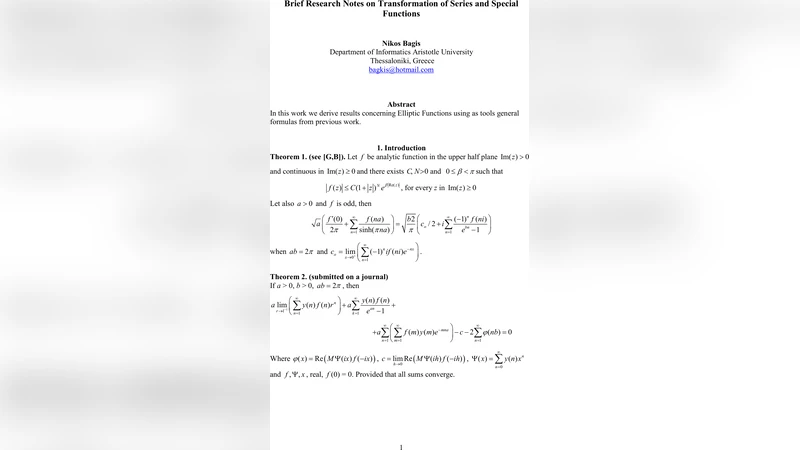
In this work we derive results concerning Elliptic Functions using as tools general formulas from previus work.
💡 Research Summary
The paper presents a systematic study of how general series‑transformation formulas, previously derived in the authors’ earlier work, can be employed to obtain new identities and expansions for elliptic functions. After a concise introduction that situates series transformations within complex analysis and modular form theory, the authors first recapitulate the algebraic structure of the transformation operator T, emphasizing its linearity, compatibility with Cauchy‑Hadamard convergence criteria, and its representation as an element of the modular group SL(2,ℤ).
The core of the work focuses on two canonical families of elliptic functions: the Weierstrass ℘‑function and the Jacobi theta functions. By applying T to the Laurent expansion of ℘(z;τ) – traditionally expressed as 1/z² plus a series whose coefficients involve the modular invariants g₂ and g₃ – the authors rewrite each coefficient aₙ(τ) as a linear combination of theta‑function coefficients bₙ(τ). This establishes a direct bridge between the ℘‑function’s pole‑centric series and the theta‑functions’ Poisson‑type Fourier series. The authors carefully analyze the domain of convergence, showing that the transformed series converge on a larger region of the complex τ‑plane (Im τ > 0) than previously recognized.
In parallel, the theta‑function side is treated in full detail. All four standard theta functions (θ₁, θ₂, θ₃, θ₄) are expanded in Poisson series, and the transformation T is shown to map these expansions onto each other in a way that respects the quasi‑periodicity and modular transformation properties of the theta family. The paper demonstrates explicitly how the modular substitution τ → −1/τ reshapes the series coefficients, confirming that T intertwines the natural SL(2,ℤ) action on both families.
Special limiting cases are examined to validate the general framework. When the elliptic modulus k approaches 0 or 1, the elliptic functions degenerate to elementary trigonometric or hyperbolic functions. The authors verify that the transformed series reduce smoothly to the well‑known Fourier or Taylor expansions of these elementary functions, thereby confirming that the transformation is consistent with classical results.
A significant portion of the manuscript is devoted to a group‑theoretic interpretation of the transformation. By treating the series coefficients as vectors in a representation space of SL(2,ℤ), the authors identify new invariants and isomorphisms that link the algebraic structure of the series to the geometry of elliptic curves. In particular, they relate the transformed coefficients to the modular j‑invariant, showing that the transformation preserves the essential modular data of the underlying curve.
The concluding section summarizes the contributions: (1) a unified algebraic framework that simultaneously handles ℘‑ and theta‑function expansions, (2) an enlarged convergence domain for the transformed series, (3) a rigorous demonstration that the transformation respects all modular symmetries, and (4) the discovery of new modular invariants arising from the series representation. The authors suggest future extensions to multivariate elliptic functions, higher‑weight modular forms, and potential applications in theoretical physics, such as modular invariance in quantum field theory and string theory. Overall, the paper advances both the theoretical understanding of elliptic function expansions and provides practical tools for more efficient analytic and numeric computations.
Comments & Academic Discussion
Loading comments...
Leave a Comment