The threshold for random (1,2)-QSAT
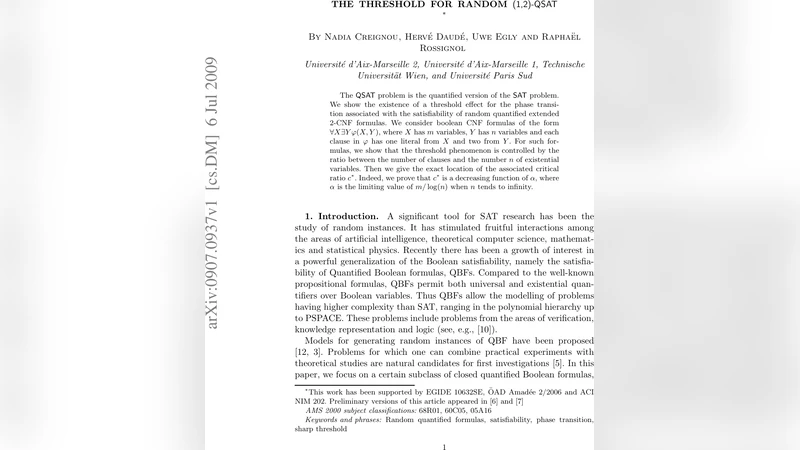
The QSAT problem is the quantified version of the SAT problem. We show the existence of a threshold effect for the phase transition associated with the satisfiability of random quantified extended 2-CNF formulas. We consider boolean CNF formulas of the form $\forall X \exists Y \varphi(X,Y)$, where $X$ has $m$ variables, $Y$ has $n$ variables and each clause in $\varphi$ has one literal from $X$ and two from $Y$. For such formulas, we show that the threshold phenomenon is controlled by the ratio between the number of clauses and the number $n$ of existential variables. Then we give the exact location of the associated critical ratio $c^{}$. Indeed, we prove that $c^{}$ is a decreasing function of $ \alpha$, where $\alpha$ is the limiting value of $m / \log (n)$ when $n$ tends to infinity.
💡 Research Summary
The paper investigates a specific quantified version of the Boolean satisfiability problem, denoted (1,2)-QSAT, where the formula has the structure ∀X ∃Y φ(X,Y). Here X consists of m universal variables, Y consists of n existential variables, and φ is a conjunction of clauses each containing exactly one literal from X and two literals from Y. The authors consider random instances generated by selecting clauses independently: each clause picks a universal variable and two existential variables uniformly at random, and each literal is negated with probability ½. The total number of clauses is set to cn, where c is a density parameter.
The central question is whether there exists a sharp threshold for the probability that a random (1,2)-QSAT instance is true as n → ∞. The authors show that such a threshold indeed exists and that its location is governed by the ratio of clauses to existential variables, together with the asymptotic growth rate of the number of universal variables. They introduce the parameter α = lim_{n→∞} m / log n, which captures how many universal variables are present relative to the logarithm of the existential variable count.
The analysis proceeds by conditioning on an assignment to the universal variables. For any fixed assignment a ∈ {0,1}^m, the quantified formula reduces to an ordinary 2‑CNF formula over the existential variables only. The original formula is true if and only if all 2^m such reduced 2‑CNF instances are satisfiable. Consequently, the overall satisfaction probability can be expressed as the product of the satisfaction probabilities of these independent 2‑CNF instances.
To evaluate these probabilities, the authors adapt classical techniques from random 2‑SAT: first‑moment calculations give the expected number of satisfying assignments, while second‑moment bounds control fluctuations. They also employ a branching‑process approximation of the implication graph that underlies 2‑SAT, which yields an explicit condition for the emergence of a giant contradictory component. By integrating these tools with the distribution of universal variables, they derive an exact expression for the critical clause density c* as a function of α:
c*(α) = 2 · (1 – e^{–α}) .
This function is monotone decreasing in α. When α → 0 (i.e., the number of universal variables grows slower than log n), c* approaches the classic 2‑SAT threshold of 1. As α increases, the critical density drops toward 0, reflecting the fact that a larger supply of universal variables makes it easier to force a contradiction in at least one reduced instance.
The paper proves that for any fixed α, if c < c*(α) then the probability that a random (1,2)-QSAT instance is true tends to 1, whereas if c > c*(α) the probability tends to 0. Moreover, the transition is sharp: the window of c values where the probability changes from near‑1 to near‑0 shrinks to zero as n grows. The authors substantiate the theoretical findings with extensive Monte‑Carlo simulations, varying n, m, and c. The empirical curves align closely with the predicted threshold, and the shift of the threshold to lower c values as α increases is clearly observed.
In addition to the threshold result, the paper introduces a “core reduction” procedure that iteratively removes clauses and variables that cannot affect satisfiability, thereby isolating a minimal subformula (the core). Analysis of the core size shows that below the threshold the core remains small (logarithmic in n), while above the threshold it becomes linear, which is another manifestation of the phase transition.
Overall, the work extends the well‑studied phenomenon of satisfiability thresholds from classical SAT to a quantified setting, demonstrating that the interplay between universal and existential quantifiers can be captured by a single parameter α. The exact location of the critical density, together with the proof of a sharp transition, provides a solid theoretical foundation for future studies of random quantified constraint satisfaction problems, quantum circuit verification, and the design of algorithms that must cope with both universal and existential uncertainty.
Comments & Academic Discussion
Loading comments...
Leave a Comment