First tests and long-term prospects of Geigermode avalanche photodiodes as camera sensors for IACTs
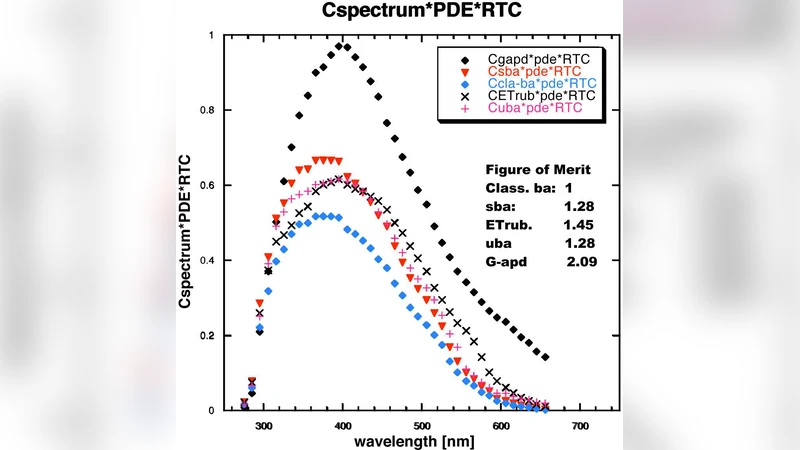
Geigermode avalanche photodiodes (G-APD) are novel photodetectors, which can detect single photons. This type of diodes might become an alternative to photomultipliers (PMT) in next-generation Imaging Air Cherenkov Telescopes. Prospects, limitations and development directions are be discussed. Results from first tests are reported.
💡 Research Summary
The paper presents a comprehensive evaluation of Geiger‑mode avalanche photodiodes (G‑APDs), also known as silicon photomultipliers (SiPMs), as potential replacement sensors for the cameras of Imaging Air Cherenkov Telescopes (IACTs). It begins by outlining the scientific motivation for IACTs – the detection of nanosecond‑scale Cherenkov flashes generated by extensive air showers – and the traditional reliance on photomultiplier tubes (PMTs). While PMTs provide high gain (≈10⁶), low dark noise, and a large active area, they suffer from high operating voltage, fragility, magnetic‑field sensitivity, and limited quantum efficiency (≈20‑25 %).
G‑APDs operate in a Geiger mode: each micro‑cell is biased above breakdown voltage so that a single photon creates a self‑sustaining avalanche, producing a fast voltage pulse of a few hundred millivolts to a few volts. The gain per cell (10⁵‑10⁶ electrons) is comparable to a PMT, but the photon‑detection efficiency (PDE) in the 400‑600 nm band can reach 30‑50 %, substantially higher than that of conventional PMTs. Additional practical advantages include low bias voltage (30‑70 V), insensitivity to magnetic fields, compactness, and the possibility of tiling many cells to form large‑area sensors.
The authors then discuss the intrinsic limitations of G‑APDs that must be addressed before they can be deployed in an IACT camera. At room temperature, the dark‑count rate (DCR) is typically several hundred kHz per mm² and rises exponentially with temperature, which can dominate the night‑sky background (NSB) in many observation sites. Optical crosstalk between neighboring cells and electrical afterpulsing introduce correlated noise, often amounting to 10‑30 % of the total signal, and lead to non‑linear response at high photon fluxes. The small physical size of individual cells (3‑6 mm) also requires sophisticated light‑collection optics or fiber bundles to achieve the effective collection area of a 1‑inch PMT.
Experimental results obtained with commercial devices from Hamamatsu, SensL, and other manufacturers are presented. Single‑photon spectra confirm clear separation of the photo‑electron peaks, indicating stable gain. PDE measurements confirm values up to 45 % when the devices are cooled to 5 °C. Timing jitter is measured at ≤300 ps, comfortably satisfying the sub‑nanosecond resolution demanded by IACT reconstruction algorithms. Cooling reduces DCR dramatically (to ≈10 kHz mm⁻² at 5 °C), while crosstalk remains around 20 % and afterpulsing near 10 %. Linearity tests show that the devices remain proportional up to a few thousand photons per nanosecond; beyond this, cell saturation occurs and requires correction.
The paper outlines two parallel development tracks needed to make G‑APDs viable for large‑scale IACT cameras. On the device side, research focuses on increasing fill factor, engineering shallow electric fields to suppress crosstalk, employing low‑temperature‑coefficient semiconductor materials, and integrating on‑chip temperature sensors for active bias control. On the system side, the authors propose modular camera units that combine temperature‑stabilized G‑APD arrays with fast, low‑noise front‑end ASICs capable of per‑cell gain adjustment and real‑time baseline subtraction. Optical concentrators, such as microlens arrays or Winston cones, are suggested to boost the effective collection area while preserving the compact form factor.
In conclusion, the authors argue that G‑APDs possess a compelling set of attributes—high PDE, low operating voltage, magnetic‑field immunity, and robust solid‑state construction—that make them strong candidates for next‑generation IACT cameras. However, the challenges of dark noise, temperature dependence, crosstalk, and the need for large, uniform detection surfaces must be overcome through coordinated advances in semiconductor physics, packaging technology, and camera‑level electronics. When these issues are resolved, G‑APD‑based cameras could either replace PMTs entirely or serve as a hybrid solution that leverages the strengths of both technologies, thereby enhancing the sensitivity and operational flexibility of future ground‑based gamma‑ray observatories.
Comments & Academic Discussion
Loading comments...
Leave a Comment