Noncommutative correspondences, duality and D-branes in bivariant K-theory
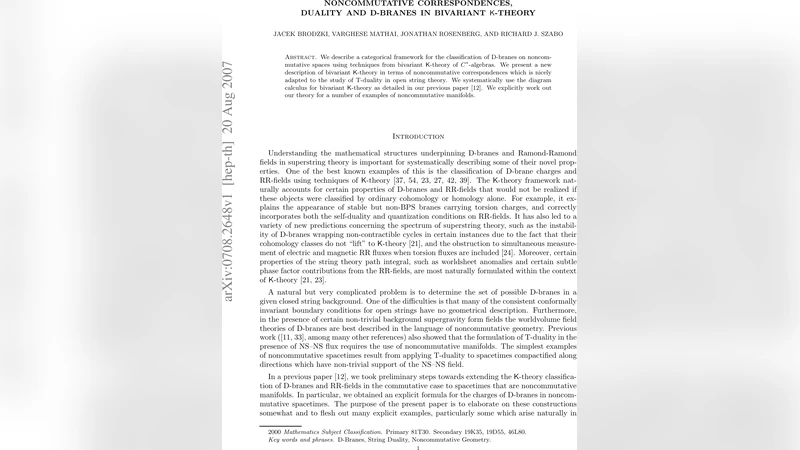
We describe a categorical framework for the classification of D-branes on noncommutative spaces using techniques from bivariant K-theory of C*-algebras. We present a new description of bivariant K-theory in terms of noncommutative correspondences which is nicely adapted to the study of T-duality in open string theory. We systematically use the diagram calculus for bivariant K-theory as detailed in our previous paper. We explicitly work out our theory for a number of examples of noncommutative manifolds.
💡 Research Summary
The paper develops a categorical framework for classifying D‑branes on non‑commutative spaces by exploiting the machinery of bivariant K‑theory (KK‑theory) for C*‑algebras. The authors begin by recalling the standard Kasparov picture of KK‑theory, where an element is represented by a Kasparov A‑B module (E, φ, F). They then introduce the notion of a “non‑commutative correspondence” – a triple (E, φ, ψ) consisting of a Hilbert A‑B bimodule E together with *‑homomorphisms φ: A → End_B(E) and ψ: B → End_A(E). This correspondence is shown to be equivalent to a KK‑class, but its formulation is deliberately adapted to the needs of string theory: the two *‑maps play the role of push‑forward and pull‑back maps, and composition of correspondences is realized by a diagrammatic calculus that the authors developed in a previous work.
With this language in hand, the paper tackles T‑duality in open string theory. The central observation is that T‑duality between two non‑commutative tori T_θ and T_{−θ} can be encoded as an invertible correspondence. The invertibility condition precisely reproduces the familiar exchange of momentum and winding modes, while the KK‑class of the correspondence captures the transformation of D‑brane charges. In the KK‑framework, D‑brane charge lives in K‑theory, whereas the D‑brane world‑volume data (the “gauge bundle”) lives in K‑homology; the correspondence therefore implements a duality between these two sides.
The authors work out several explicit examples to demonstrate the practicality of their approach. For the non‑commutative two‑torus C(T_θ) they construct the correspondence that implements the θ → −θ map, compute its KK‑class, and verify that it reproduces the expected charge exchange under T‑duality. They then treat a non‑commutative three‑sphere, a twisted non‑commutative disc, and a non‑commutative elliptic curve, each time exhibiting the relevant bimodule, the two *‑homomorphisms, and the resulting KK‑class. In each case the diagram calculus makes the composition of dualities transparent, and the calculations confirm that D‑brane charge and flux are preserved as required by physical consistency.
Beyond concrete models, the paper argues that the correspondence picture provides conceptual advantages. First, it renders the composition and inversion of KK‑elements as simple graphical operations, which greatly simplifies calculations in complicated non‑commutative settings. Second, it makes the role of the non‑commutative deformation parameter (such as θ) explicit in the duality transformation, revealing a direct link between T‑duality and modular transformations in the parameter space. Third, by treating K‑theory and K‑homology on equal footing, the framework naturally accommodates both charge and world‑volume data, leading to a complete classification of D‑branes on the considered non‑commutative manifolds.
In the concluding section the authors outline future directions: extending the correspondence formalism to incorporate non‑commutative cyclic cohomology, exploring connections with non‑commutative motives, and applying the machinery to interacting D‑brane systems and to the study of anomalies. Overall, the work bridges abstract operator‑algebraic techniques with concrete string‑theoretic applications, offering a powerful new tool for the study of D‑branes and dualities in non‑commutative geometry.
Comments & Academic Discussion
Loading comments...
Leave a Comment