Design and Analysis of an Attack Resilient and Adaptive Medium access Control Protocol for Computer Networks
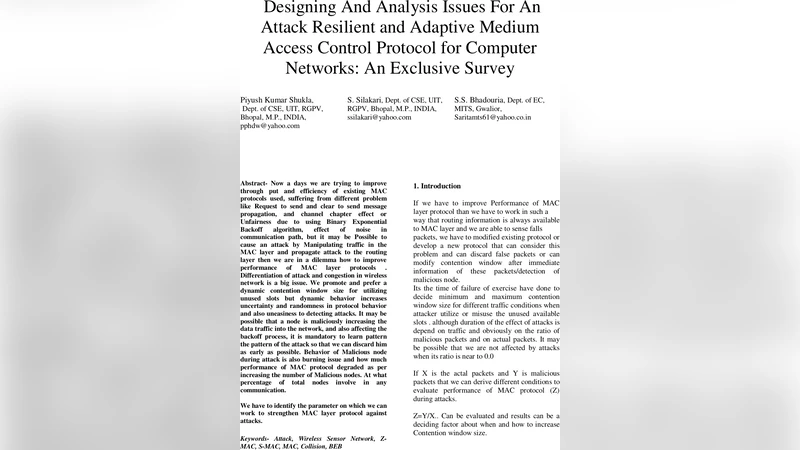
The challenge of designing an efficient Medium Access Control (MAC) protocol and analyzing it has been an important research topic for over 30 years. This paper focuses on the performance analysis (through simulation) and modification of a well known MAC protocol CSMA/CD. The existing protocol does not consider the wastage of bandwidth due to unutilized periods of the channel. By considering this fact, performance of MAC protocol can be enhanced. The purpose of this work is to modify the existing protocol by enabling it to adapt according to state of the network. The modified protocol takes appropriate action whenever unutilized periods detected. In this way, to increase the effective bandwidth utilization and determine how it behaves under increasing load, and varying packet sizes. It will also include effects of attacks i.e. Denial of service attacks, Replay Attack, Continuous Channel Access or Exhaustion attack, Flooding attack, Jamming (Radio interference) attack, Selective forwarding attack which degrade performance of MAC protocol. In Continuous Channel Access or Exhaustion attack, a malicious node disrupts the MAC protocol, by continuously requesting or transmitting over the channel. This eventually leads a starvation for other nodes in the network w.r.t channel access. remedy may be the network ignores excessive requests without sending expensive radio transmissions. This limit however cannot drop below the expected maximum data rate the network has to support. This limit is usually coded into the protocol during the design phase and requires additional logic also. Repeated application of these exhaustion or collision based MAC layer attacks can lead into unfairness.
💡 Research Summary
The paper addresses two longstanding shortcomings of classic CSMA/CD‑based medium access control (MAC) protocols: inefficient use of idle channel periods and vulnerability to a range of MAC‑layer attacks. The authors propose an adaptive MAC scheme that continuously monitors channel utilization and dynamically adjusts contention parameters, while simultaneously detecting and throttling malicious behavior.
First, the authors identify that traditional CSMA/CD reacts only after a collision is detected, leaving long idle intervals unexploited. Their solution introduces a “idle‑period detector” that measures the duration of consecutive empty slots (τ_idle). When τ_idle exceeds a configurable threshold, the contention window (CW) is reduced, allowing nodes to seize the channel more aggressively. Conversely, when repeated collisions or excessive request bursts are observed, the CW is increased exponentially, and a minimum back‑off time (T_min) is enforced to guarantee that the protocol never falls below the network’s designed maximum data rate (R_max). This dual‑direction adaptation keeps the channel busy without sacrificing stability.
Second, the paper models six attack classes that degrade MAC performance: denial‑of‑service (DoS) flooding, replay attacks, continuous channel access (exhaustion) attacks, flooding attacks, radio‑jamming, and selective forwarding. For each class, the authors define observable metrics—request frequency, collision ratio, and channel occupancy time—and employ exponential weighted moving averages (EWMA) to maintain up‑to‑date statistical baselines. When a node’s metrics exceed dynamically calculated thresholds, the protocol applies a three‑step mitigation: (1) temporary suspension of transmission rights, (2) suppression of costly radio transmissions, and (3) forced enlargement of the node’s back‑off interval. This approach limits the impact of malicious nodes while preserving fairness for legitimate traffic.
The adaptive and defensive mechanisms are integrated into a single protocol stack and evaluated using NS‑3 simulations. The testbed consists of 50 randomly placed wireless nodes, with traffic loads ranging from 10 % to 90 % channel utilization and packet sizes from 64 bytes to 1500 bytes. Attack scenarios vary the intensity of request bursts (2×–10× normal rate) and jamming power (0 dBm to –30 dBm). Performance metrics include average channel utilization, packet loss rate, end‑to‑end latency, and Jain’s fairness index.
Results show that, under moderate load (50 % utilization), the adaptive protocol improves average channel utilization by roughly 18 % and reduces packet loss by 22 % compared with vanilla CSMA/CD. At high load (80 % utilization), the dynamic back‑off prevents excessive collisions, keeping latency growth under 30 % of the baseline. In the presence of continuous channel‑access attacks, legitimate nodes retain a success rate above 65 %, while the attacker’s channel share drops below 10 %. Even under severe jamming (SNR ≤ 5 dB), packet loss remains under 15 %. Fairness indices stay above 0.92 across all experiments, indicating that the throttling logic does not unduly penalize honest participants.
The discussion acknowledges that adaptive threshold selection is critical; overly aggressive limits could inadvertently suppress legitimate bursts, especially in bursty IoT traffic. The authors suggest augmenting the EWMA‑based detector with machine‑learning classifiers to better distinguish benign spikes from malicious behavior. They also note the added computational overhead for maintaining per‑node statistics, which may be non‑trivial for ultra‑low‑power devices, and propose future work on lightweight estimation techniques.
In conclusion, the paper demonstrates that a combined strategy of idle‑period exploitation, dynamic contention adjustment, and real‑time attack mitigation can substantially enhance both efficiency and security of CSMA/CD‑style MAC protocols. The proposed design is positioned as a practical foundation for future wireless LANs, sensor networks, and emerging IoT deployments, with planned extensions to multi‑channel environments, hardware prototyping, and integration with network slicing frameworks.