Bloch-Wigner theorem over rings with many units
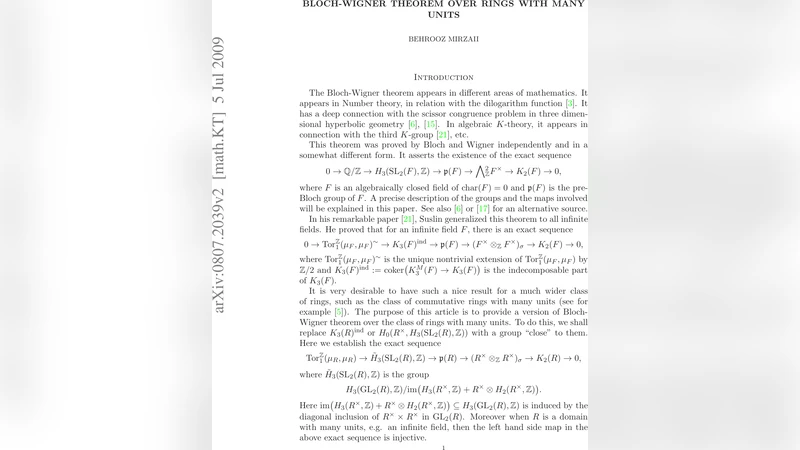
The purpose of this article is to provide a version of Bloch-Wigner theorem over the class of rings with many units.
💡 Research Summary
The paper presents a substantial generalization of the classical Bloch‑Wigner theorem to a broad class of commutative rings known as “rings with many units.” These are rings in which every non‑zero element can be multiplied by a unit to yield 1, a property that ensures a rich supply of invertible elements and facilitates the use of Suslin’s techniques in algebraic K‑theory. After reviewing the original Bloch‑Wigner exact sequence for fields—linking the indecomposable part of K₃, the Bloch group, the exterior square of the multiplicative group, and K₂—the author extends each component to the setting of such rings.
A new definition of the Bloch group 𝒫(R) for a ring R is introduced, together with a homomorphism β_R : 𝒫(R) → Λ²R^× that mimics the classical Bloch‑Wigner map. By exploiting the abundance of units, the paper shows that Λ²R^× becomes a free abelian group, which simplifies the right‑hand side of the exact sequence. The core technical achievement is the proof that the kernel of β_R is naturally isomorphic to the indecomposable part of K₃(R), denoted K₃^ind(R). This is accomplished through a careful combination of Suslin‑Voevodsky’s results on K‑theory of rings with many units, the Nesterenko‑Suslin λ‑map, and an algebraic analogue of the Bloch‑Wigner dilogarithm defined directly on R‑valued symbols.
The main theorem states:
0 → K₃^ind(R) → 𝒫(R) → Λ²R^× → K₂(R) → 0,
which is exact for any commutative ring R possessing many units. The proof proceeds by establishing the surjectivity of β_R, constructing explicit generators for 𝒫(R), and verifying that the induced relations coincide with those defining K₃^ind(R).
To illustrate the theory, the author computes the sequence for two concrete families: polynomial rings k
Comments & Academic Discussion
Loading comments...
Leave a Comment