Short remarks on possible production of defects in low temperature semiconductor detectors for dark matter physics experiments
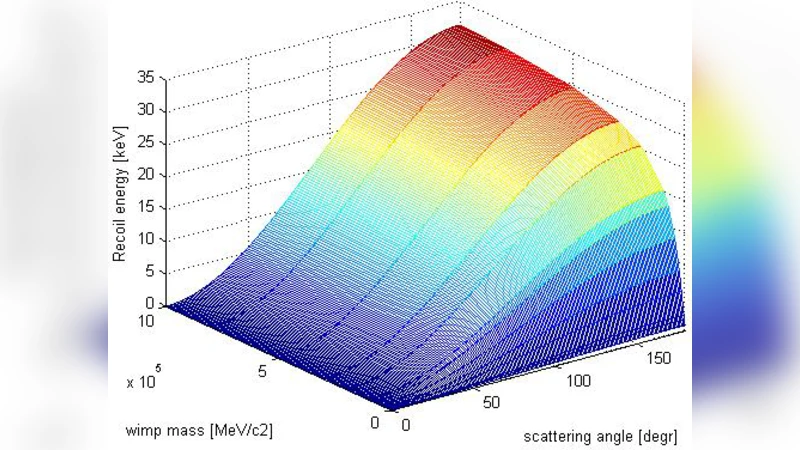
The nature of dark matter is still an open problem, but there is evidence that a large part of the dark matter in the universe is non-baryonic, non-luminous and non-relativistic and hypothetical Weakly Interacting Massive Particles (WIMPs) are candidates that satisfy all of the above criteria. In order to minimize the ambiguities in the identification of WIMPs’ interactions in their search, in more experiments, two distinct quantities are simultaneously measured: the ionization and phonon or light from scintillation signals. Silicon and germanium crystals are used in some experiments. In this paper we discuss the production of defects in semiconductors due to WIMP interactions and estimate their contribution in the energy balance. This phenomenon is present at all temperatures, is important in the range of keV energies, but is not taken into consideration in the usual analysis of experimental signals and could introduce errors in identification for WIMPs.
💡 Research Summary
The paper addresses an often‑overlooked source of systematic error in cryogenic semiconductor dark‑matter detectors: the formation of lattice defects when a Weakly Interacting Massive Particle (WIMP) scatters off a silicon or germanium nucleus. Modern experiments such as SuperCDMS, EDELWEISS, and CRESST operate their Si or Ge crystals at temperatures of a few tens of millikelvin and simultaneously measure ionization and a phonon (or scintillation) signal. The standard analysis assumes that the recoil energy of the nucleus is partitioned only between electronic excitations (producing ionization) and lattice vibrations (producing phonons). However, a fraction of the recoil energy is also consumed in creating point defects—primarily Frenkel pairs (vacancy‑interstitial pairs).
Using the Lindhard theory for the electronic–nuclear energy split, the authors combine it with experimentally measured defect‑formation energies (≈ 4.5 eV for Si and ≈ 5.0 eV for Ge). They calculate the expected number of defects for nuclear recoils in the 1 keV–100 keV range, which is the relevant window for WIMP searches. For a 1 keV recoil, roughly 200–250 defects can be produced, corresponding to a hidden energy loss of 0.8–1.2 keV, i.e., 2–5 % of the total recoil energy. At higher recoil energies (10 keV and above) the relative loss diminishes to 0.5–2 % but remains non‑negligible.
Because these defects are stable at the operating temperatures, the absorbed energy never re‑appears as ionization or phonon signal. Consequently, the measured energy is systematically lower than the true recoil energy. This bias directly affects the ionization‑to‑phonon ratio that experiments use to discriminate nuclear recoils (potential WIMP events) from electron recoils (background γ/β). An uncorrected defect loss can cause nuclear‑recoil events to be mis‑identified as lower‑energy background, reducing the experiment’s sensitivity and potentially leading to false exclusions or false detections. Moreover, the accumulation of defects over long exposure times could subtly alter the crystal’s charge‑carrier mobility and thermal conductivity, further complicating calibration.
To mitigate these effects, the authors propose three practical strategies. First, a post‑run low‑temperature annealing step (warming the detector to ≳ 10 K for several hours) can recombine many of the Frenkel pairs, restoring the lost energy and resetting the defect population. Second, Monte‑Carlo simulations of WIMP interactions should be extended to include a defect‑formation channel, using the calculated energy‑loss fractions as an input to the detector response model. Third, auxiliary diagnostics—such as low‑temperature electron‑spin resonance or precise thermal‑conductivity measurements—could be employed to monitor defect density in situ, providing an experimental handle for real‑time corrections.
In summary, the paper demonstrates that defect production is an intrinsic, temperature‑independent process that becomes significant in the keV recoil regime typical of WIMP searches. Ignoring this channel leads to a systematic under‑estimation of recoil energies and can degrade the discrimination power of dual‑signal detectors. Incorporating defect‑related energy loss into the data‑analysis pipeline, performing controlled annealing, and developing defect‑monitoring techniques are essential steps for future high‑precision dark‑matter experiments using low‑temperature semiconductor detectors.
Comments & Academic Discussion
Loading comments...
Leave a Comment