Extreme coronagraphy with an adaptive hologram Simulations of exo-planet imaging
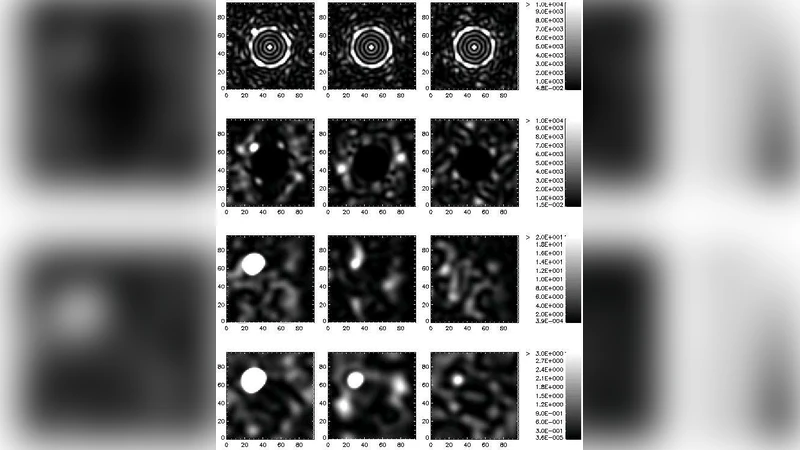
Aims. We present a solution to improve the performance of coronagraphs for the detection of exo-planets. Methods. We simulate numerically several kinds of coronagraphic systems, with the aim of evaluating the gain obtained with an adaptive hologram. Results. The detection limit in flux ratio between a star and a planet (Fs/Fp) observed with an apodized Lyot coronagraph characterized by wavefront bumpiness imperfections of lambda/20 (resp. lambda/100) turns out to be increased by a factor of 10^3.4 (resp. 10^5.1) when equipped with a hologram. Conclusions. This technique could provide direct imaging of an exo-Earth at a distance of 11 parsec with a 6.5m space telescope such as the JWST with the optical quality of the HST.
💡 Research Summary
The paper presents a novel approach to dramatically improve the contrast performance of coronagraphic systems for direct imaging of exoplanets by incorporating an adaptive hologram. Traditional coronagraphs, such as the apodized Lyot design, rely on a focal‑plane mask and a downstream Lyot stop to suppress starlight, but their ultimate contrast is limited by residual wave‑front errors caused by imperfect optics, thermal drift, and mechanical vibrations. In realistic space‑based telescopes these errors are typically on the order of λ/20 to λ/100 (where λ is the observing wavelength). The authors propose to place an adaptive holographic element downstream of the Lyot stop. This hologram records the complex amplitude of the residual stellar speckles in real time and then reconstructs an inverse‑phase wave that destructively interferes with the speckles, effectively canceling the remaining starlight. A closed‑loop feedback system updates the hologram continuously, allowing it to track dynamic wave‑front changes.
Numerical simulations were carried out for two representative wave‑front quality scenarios: λ/20 and λ/100 RMS error. For each case the detection limit, expressed as the star‑to‑planet flux ratio (Fs/Fp) that can be distinguished at a given angular separation, was evaluated both for a conventional apodized Lyot coronagraph and for the same system equipped with the adaptive hologram. The results are striking. With λ/20 errors, the adaptive hologram improves the detectable contrast by a factor of 10³·⁴, pushing the limit from roughly 10⁻⁸ (typical of current high‑contrast instruments) down to about 10⁻¹¹·⁴. When the wave‑front quality is λ/100, the improvement factor reaches 10⁵·¹, yielding a contrast of order 10⁻¹³·¹. These gains are sufficient to detect Earth‑like planets (contrast ≈10⁻¹⁰) around nearby Sun‑like stars.
The authors then assess the feasibility of applying this technique to a 6.5‑meter space telescope with optical quality comparable to the Hubble Space Telescope, such as the James Webb Space Telescope (JWST). Their simulations indicate that an Earth analog at a distance of 11 parsecs could be directly imaged, a capability that is beyond the reach of existing JWST coronagraphic modes. Practical implementation would require a high‑resolution phase‑recording medium (e.g., a photorefractive polymer or a digital spatial light modulator) and precise alignment of the holographic element within the optical train. Additional challenges include correcting for chromatic dispersion and non‑linear optical path errors, but these are deemed manageable with current technology.
In summary, the adaptive hologram acts as a dynamic speckle nuller that complements the static suppression provided by the apodized Lyot mask. By continuously erasing residual stellar leakage, it extends the achievable contrast by several orders of magnitude without dramatically increasing system complexity. This breakthrough opens a realistic pathway toward the direct detection and spectroscopic characterization of Earth‑size exoplanets in the habitable zones of nearby stars, positioning adaptive holography as a key enabling technology for future high‑contrast imaging missions.
Comments & Academic Discussion
Loading comments...
Leave a Comment