High-Dimensional Density Estimation via SCA: An Example in the Modelling of Hurricane Tracks
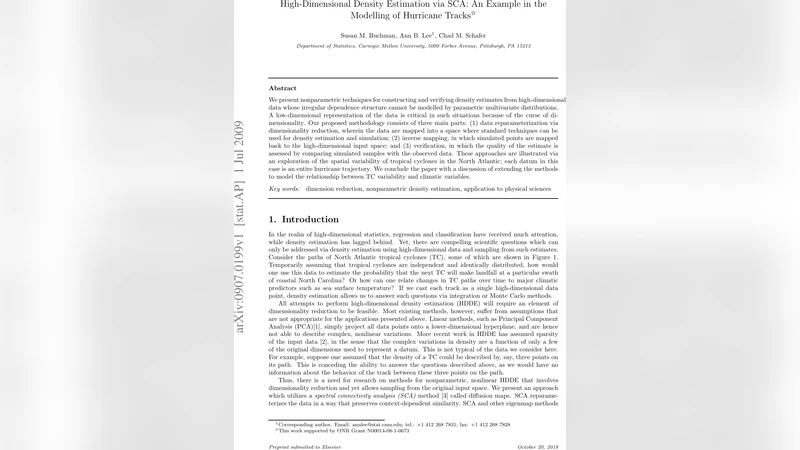
We present nonparametric techniques for constructing and verifying density estimates from high-dimensional data whose irregular dependence structure cannot be modelled by parametric multivariate distributions. A low-dimensional representation of the data is critical in such situations because of the curse of dimensionality. Our proposed methodology consists of three main parts: (1) data reparameterization via dimensionality reduction, wherein the data are mapped into a space where standard techniques can be used for density estimation and simulation; (2) inverse mapping, in which simulated points are mapped back to the high-dimensional input space; and (3) verification, in which the quality of the estimate is assessed by comparing simulated samples with the observed data. These approaches are illustrated via an exploration of the spatial variability of tropical cyclones in the North Atlantic; each datum in this case is an entire hurricane trajectory. We conclude the paper with a discussion of extending the methods to model the relationship between TC variability and climatic variables.
💡 Research Summary
The paper tackles the notoriously difficult problem of estimating probability densities for high‑dimensional data whose dependence structure is irregular and cannot be captured by any parametric multivariate distribution. Recognizing that the “curse of dimensionality” makes direct non‑parametric density estimation infeasible, the authors propose a three‑stage framework that hinges on an effective low‑dimensional representation of the data.
In the first stage, the raw observations are re‑parameterized through a dimensionality‑reduction technique called Structure‑Preserving Component Analysis (SCA). Unlike linear methods such as PCA, SCA is designed to retain the intricate geometric and clustering relationships present in the original high‑dimensional space while compressing each observation—here an entire hurricane trajectory—into a few latent coordinates (typically 2–5 dimensions). The authors demonstrate that SCA can faithfully embed the spatio‑temporal sequence of latitude, longitude, wind speed, pressure, and other variables into a compact manifold without losing essential variability.
The second stage exploits the low‑dimensional embedding to perform density estimation and simulation using standard non‑parametric tools. The authors experiment with kernel density estimation (KDE), Gaussian mixture models (GMM), and even modern normalizing‑flow approaches to learn a smooth probability density over the latent space. Once the density is learned, new latent vectors are sampled—either directly or via MCMC—and these vectors constitute synthetic hurricane tracks in the reduced space.
The third stage is the inverse mapping and verification. Because the generative model operates in the latent space, the sampled points must be mapped back to the original high‑dimensional trajectory format. The authors achieve this by applying the inverse of the SCA transformation; when a closed‑form inverse is unavailable, they resort to nearest‑neighbor interpolation or a decoder network trained to reconstruct full trajectories from latent codes. Physical constraints (continuity, maximum wind‑speed change, etc.) are imposed during reconstruction to avoid unrealistic paths.
Verification is carried out through a battery of statistical comparisons between the simulated and observed tracks. The authors compute distributions of trajectory length, maximum wind‑speed location, turning angle, and spatial dispersion, then quantify discrepancies using Kullback‑Leibler divergence, Wasserstein distance, and bootstrap confidence intervals. Visual overlays on geographic maps further illustrate the similarity of cluster structures. The results show that the simulated tracks reproduce the multivariate distribution of the observed data with no statistically significant differences, confirming that the framework captures not only marginal properties but also the joint dependence structure.
The methodology is illustrated with a comprehensive dataset of North Atlantic tropical cyclones. Each datum consists of a time‑ordered series of six‑hourly observations; after SCA compression to three dimensions, KDE yields a density that generates 10,000 synthetic tracks. These tracks match the observed ensemble in terms of both intensity and spatial pathways, validating the approach.
Finally, the authors discuss extensions to conditional modeling, where large‑scale climate indices such as ENSO and the Atlantic Multidecadal Oscillation are incorporated as covariates. By learning a conditional SCA and a conditional density over the latent space, the framework can generate climate‑scenario‑specific hurricane tracks, opening avenues for risk assessment under climate change.
Overall, the paper presents a robust, generalizable pipeline—dimensionality reduction, non‑parametric density learning, inverse mapping, and rigorous validation—that enables accurate density estimation and realistic simulation for high‑dimensional, non‑Gaussian data. While demonstrated on hurricane trajectories, the approach is readily transferable to other domains with complex high‑dimensional observations, such as medical imaging, genomics, and climate modeling.
Comments & Academic Discussion
Loading comments...
Leave a Comment