Criteria to observe mesoscopic emergence of protein biophysical properties
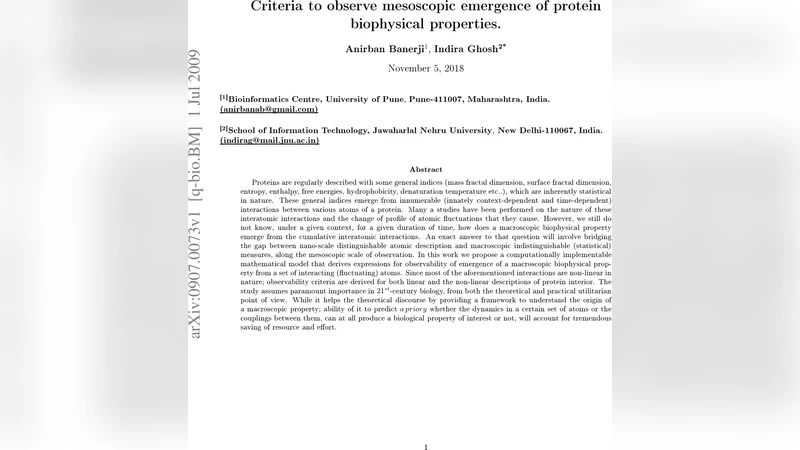
Proteins are regularly described with some general indices (mass fractal dimension, surface fractal dimension, entropy, enthalpy, free energies, hydrophobicity, denaturation temperature etc..), which are inherently statistical in nature. These general indices emerge from innumerable (innately context-dependent and time-dependent) interactions between various atoms of a protein. Many a studies have been performed on the nature of these inter-atomic interactions and the change of profile of atomic fluctuations that they cause. However, we still do not know, under a given context, for a given duration of time, how does a macroscopic biophysical property emerge from the cumulative inter-atomic interactions. An exact answer to that question will involve bridging the gap between nano-scale distinguishable atomic description and macroscopic indistinguishable (statistical) measures, along the mesoscopic scale of observation. In this work we propose a computationally implementable mathematical model that derives expressions for observability of emergence of a macroscopic biophysical property from a set of interacting (fluctuating) atoms. Since most of the aforementioned interactions are non-linear in nature; observability criteria are derived for both linear and the non-linear descriptions of protein interior. The study assumes paramount importance in 21st-century biology, from both the theoretical and practical utilitarian point of view.
💡 Research Summary
The manuscript tackles a fundamental gap in protein biophysics: how the myriad, context‑dependent atomic interactions give rise to macroscopic, statistically described properties such as fractal dimensions, enthalpy, or denaturation temperature. The authors argue that existing approaches either stay at the atomistic level (molecular dynamics, quantum chemistry) or jump directly to bulk thermodynamic descriptors, leaving the mesoscopic scale—where emergent properties become observable—poorly defined. To bridge this gap, they develop a mathematically rigorous, computationally tractable framework that quantifies the “observability” of a macroscopic property emerging from a set of fluctuating atoms.
The core of the model treats a protein as a system of N atoms with a state vector x(t) ∈ ℝ³ᴺ. The dynamics are described by a (generally nonlinear) differential equation ẋ = f(x, t), where f encodes all relevant inter‑atomic potentials (electrostatic, van‑der‑Waals, hydrogen‑bonding, etc.). A macroscopic property y(t) is defined as a smooth mapping g(x(t)), for example total surface area, mass fractal dimension, or average enthalpy. The central question becomes: under what conditions can y(t) be used to infer the underlying atomic state x(t) within a finite observation window **
Comments & Academic Discussion
Loading comments...
Leave a Comment