The Grothendieck Construction and Gradings for Enriched Categories
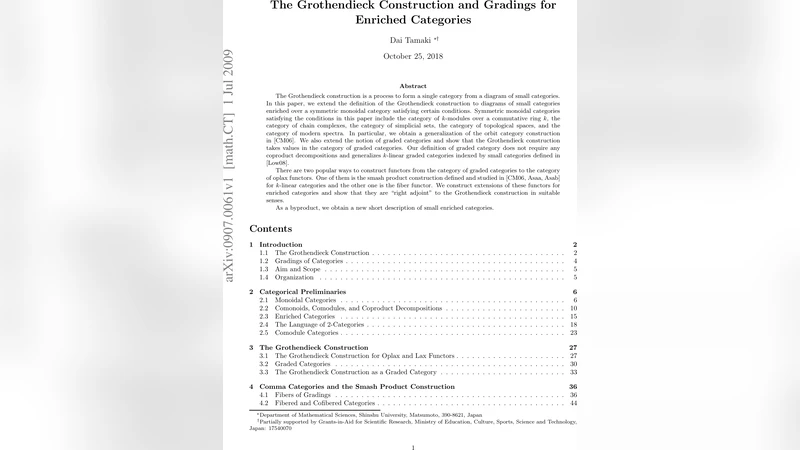
The Grothendieck construction is a process to form a single category from a diagram of small categories. In this paper, we extend the definition of the Grothendieck construction to diagrams of small categories enriched over a symmetric monoidal category satisfying certain conditions. Symmetric monoidal categories satisfying the conditions in this paper include the category of $k$-modules over a commutative ring $k$, the category of chain complexes, the category of simplicial sets, the category of topological spaces, and the category of modern spectra. In particular, we obtain a generalization of the orbit category construction in [math/0312214]. We also extend the notion of graded categories and show that the Grothendieck construction takes values in the category of graded categories. Our definition of graded category does not require any coproduct decompositions and generalizes $k$-linear graded categories indexed by small categories defined by Lowen. There are two popular ways to construct functors from the category of graded categories to the category of oplax functors. One of them is the smash product construction defined and studied in [math/0312214,0807.4706,0905.3884] for $k$-linear categories and the other one is the fiber functor. We construct extensions of these functors for enriched categories and show that they are ``right adjoint’’ to the Grothendieck construction in suitable senses. As a byproduct, we obtain a new short description of small enriched categories.
💡 Research Summary
The paper extends the classical Grothendieck construction, which assembles a diagram of small ordinary categories into a single category, to the setting of diagrams of small categories enriched over a symmetric monoidal category 𝓥. The author first isolates three technical conditions on 𝓥: (i) it is complete and cocomplete, (ii) the tensor product ⊗ is continuous in each variable, and (iii) the unit object I is a small compact object. These hypotheses are satisfied by many familiar bases such as k‑modules for a commutative ring k, chain complexes, simplicial sets, topological spaces, and modern spectra.
Given a 𝓥‑enriched diagram F : 𝓘 → Cat𝓥 (where 𝓘 is a small 𝓥‑enriched index category), the enriched Grothendieck construction ∫𝓘 F is defined as follows. An object is a pair (i, x) with i∈𝓘 and x∈F(i). The hom‑object between (i, x) and (j, y) is the tensor product 𝓘(i, j) ⊗ F(i)(x, F_{i→j}(y)). Composition uses the associativity of ⊗ together with the enrichment of F, and the unit is given by the unit of 𝓘 together with the identity of F(i). The resulting ∫𝓘 F is again a 𝓥‑enriched category, and when 𝓥=Set the construction recovers the ordinary Grothendieck construction.
A central contribution is a new definition of a graded category that does not rely on a coproduct decomposition of the underlying hom‑sets. Instead, a graded 𝓥‑category is a pair (𝓒, G) where 𝓒 is a 𝓥‑enriched category and G : 𝓒 → 𝓘 is a 𝓥‑enriched functor to a small index category 𝓘. The grading is encoded by the image of each hom‑object under G, which lives in the hom‑object of 𝓘. This formulation generalizes Lowen’s k‑linear graded categories (which required a direct sum decomposition indexed by a small category) and works uniformly for any symmetric monoidal base satisfying the above conditions.
The paper then revisits two well‑known constructions that turn graded categories into oplax functors: the smash product and the fiber functor. The smash product of a graded 𝓥‑category (𝓒, G) with its index 𝓘 produces a new enriched category 𝓒 ♯ 𝓘 whose objects are pairs (i, x) and whose hom‑objects are 𝓘(i, j) ⊗ 𝓒(x, y). The author proves that this smash product is right adjoint to the enriched Grothendieck construction in the sense that \
Comments & Academic Discussion
Loading comments...
Leave a Comment