Relativistic diffusion of massless particles
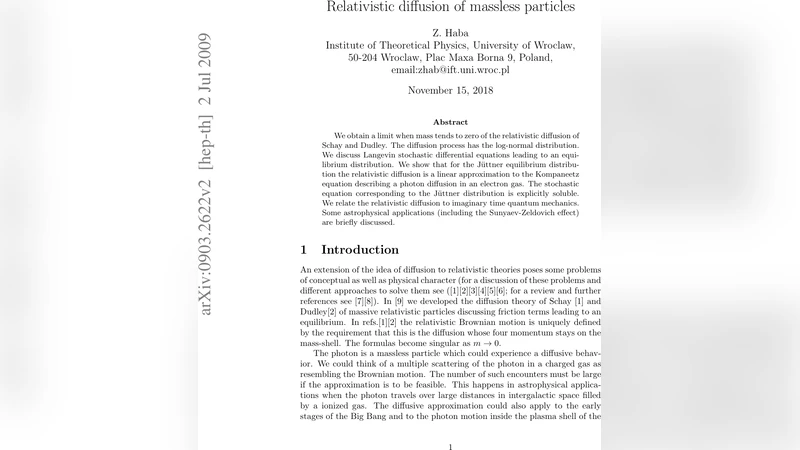
We obtain a limit when mass tends to zero of the relativistic diffusion of Schay and Dudley. The diffusion process has the log-normal distribution. We discuss Langevin stochastic differential equations leading to an equilibrium distribution.We show that for the Juttner equilibrium distribution the relativistic diffusion is a linear approximation to the Kompaneetz equation describing a photon diffusion in an electron gas.The stochastic equation corresponding to the Juttner distribution is explicitly soluble. We relate the relativistic diffusion to imaginary time quantum mechanics. Some astrophysical applications (including the Sunyaev-Zeldovich effect) are briefly discussed.
💡 Research Summary
The paper investigates the relativistic diffusion of mass‑less particles, focusing on the limit where the particle mass m→0 in the Schay‑Dudley relativistic diffusion framework. The authors first show that, in this limit, the diffusion kernel converges to a log‑normal distribution. This result follows from the multiplicative nature of the stochastic noise acting on the particle’s energy (or momentum magnitude), which naturally yields a log‑normal law for any strictly positive variable. Consequently, the energy spectrum of a massless particle undergoing relativistic diffusion spreads in a log‑normal fashion.
To describe the dynamics at the stochastic level, the authors construct a Langevin‑type stochastic differential equation (SDE). The SDE consists of a diffusion term driven by independent Wiener processes and a drift term that enforces a chosen equilibrium distribution. The equilibrium is taken to be the Jüttner distribution, the relativistic analogue of the Maxwell‑Boltzmann distribution, characterized by temperature T and the scalar product p·u of the particle four‑momentum with the fluid four‑velocity. When the drift is tuned to make the Jüttner distribution stationary, the drift operator reduces to a linear term proportional to p·∂_p. This linear drift, together with the diffusion term, reproduces the linearized Kompaneetz equation, which describes photon diffusion (inverse Compton scattering) in an electron gas. Hence the relativistic diffusion of massless particles provides a probabilistic, linear‑approximation to the Kompaneetz dynamics.
The authors further relate the diffusion generator to an imaginary‑time quantum‑mechanical Hamiltonian. By defining H = –L, where L is the diffusion operator, the evolution of a “wavefunction” ψ(p,τ)=e^{-τH}ψ₀(p) obeys a Schrödinger‑type equation in imaginary time τ (the diffusion time). The Hamiltonian contains a harmonic‑oscillator‑like potential that reflects the log‑normal statistics, allowing a spectral decomposition of the diffusion process. This connection offers analytical tools for solving the SDE, for computing correlation functions, and for performing efficient numerical simulations via the propagator e^{-τH}.
In the final part, the paper discusses astrophysical applications, most notably the Sunyaev‑Zeldovich (SZ) effect. The SZ effect arises when Cosmic Microwave Background (CMB) photons traverse a hot electron plasma in galaxy clusters, gaining energy through inverse Compton scattering. Traditionally, the SZ distortion is derived by solving the full Kompaneetz equation, which is nonlinear and computationally demanding. By employing the log‑normal diffusion model with a Jüttner equilibrium, the authors obtain a closed‑form, linearized description that reproduces the characteristic spectral shift of the SZ effect while simplifying the calculations. Moreover, the model naturally incorporates higher‑order (non‑linear) corrections in the high‑energy tail of the photon distribution, which are difficult to capture in standard treatments.
Overall, the paper makes several significant contributions: (1) it rigorously derives the massless limit of the Schay‑Dudley relativistic diffusion, establishing the log‑normal nature of the resulting process; (2) it formulates a Langevin SDE whose stationary solution is the Jüttner distribution and shows its equivalence to the linearized Kompaneetz equation; (3) it unveils a deep link between relativistic diffusion and imaginary‑time quantum mechanics, providing a powerful analytical framework; and (4) it demonstrates the practical relevance of the theory by applying it to the Sunyaev‑Zeldovich effect and suggesting broader applications in plasma physics, high‑energy astrophysics, and early‑universe cosmology. The work thus bridges stochastic relativistic dynamics, kinetic theory, and observational astrophysics, offering both conceptual insight and computationally tractable tools.
Comments & Academic Discussion
Loading comments...
Leave a Comment