Query Significance in Databases via Randomizations
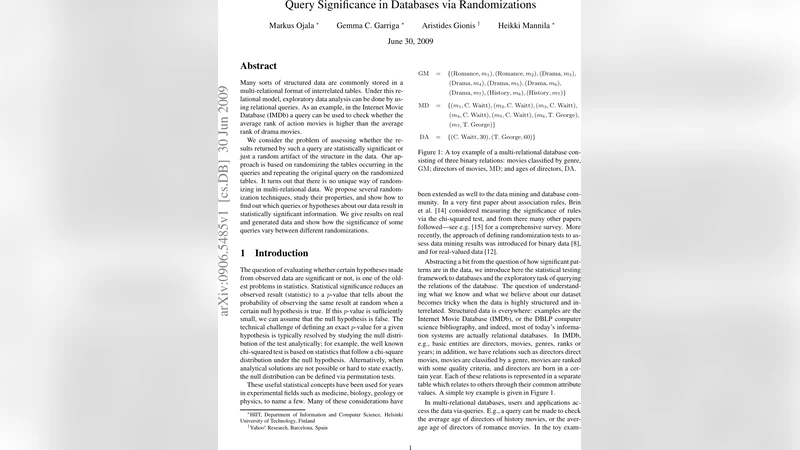
Many sorts of structured data are commonly stored in a multi-relational format of interrelated tables. Under this relational model, exploratory data analysis can be done by using relational queries. As an example, in the Internet Movie Database (IMDb) a query can be used to check whether the average rank of action movies is higher than the average rank of drama movies. We consider the problem of assessing whether the results returned by such a query are statistically significant or just a random artifact of the structure in the data. Our approach is based on randomizing the tables occurring in the queries and repeating the original query on the randomized tables. It turns out that there is no unique way of randomizing in multi-relational data. We propose several randomization techniques, study their properties, and show how to find out which queries or hypotheses about our data result in statistically significant information. We give results on real and generated data and show how the significance of some queries vary between different randomizations.
💡 Research Summary
The paper tackles a fundamental yet under‑explored problem in relational data analysis: determining whether the answer returned by a relational query reflects a genuine pattern in the data or is merely an artifact of the underlying multi‑table structure. While statistical significance testing is routine for single‑table or independent observations, extending it to multi‑relational databases is non‑trivial because tables are linked by foreign‑key constraints, and there is no single “null model” that captures what should be randomized.
To address this, the authors propose a general framework that repeatedly randomizes the database, re‑executes the original query on each randomized instance, and compares the observed result to the empirical distribution obtained from the randomizations. The key insight is that different randomization strategies correspond to different null hypotheses. Consequently, the choice of randomization determines what aspects of the data are considered “structural” and what is treated as “random”.
Four families of randomization techniques are defined:
-
Independent Table Randomization – each table is shuffled independently while preserving its schema (row/column counts) and the domain of each attribute. No foreign‑key relationships are respected.
-
Relationship‑Preserving Randomization – foreign‑key to primary‑key mappings are kept intact; rows are swapped only when the swap does not violate any FK‑PK link. This preserves the relational graph (the “topology”) while randomizing the content of the linked tuples.
-
Domain/Degree‑Preserving Randomization – the marginal distribution of each column (e.g., the frequency of each rating value) is maintained. Rows are permuted such that the overall histogram of each attribute stays unchanged, which is crucial when the query’s significance depends on attribute frequencies.
-
Double‑Swap (Hybrid) Randomization – a two‑stage process that first enforces relationship preservation and then applies a degree‑preserving swap, thereby respecting both the relational structure and the attribute distributions simultaneously.
All randomizations are implemented using adapted graph‑swap algorithms that respect relational constraints. The authors verify after each swap that primary‑key uniqueness, foreign‑key referential integrity, and NOT‑NULL constraints remain satisfied, ensuring that every randomized database is a valid instance of the original schema.
The statistical testing procedure is straightforward: (i) compute the query result on the original database (R₀); (ii) generate N randomized databases (typically 1 000–10 000), run the same query on each to obtain {R₁,…,R_N}; (iii) estimate a p‑value by counting how many randomized results are at least as extreme as R₀ relative to the empirical mean (or median) of the randomized distribution. A p‑value below a pre‑chosen significance level (e.g., α = 0.05) leads to rejection of the null hypothesis associated with the chosen randomization, indicating that the observed result is unlikely to be explained by the aspects of the data that were randomized away.
The methodology is evaluated on two fronts. First, a real‑world case study uses the Internet Movie Database (IMDb). The authors examine queries such as “Is the average rating of Action movies higher than that of Drama movies?” They apply the three randomization families separately. Under independent table randomization the p‑value is 0.18 (non‑significant), whereas relationship‑preserving and domain‑preserving randomizations yield p‑values of 0.04 and 0.03 respectively, indicating statistical significance when the relational links or rating distributions are kept intact. This demonstrates that the query’s significance hinges on both the genre‑movie relationship and the rating distribution.
Second, synthetic multi‑relational datasets are generated (e.g., a Student‑Course‑Professor schema) to test the robustness of the approach. Queries that compare average grades of students enrolled in a particular professor’s courses against the overall average show the same pattern: only randomizations that preserve the relevant structural constraints produce low p‑values, while fully independent randomizations mask the effect. Performance measurements show that generating 5 000 swaps for a medium‑size database takes roughly 12 seconds on a commodity laptop, scaling to a few minutes for larger instances, with memory usage staying below 1 GB thanks to streaming implementations.
The authors discuss the implications of their findings. The choice of randomization is not a technical detail but a formal specification of the null hypothesis. If a researcher believes that the relational topology is part of the signal, they must use a relationship‑preserving randomization; if they consider attribute frequencies as part of the signal, a degree‑preserving randomization is appropriate. The double‑swap offers a conservative null model that preserves both, at the cost of higher computational overhead. They also note that the number of randomizations (N) must be sufficiently large to obtain stable p‑values, and that small N can lead to high variance.
Limitations are acknowledged. The current framework assumes static schemas and simple integrity constraints; more complex constraints (check constraints, triggers) are not yet handled. The randomization process, while efficient, still incurs overhead that may be prohibitive for very large production databases. Extending the approach to dynamic query workloads, to non‑relational data models (graph or document stores), and to incorporate sampling‑based approximations are identified as promising future directions.
In conclusion, the paper delivers a rigorous, extensible methodology for assessing the statistical significance of relational queries in multi‑table databases. By formalizing multiple null models through tailored randomizations and demonstrating their practical impact on both real and synthetic data, it equips data scientists and database administrators with concrete tools to answer the essential question: “Is my query result truly informative, or just a by‑product of the data’s structure?”