Reasoning About Knowledge of Unawareness Revisited
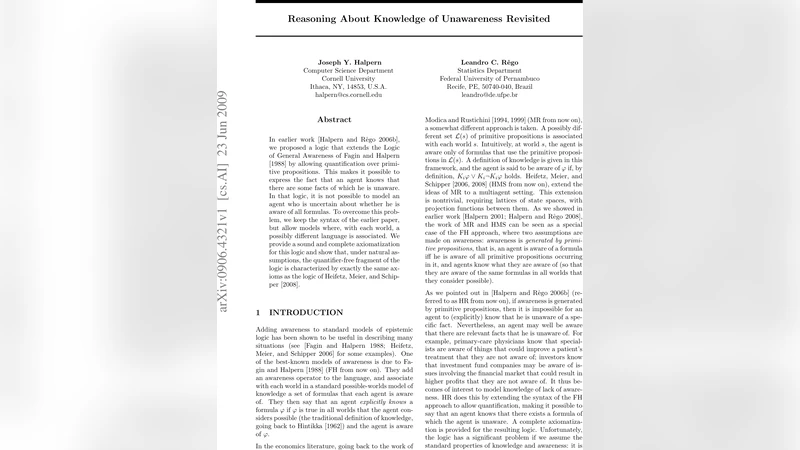
In earlier work, we proposed a logic that extends the Logic of General Awareness of Fagin and Halpern [1988] by allowing quantification over primitive propositions. This makes it possible to express the fact that an agent knows that there are some facts of which he is unaware. In that logic, it is not possible to model an agent who is uncertain about whether he is aware of all formulas. To overcome this problem, we keep the syntax of the earlier paper, but allow models where, with each world, a possibly different language is associated. We provide a sound and complete axiomatization for this logic and show that, under natural assumptions, the quantifier-free fragment of the logic is characterized by exactly the same axioms as the logic of Heifetz, Meier, and Schipper [2008].
💡 Research Summary
The paper revisits the problem of reasoning about an agent’s knowledge of unawareness, building on the Logic of General Awareness (LGA) introduced by Fagin and Halpern (1988). The original LGA allowed quantification over primitive propositions, which made it possible to express statements such as “the agent knows that there are some facts of which he is unaware.” However, LGA could not capture a situation where an agent is uncertain about whether he is aware of all possible formulas; that is, the logic lacked a way to represent meta‑uncertainty about one’s own awareness scope.
To address this limitation, the authors retain the syntactic framework of the earlier work but modify the underlying semantic models. In the new models each possible world w is equipped with its own language L_w, i.e., a set of primitive propositions that are meaningful at that world. Consequently, the truth of a formula φ at w is evaluated only if φ belongs to L_w. This world‑dependent language mechanism enables the representation of agents who may be unaware of certain propositions altogether in some worlds, while being aware of them in others.
The language retains the two basic modal operators of LGA: K_i φ (agent i knows φ) and A_i φ (agent i is aware of φ). Quantification is allowed over primitive proposition variables p, written ∀p φ(p), with the side condition that the quantified proposition must be part of the language of the world where the formula is evaluated. The authors introduce additional axioms that govern the relationship between languages of different worlds, essentially stating that if L_w ⊆ L_v then any knowledge or awareness that holds at w also holds at v. This captures the intuition that expanding the language cannot invalidate previously held knowledge.
The main technical contributions are twofold. First, a sound and complete axiomatization for the full logic (including quantifiers) is presented. The axiom system combines the classic LGA axioms (distribution, positive introspection, etc.) with the standard first‑order quantifier axioms, and augments them with language‑inclusion axioms that handle the world‑specific vocabularies. Second, the authors isolate the quantifier‑free fragment and show that, under natural assumptions (e.g., each world’s language is a subset of a global “master” language), this fragment is characterized by exactly the same axioms as the logic of Heifetz, Meier, and Schipper (2008). Thus the new framework subsumes the earlier unawareness logics while offering strictly greater expressive power.
On the model‑theoretic side, the paper defines operations of language expansion and contraction and studies how they interact with the modal operators. For example, a formula K_i ¬A_i p (agent i knows that he is unaware of p) can be true in a world where p is not in L_w, while the same agent may be unaware of the existence of such a p in another world where the language includes p. This fine‑grained distinction between “not aware of p” and “aware that I am not aware of p” is essential for applications in economics and game theory where agents may have higher‑order beliefs about the limits of their own information.
The completeness proof proceeds in two stages. The first stage adapts a Hilbert‑style proof system, showing that every semantically valid formula can be derived using the combined axioms. The second stage employs a canonical model construction that respects the language‑varying nature of worlds. A key lemma, the “language‑extension preservation theorem,” guarantees that if a formula holds in a world, it continues to hold in any extension of that world’s language, thereby enabling the usual canonical‑model argument despite the added complexity.
In conclusion, the paper delivers a robust logical apparatus for reasoning about knowledge of unawareness that overcomes a notable gap in earlier frameworks. By allowing world‑dependent languages, it captures agents’ meta‑uncertainty about their own awareness, aligns with existing unawareness logics on the quantifier‑free level, and provides a sound and complete axiomatization for the richer quantified language. The results have immediate relevance for formal analyses of strategic interaction under incomplete information and incomplete awareness, and they open avenues for further extensions such as dynamic language change, probabilistic awareness, and multi‑agent language coordination.
Comments & Academic Discussion
Loading comments...
Leave a Comment