Persistence, extinction and spatio-temporal synchronization of SIRS cellular automata models
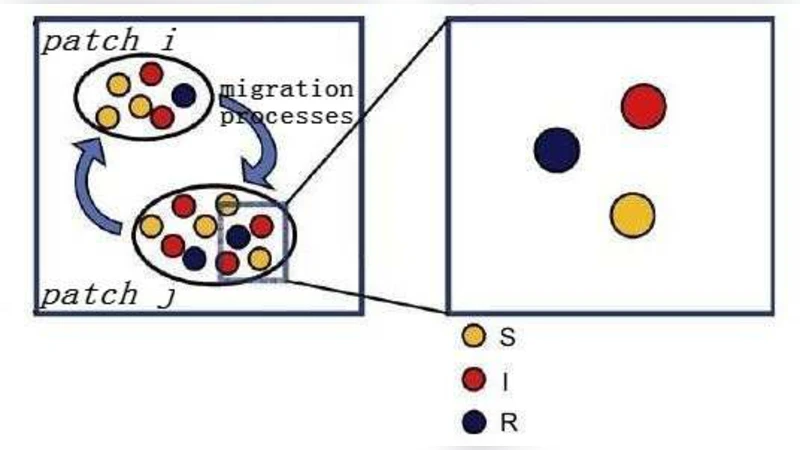
Spatially explicit models have been widely used in today’s mathematical ecology and epidemiology to study persistence and extinction of populations as well as their spatial patterns. Here we extend the earlier work–static dispersal between neighbouring individuals to mobility of individuals as well as multi-patches environment. As is commonly found, the basic reproductive ratio is maximized for the evolutionary stable strategy (ESS) on diseases’ persistence in mean-field theory. This has important implications, as it implies that for a wide range of parameters that infection rate will tend maximum. This is opposite with present results obtained in spatial explicit models that infection rate is limited by upper bound. We observe the emergence of trade-offs of extinction and persistence on the parameters of the infection period and infection rate and show the extinction time having a linear relationship with respect to system size. We further find that the higher mobility can pronouncedly promote the persistence of spread of epidemics, i.e., the phase transition occurs from extinction domain to persistence domain, and the spirals’ wavelength increases as the mobility increasing and ultimately, it will saturate at a certain value. Furthermore, for multi-patches case, we find that the lower coupling strength leads to anti-phase oscillation of infected fraction, while higher coupling strength corresponds to in-phase oscillation.
💡 Research Summary
This paper extends the classic spatially explicit SIRS (susceptible‑infected‑recovered‑susceptible) cellular automaton (CA) framework by incorporating two realistic ecological features: individual mobility and a multi‑patch environment. In the baseline CA, each lattice site can be in one of the three epidemiological states, and updates follow stochastic rules for infection transmission, recovery, loss of immunity, and return to susceptibility. The authors first add a mobility parameter μ, which with probability μ allows an individual to move to a neighboring site before the disease‑state update. This transforms the model from a purely static nearest‑neighbour transmission scheme to one where individuals can carry infection across space, thereby mimicking real‑world movement such as commuting or animal dispersal.
The second extension partitions the whole lattice into L sub‑lattices (patches) and introduces a coupling strength ε that governs the rate of disease exchange between adjacent patches. This construction captures the effect of inter‑regional travel or habitat connectivity. By systematically varying four key parameters—infection rate β, infectious period τ_I, mobility μ, and patch coupling ε—the authors perform long‑time Monte‑Carlo simulations to measure several observables: the average infected fraction ⟨I⟩, its variance, the extinction time T_ext (time until the system reaches the disease‑free absorbing state), and the spatial characteristics of emergent wave patterns, notably the wavelength λ of spiral waves.
The results reveal several robust phenomena. First, there is a mobility‑driven phase transition. When μ is low, infection remains localized and eventually dies out, leaving the lattice in the susceptible state (the “extinction domain”). As μ exceeds a critical value μ_c, the system abruptly switches to a “persistence domain” where the disease remains endemic. This transition resembles a second‑order percolation‑type transition and demonstrates that even modest individual movement can dramatically alter epidemic outcomes.
Second, the wavelength of spiral waves increases with μ. For small μ the spirals are tight; as μ grows, λ expands roughly linearly until it reaches a saturation plateau. The saturation indicates that beyond a certain mobility level, additional random movement no longer stretches the wave fronts because the spatial coherence of the pattern is already maximized.
Third, the authors uncover a trade‑off between β and τ_I. High β accelerates transmission, but if τ_I is short the infected individuals recover quickly, limiting the overall prevalence. Conversely, a long infectious period sustains transmission but only if β is sufficiently large to seed new infections. The authors map a critical line in the (β, τ_I) plane that separates extinction from persistence, showing that the system’s fate can be predicted by the relative magnitudes of these two parameters.
Fourth, system size N (the linear dimension of the lattice) scales linearly with extinction time T_ext. Larger populations therefore support longer-lived epidemics, a finding that aligns with classic stochastic extinction theory but is explicitly demonstrated here for a spatially explicit CA.
In the multi‑patch scenario, coupling strength ε determines the phase relationship of infection oscillations across patches. Weak coupling (ε ≪ ε_c) yields anti‑phase dynamics: when one patch experiences a peak in infection, the neighboring patch is near its trough. Strong coupling (ε ≫ ε_c) synchronizes patches in‑phase, producing simultaneous peaks and troughs across the entire landscape. The transition between anti‑phase and in‑phase behavior occurs sharply at a critical ε_c, mirroring results from network synchronization literature.
Importantly, the study highlights a fundamental difference between mean‑field predictions and spatially explicit dynamics. In mean‑field theory the basic reproductive number R₀ (proportional to β) can be increased arbitrarily to maximize persistence, leading to an evolutionary stable strategy (ESS) with maximal β. In contrast, the CA model shows that spatial constraints, mobility, and patch coupling impose an effective upper bound on β; beyond this bound further increases do not enhance persistence because the disease becomes limited by the rate at which individuals can physically encounter susceptibles. This limitation mirrors real‑world constraints such as social distancing, travel restrictions, and heterogeneous contact patterns.
The authors conclude that (1) individual mobility is a potent driver of epidemic persistence and can reshape spatial wave patterns; (2) the interplay between infection rate and infectious period defines a clear extinction‑persistence frontier; (3) inter‑patch coupling controls the synchrony of regional outbreaks, offering a mechanistic explanation for observed phase‑lagged epidemic waves in metapopulations. They suggest future extensions to heterogeneous networks, non‑uniform mobility distributions, and the inclusion of vaccination or treatment interventions, which would further bridge the gap between theoretical models and public‑health policy design.
Comments & Academic Discussion
Loading comments...
Leave a Comment