Most of the research related to Non Functional Requirements (NFRs) have presented NFRs frameworks by integrating non functional requirements with functional requirements while we proposed that measurement of NFRs is possible e.g. cost and performance and NFR like usability can be scaled. Our novel hybrid approach integrates three things rather than two i.e. Functional Requirements (FRs), Measurable NFRs (M-NFRs) and Scalable NFRs (S-NFRs). We have also found the use of Fuzzy Logic and Likert Scale effective for handling of discretely measurable as well as scalable NFRs as these techniques can provide a simple way to arrive at a discrete or scalable NFR in contrast to vague, ambiguous, imprecise, noisy or missing NFR. Our approach can act as baseline for new NFR and aspect oriented frameworks by using all types of UML diagrams.
Deep Dive into Measurable & Scalable NFRs using Fuzzy Logic and Likert Scale.
Most of the research related to Non Functional Requirements (NFRs) have presented NFRs frameworks by integrating non functional requirements with functional requirements while we proposed that measurement of NFRs is possible e.g. cost and performance and NFR like usability can be scaled. Our novel hybrid approach integrates three things rather than two i.e. Functional Requirements (FRs), Measurable NFRs (M-NFRs) and Scalable NFRs (S-NFRs). We have also found the use of Fuzzy Logic and Likert Scale effective for handling of discretely measurable as well as scalable NFRs as these techniques can provide a simple way to arrive at a discrete or scalable NFR in contrast to vague, ambiguous, imprecise, noisy or missing NFR. Our approach can act as baseline for new NFR and aspect oriented frameworks by using all types of UML diagrams.
The major objective of the paper is to discuss existing methodologies to identify, capture and specify NFRs and propose an improved approach. A novel hybrid approach is proposed for discretely measurable and scalable NFRs by applying Fuzzy Logic and Likert Scale. The proposed methodology will give comparison between vague, ambiguous, imprecise, noisy or missing NFRs to clear, precise and measurable NFRs. Also as requirements can be obtained either through open-ended or closed-ended ways, or a combination of the two, the use of Likert scale can be very useful for gaining quantifiable requirements. It is also a regular method followed by Project Management Institute (PMI) for capturing various grey areas of requirements. The paper not only addresses yes/no questions of requirements but also focuses on areas between FRs and NFRs by using fuzzy logic and Likert Scale. Our work initially investigates work done related to NFRs along with background of issues. Secondly we have given our proposed approach, findings and finally expected future work as well.
Research related to NFRs frameworks in UML mostly used use case and class diagrams and almost all of them have proposed extensions in the current UML for the incorporation of NFRs. Moreover, past research works do have serious issues at the point of integration of FRs and NFRs, which are mainly due to the separation of concerns for both types of requirements. How FRs and NFRs should be developed in a tightly or loosely integrated approach is another area of future research. As at some point of time you might need them separately and yet integrated to address the overall objectives of the system.
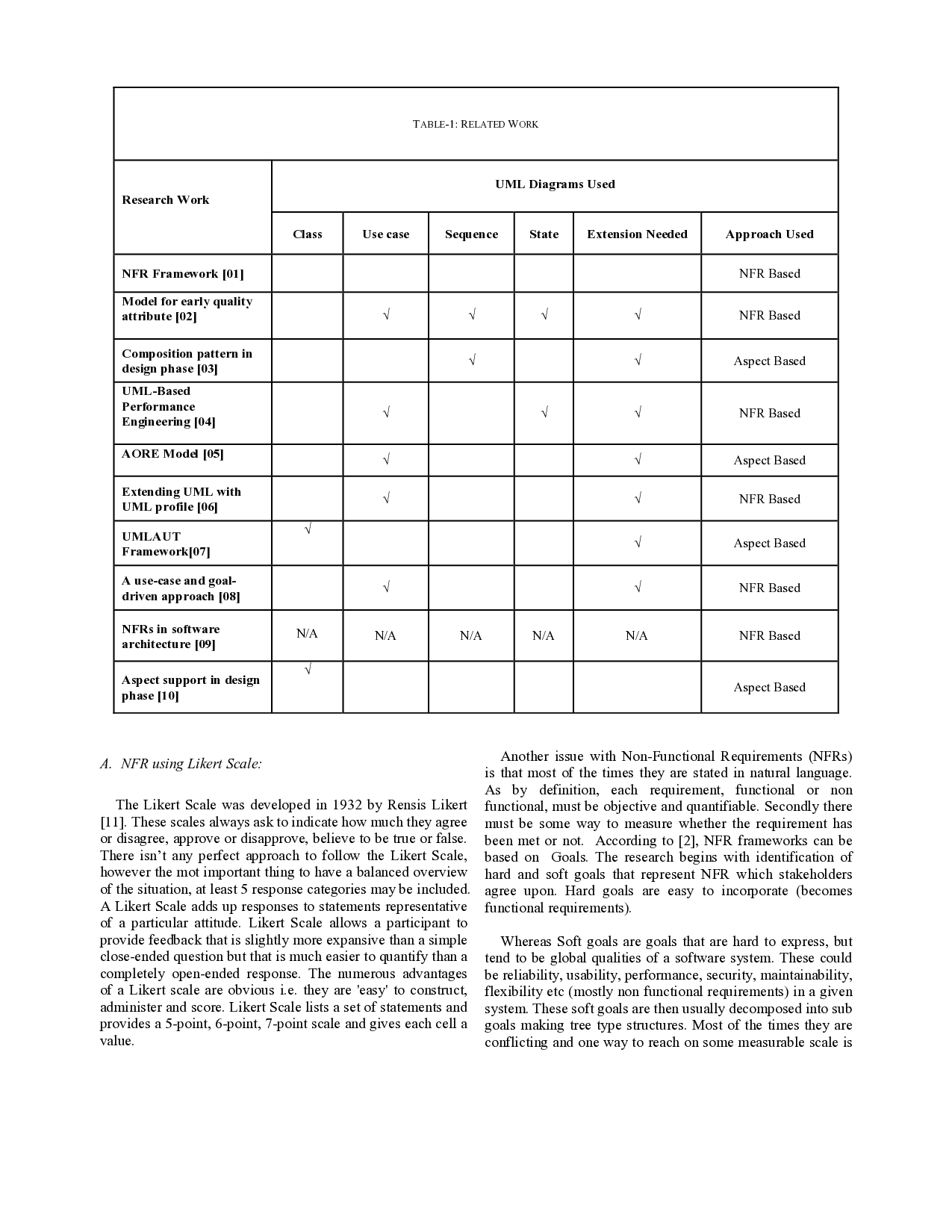
In reality, there is no formal rule to form/analyze aspects and to address cross cutting concerns for FRs and NFRs. Integrating NFRs with FRs at requirement level through some integration point is a normal practice as we found from our survey [Table -1]. Also as per our literature survey many authors have used use case diagrams for this integration and most of them have proposed extensions to existing UML model for the integration purpose [Table -1]. Furthermore, these approaches have kept the options open both for functional and non functional view of the system. However, NFR-Based approach also emphasizes the use case cohesion. Aspect-Based approaches concentrate more on class diagrams. Our approach includes the proposal of measurement of NFRs i.e. possibility of measurement of NFRs is explored through Measurable NFRs and Scalable NFRS and we have also tried to reduce the grey areas of NFRs.
The research related to Non Functional Requirements (NFRs) emphasize its importance but very little implementation could be found. By definition, requirement should be something which can be verified at some point of time, which is not possible for all the non functional requirements i.e. you can not formally say yes or no e.g. usability. Also there is no point to be precise when we don’t know what is actually required and what NFRs are necessary for which system. So, our research is aimed at bridging this gap between vague/hazy and precise/scalable. To make non functional requirements measurable we have used fuzzy logic and Likert Scale.
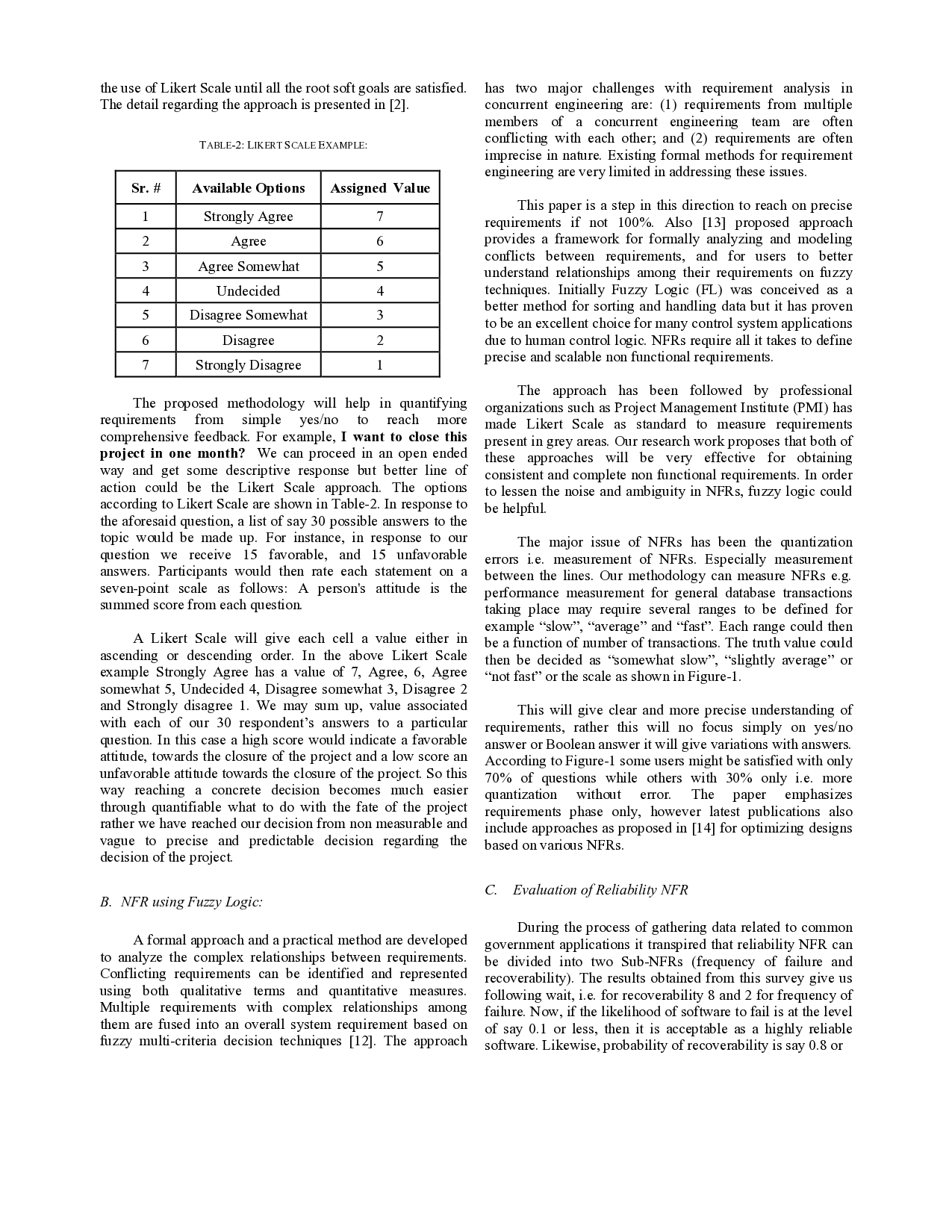
The Likert Scale was developed in 1932 by Rensis Likert [11]. These scales always ask to indicate how much they agree or disagree, approve or disapprove, believe to be true or false. There isn’t any perfect approach to follow the Likert Scale, however the mot important thing to have a balanced overview of the situation, at least 5 response categories may be included. A Likert Scale adds up responses to statements representative of a particular attitude. Likert Scale allows a participant to provide feedback that is slightly more expansive than a simple close-ended question but that is much easier to quantify than a completely open-ended response. The numerous advantages of a Likert scale are obvious i.e. they are ’easy’ to construct, administer and score. Likert Scale lists a set of statements and provides a 5-point, 6-point, 7-point scale and gives each cell a value.
Another issue with Non-Functional Requirements (NFRs) is that most of the times they are stated in natural language. As by definition, each requirement, functional or non functional, must be objective and quantifiable. Secondly there must be some way to measure whether the requirement has been met or not. According to [2], NFR frameworks can be based on Goals. The research begins with identification of hard and soft goals that represent NFR which stakeholders agree upon. Hard goals are easy to incorporate (becomes functional requirements).
Whereas Soft goals are goals that are hard to express, but tend to be global qualities of a software system. These could be reliability, usability, performance, security, maintainability, flexibility etc (mostly non functional requirements) in a given system. These soft goals are then usually decomposed into sub goals making tree type structure
…(Full text truncated)…
This content is AI-processed based on ArXiv data.