Quantum Measurement Theory Explains the Deuteration Effect in Radical-Ion-Pair Reactions
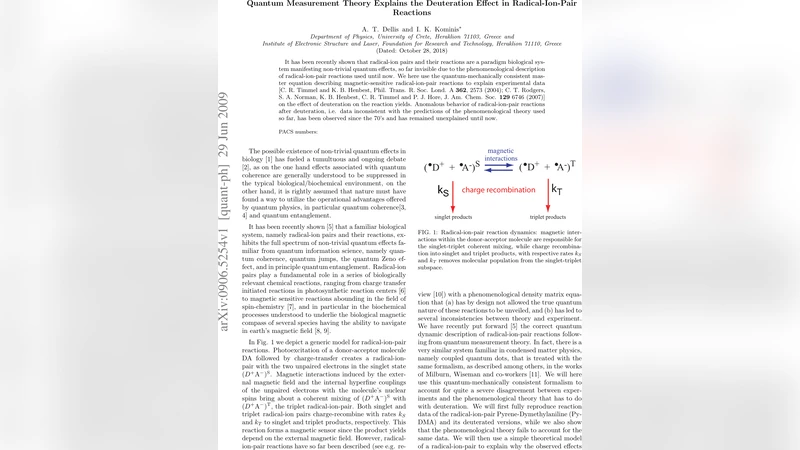
It has been recently shown that radical-ion pairs and their reactions are a paradigm biological system manifesting non-trivial quantum effects, so far invisible due to the phenomenological description of radical-ion-pair reactions used until now. We here use the quantum-mechanically consistent master equation describing magnetic-sensitive radical-ion-pair reactions to explain experimental data [C. R. Timmel and K. B. Henbest, Phil. Trans. R. Soc. Lond. A {\bf 362}, 2573 (2004); C. T. Rodgers, S. A. Norman, K. B. Henbest, C. R. Timmel and P. J. Hore, J. Am. Chem. Soc. {\bf 129} 6746 (2007)] on the effect of deuteration on the reaction yields. Anomalous behavior of radical-ion-pair reactions after deuteration, i.e. data inconsistent with the predictions of the phenomenological theory used so far, has been observed since the 70’s and has remained unexplained until now.
💡 Research Summary
The paper addresses a long‑standing discrepancy between experimental observations of deuterium (or more precisely, deuteration) effects in radical‑ion‑pair (RIP) reactions and the predictions of the traditional phenomenological master equation that has been used to model these systems for decades. Radical‑ion‑pair reactions are central to many biologically relevant processes, such as the magnetic compass of migratory birds, because their recombination yields depend sensitively on the spin state of the pair, which in turn is influenced by hyperfine interactions, external magnetic fields, and spin‑selective recombination pathways.
The authors argue that the phenomenological model fails because it treats spin dynamics as a purely unitary evolution interrupted by irreversible recombination events, without explicitly accounting for the continuous quantum measurement that the spin‑selective recombination imposes on the system. To remedy this, they adopt a quantum‑measurement‑theoretic framework in which the recombination process is modeled as a continuous measurement of the singlet–triplet (S–T) observable. In this picture, two key rates appear: the recombination rate (k) (which determines how quickly population is removed from the singlet or triplet subspace) and the measurement strength (\gamma) (which governs the rate of decoherence between singlet and triplet states).
The resulting master equation is:
\
Comments & Academic Discussion
Loading comments...
Leave a Comment