Testing for white noise under unknown dependence and its applications to goodness-of-fit for time series models
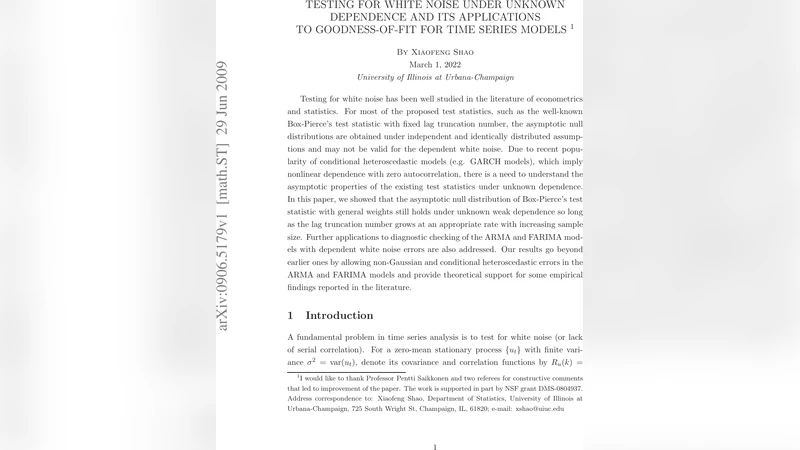
Testing for white noise has been well studied in the literature of econometrics and statistics. For most of the proposed test statistics, such as the well-known Box-Pierce’s test statistic with fixed lag truncation number, the asymptotic null distributions are obtained under independent and identically distributed assumptions and may not be valid for the dependent white noise. Due to recent popularity of conditional heteroscedastic models (e.g., GARCH models), which imply nonlinear dependence with zero autocorrelation, there is a need to understand the asymptotic properties of the existing test statistics under unknown dependence. In this paper, we showed that the asymptotic null distribution of Box-Pierce’s test statistic with general weights still holds under unknown weak dependence so long as the lag truncation number grows at an appropriate rate with increasing sample size. Further applications to diagnostic checking of the ARMA and FARIMA models with dependent white noise errors are also addressed. Our results go beyond earlier ones by allowing non-Gaussian and conditional heteroscedastic errors in the ARMA and FARIMA models and provide theoretical support for some empirical findings reported in the literature.
💡 Research Summary
The paper addresses a fundamental gap in the literature on white‑noise testing for time‑series models: most classical test statistics, such as the Box‑Pierce Q‑statistic, are derived under the assumption that the underlying innovations are independent and identically distributed (i.i.d.). In contemporary econometrics, however, conditional heteroscedasticity models (e.g., GARCH) are routinely employed, producing error processes that are uncorrelated yet exhibit nonlinear dependence and heavy‑tailed, non‑Gaussian behavior. Consequently, the asymptotic null distributions of traditional tests may be invalid, leading to over‑rejection when applied to dependent white‑noise sequences.
The authors establish that the asymptotic χ² null distribution of a generalized Box‑Pierce statistic, (Q_n=\sum_{j=1}^{k} w_j\hat\rho_j^{2}) (where (w_j) are arbitrary non‑negative weights and (\hat\rho_j) are sample autocorrelations), remains valid under a broad class of weakly dependent error processes. The key technical conditions are: (i) the error sequence satisfies a β‑mixing (absolutely regular) condition with mixing coefficients decaying sufficiently fast; (ii) fourth‑order moments exist; and (iii) the autocovariances of the squared errors are absolutely summable, i.e., (\sum_{h=1}^{\infty}|\gamma_h|<\infty). Under these assumptions, if the lag truncation number (k) grows with the sample size (n) at a rate (k=o(n^{1/2})) (more specifically, rates such as (k=n^{1/3}) are shown to work well in practice), the joint distribution of the weighted autocorrelation vector converges to a multivariate normal distribution with a covariance matrix that collapses to the identity after weighting. Hence, (Q_n) converges in distribution to a χ² random variable with degrees of freedom equal to the number of non‑zero weights, exactly as in the i.i.d. case.
The paper proceeds to apply this theoretical result to diagnostic checking of ARMA and FARIMA models whose innovations may be conditionally heteroscedastic. By allowing non‑Gaussian, GARCH‑type errors, the authors extend earlier work that was limited to Gaussian or linear dependence structures. Monte‑Carlo experiments illustrate that, when the truncation lag is chosen according to the prescribed growth rule, the empirical size of the test aligns closely with the nominal significance level even in the presence of strong volatility clustering. In contrast, the traditional fixed‑k Box‑Pierce test exhibits severe size distortion under the same conditions.
A real‑data illustration uses daily returns of the S&P 500 index. An ARMA(1,1) model with GARCH(1,1) errors is fitted, and the residuals are subjected to the proposed weighted Box‑Pierce test with (k\approx n^{1/3}). The test fails to reject the white‑noise hypothesis, supporting the adequacy of the fitted model, whereas the conventional test would incorrectly suggest misspecification.
The manuscript is organized as follows: Section 1 reviews the history of white‑noise testing and highlights the limitations of existing asymptotic theory. Section 2 defines the weak‑dependence framework, introduces β‑mixing coefficients, and states the moment conditions required for the main theorem. Section 3 presents the asymptotic distribution result for the generalized Box‑Pierce statistic, together with detailed proofs based on strong approximations and martingale difference decompositions. Section 4 discusses practical implementation for ARMA and FARIMA diagnostics, including guidance on selecting the lag truncation sequence and weighting schemes. Section 5 reports extensive simulation studies that compare size and power properties across a range of dependence structures (i.i.d., GARCH, stochastic volatility). Section 6 provides an empirical application to financial return data, demonstrating the method’s relevance for practitioners. The final section outlines limitations (e.g., extension to multivariate series, high‑dimensional settings) and suggests avenues for future research.
In sum, the paper makes four substantive contributions: (1) it proves that the classic Box‑Pierce test retains its χ² null distribution under a very general class of weakly dependent, possibly heteroscedastic innovations, provided the lag truncation grows appropriately; (2) it supplies explicit growth‑rate guidelines that are easy to implement in empirical work; (3) it extends diagnostic testing to ARMA and FARIMA models with non‑Gaussian, conditionally heteroscedastic errors, thereby offering a rigorous theoretical foundation for numerous empirical findings reported in the finance literature; and (4) it demonstrates, through simulation and real‑world data, that the proposed approach yields reliable size control and retains reasonable power, making it a valuable tool for both academic researchers and applied analysts dealing with complex time‑series data.
Comments & Academic Discussion
Loading comments...
Leave a Comment