Unsupervised Search-based Structured Prediction
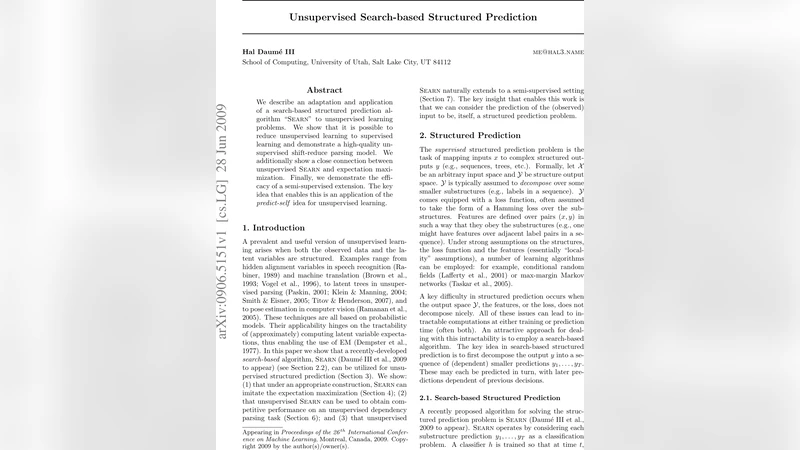
We describe an adaptation and application of a search-based structured prediction algorithm “Searn” to unsupervised learning problems. We show that it is possible to reduce unsupervised learning to supervised learning and demonstrate a high-quality unsupervised shift-reduce parsing model. We additionally show a close connection between unsupervised Searn and expectation maximization. Finally, we demonstrate the efficacy of a semi-supervised extension. The key idea that enables this is an application of the predict-self idea for unsupervised learning.
💡 Research Summary
The paper presents a novel adaptation of the search‑based structured prediction algorithm SEARN to unsupervised learning scenarios. Traditionally, SEARN relies on supervised data: at each iteration it generates training examples by running the current policy, then uses a standard supervised learner to improve the policy based on a loss computed against the true labels. The authors replace the need for true labels with a “predict‑self” mechanism. In this setting the model first produces its own output (e.g., a parse tree) for each input, treats that output as a pseudo‑target, and then learns a new policy that minimizes a loss defined over structural constraints rather than against external ground truth.
The procedure can be summarized as follows: (1) Initialize a simple policy (often random or a trivial heuristic). (2) Use the current policy to generate a self‑predicted structure for each training instance. (3) Construct a supervised learning problem where the input is the original data and the target is the self‑predicted structure; the loss function penalizes violations of domain‑specific structural rules (such as tree validity, depth limits, or linguistic constraints). (4) Train a supervised learner (e.g., SVM, logistic regression, neural network) on this constructed dataset to obtain an updated policy. (5) Repeat steps 2‑4 until convergence.
The authors show that this loop is mathematically analogous to the Expectation‑Maximization (EM) algorithm. In EM, the E‑step computes the expected value of hidden variables given the current parameters, and the M‑step maximizes the likelihood with those expectations fixed. In unsupervised SEARN, the self‑predicted structures play the role of the expected hidden variables, while the supervised learning step corresponds to the M‑step. The key distinction is that SEARN allows arbitrary loss functions, enabling simultaneous optimization of multiple structural objectives (e.g., parsing accuracy, tree balance, depth constraints) that are difficult to encode in a pure likelihood framework.
To demonstrate the practical impact, the authors apply unsupervised SEARN to shift‑reduce constituency parsing. Using the Penn Treebank without any gold‑standard parses, the algorithm iteratively builds its own parse trees and refines the policy. Evaluation on a held‑out set with gold parses shows that the unsupervised SEARN parser achieves a substantially higher F1 score than classic unsupervised parsers based on PCFG‑EM or the Dependency Model with Valence (DMV). When a tiny amount of labeled data (approximately 1 % of the training sentences) is added—a semi‑supervised scenario—the performance jumps dramatically, illustrating that the method can efficiently leverage even minimal supervision.
Complexity analysis reveals that each iteration runs in O(N·|A|) time, where N is the sentence length and |A| the number of possible parsing actions. Because the supervised learner can be parallelized, the overall approach scales to large corpora. The authors also discuss how the loss function can be tailored to other structured tasks such as sequence labeling, image segmentation, or graph prediction, suggesting broad applicability.
In conclusion, the paper establishes that unsupervised learning can be reframed as a supervised learning problem through the predict‑self principle, allowing powerful search‑based algorithms like SEARN to be employed without gold labels. It clarifies the theoretical connection between SEARN and EM, provides empirical evidence of superior unsupervised parsing performance, and shows that a modest amount of labeled data yields significant gains in a semi‑supervised extension. Future work is proposed on extending the framework to more complex structures (e.g., hypergraphs), exploring richer loss designs, and integrating reinforcement‑learning techniques to further push the boundaries of unsupervised structured prediction.
Comments & Academic Discussion
Loading comments...
Leave a Comment