Cycle modules and the intersection A-infinity algebra
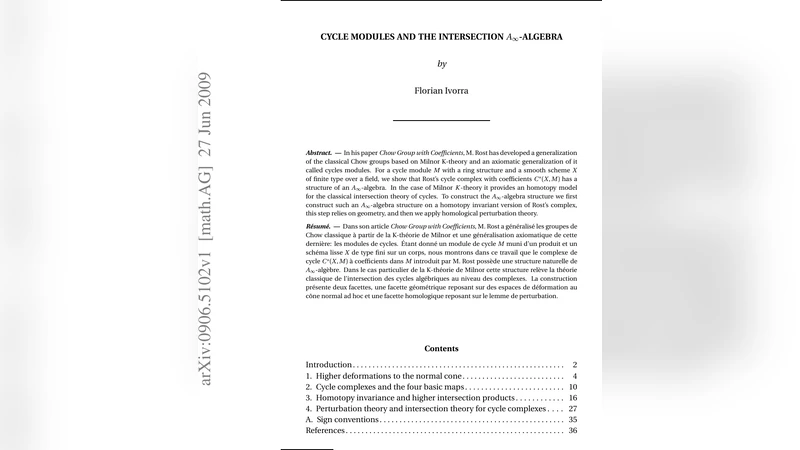
Given a cycle module M with a ring structure we show that the cycle complex with coefficients in M of a smooth scheme of finite type over a field has a A-infinity algebra structure. In the case of Milnor K-theory this gives a homotopy model for the classical intersection theory of algebraic cycles.
💡 Research Summary
The paper investigates the interplay between Rost’s cycle modules equipped with a multiplicative (ring) structure and the homotopical algebra of their associated cycle complexes. Let (M) be a cycle module over a base field (k) that carries a graded commutative product (\mu: M_a\otimes M_b\to M_{a+b}) satisfying the usual transfer and functoriality axioms. For a smooth scheme (X) of finite type over (k), the cycle complex (C^\ast(X,M)) is the direct sum over codimension‑(p) points of (X) of the groups (M_{p}(\kappa(x))) placed in degree (p). The differential is Rost’s usual boundary map.
The central result is that, under the above multiplicative hypothesis, the collection of higher operations \
Comments & Academic Discussion
Loading comments...
Leave a Comment