Spread of Misinformation in Social Networks
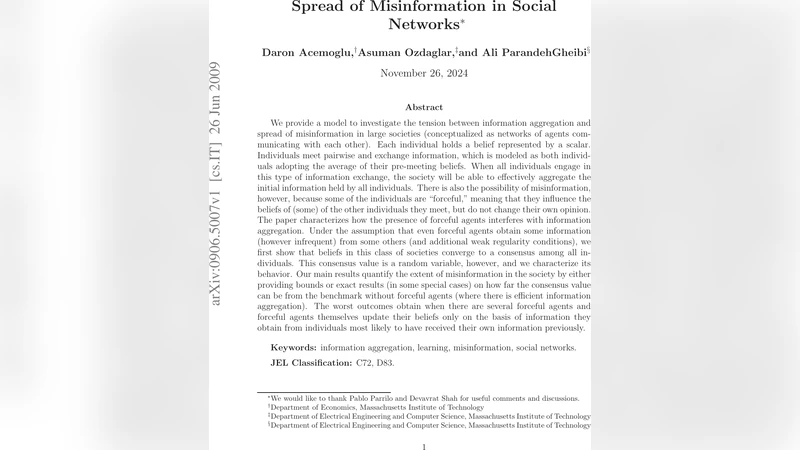
We provide a model to investigate the tension between information aggregation and spread of misinformation in large societies (conceptualized as networks of agents communicating with each other). Each individual holds a belief represented by a scalar. Individuals meet pairwise and exchange information, which is modeled as both individuals adopting the average of their pre-meeting beliefs. When all individuals engage in this type of information exchange, the society will be able to effectively aggregate the initial information held by all individuals. There is also the possibility of misinformation, however, because some of the individuals are “forceful,” meaning that they influence the beliefs of (some) of the other individuals they meet, but do not change their own opinion. The paper characterizes how the presence of forceful agents interferes with information aggregation. Under the assumption that even forceful agents obtain some information (however infrequent) from some others (and additional weak regularity conditions), we first show that beliefs in this class of societies converge to a consensus among all individuals. This consensus value is a random variable, however, and we characterize its behavior. Our main results quantify the extent of misinformation in the society by either providing bounds or exact results (in some special cases) on how far the consensus value can be from the benchmark without forceful agents (where there is efficient information aggregation). The worst outcomes obtain when there are several forceful agents and forceful agents themselves update their beliefs only on the basis of information they obtain from individuals most likely to have received their own information previously.
💡 Research Summary
The paper develops a rigorous mathematical model to study the tension between efficient information aggregation and the spread of misinformation in large societies represented as networks of interacting agents. Each agent holds a scalar belief. When two agents meet, they exchange information by both adopting the average of their pre‑meeting beliefs—a standard “pairwise averaging” rule. In a purely averaging network, repeated interactions guarantee that all agents converge to the same value, which is exactly the weighted average of the initial beliefs; thus the system perfectly aggregates dispersed information.
The novelty lies in introducing “forceful” agents. A forceful agent never updates its own belief; instead, when it meets another agent, it imposes its current belief on the counterpart, which then averages the forceful belief with its own. Forceful agents may occasionally receive information from others, but this occurs with a low probability (denoted ε). The authors assume only mild regularity conditions on the underlying graph (connectedness, aperiodicity) and on the stochastic process governing meetings.
The first major result shows that despite the asymmetry introduced by forceful agents, the belief dynamics still form a primitive stochastic matrix, guaranteeing almost‑sure convergence to a consensus. However, the consensus is now a random variable whose expectation is no longer the simple average of the initial beliefs. Instead, the stationary distribution of the transition matrix places disproportionate weight on forceful agents, so their initial beliefs heavily influence the final outcome.
To quantify the distortion, the paper derives bounds that depend on three key parameters:
- Proportion of forceful agents (p). Larger p increases the potential deviation.
- External update probability (ε). Higher ε dilutes the forceful influence because forceful agents occasionally incorporate external information.
- Algebraic connectivity (λ₂) of the underlying graph. A higher λ₂ (more robust connectivity) facilitates rapid mixing of information, reducing the impact of any single subgroup.
The authors prove an inequality of the form
|Consensus – IdealAverage| ≤ C·p·(1‑ε)/λ₂,
where C is a constant determined by the graph topology. This bound captures the intuition that misinformation spreads most severely when forceful agents are numerous, rarely update, and are embedded in poorly connected regions of the network.
Special cases are examined in detail. When forceful agents form a tightly‑connected clique that is linked to the rest of the network by only a few edges, the consensus can be expressed exactly as a weighted average of the clique’s mean belief and the mean belief of the remaining agents. In the extreme limit ε → 0, the clique essentially becomes an “information sink,” and the final consensus is dominated by its initial average, representing the worst‑case misinformation scenario.
The paper also explores time‑varying ε, modeling situations where forceful agents become gradually more receptive to external information. Simulations and analytical arguments show that early‑stage misinformation can create a persistent bias that decays only slowly, highlighting the importance of early interventions.
From a policy perspective, the results suggest three practical levers to mitigate misinformation:
- Increase network connectivity (raise λ₂) by encouraging cross‑group interactions, which speeds up mixing and reduces the weight of any forceful subgroup.
- Boost the frequency of external updates for forceful agents (increase ε) through fact‑checking services, authoritative broadcasts, or algorithmic nudges that expose them to diverse viewpoints.
- Limit the concentration of forceful agents in central positions of the network, perhaps by redistributing influence or by regulating platforms that enable a small set of users to dominate discourse.
Overall, the paper provides a comprehensive theoretical framework that bridges classic opinion‑dynamics models with realistic features of modern social media—namely, the presence of highly influential, stubborn actors. By quantifying how network structure and behavioral parameters shape the magnitude of misinformation, it offers both deep analytical insights and actionable guidance for researchers, platform designers, and policymakers concerned with preserving the integrity of collective information processing.
Comments & Academic Discussion
Loading comments...
Leave a Comment