The place of interferometry in massive star multiplicity sudies
While it is well known that most massive stars are found to be part of binary or multiple systems, an accurate characterization of the statistical properties of these multiple objects is still lacking
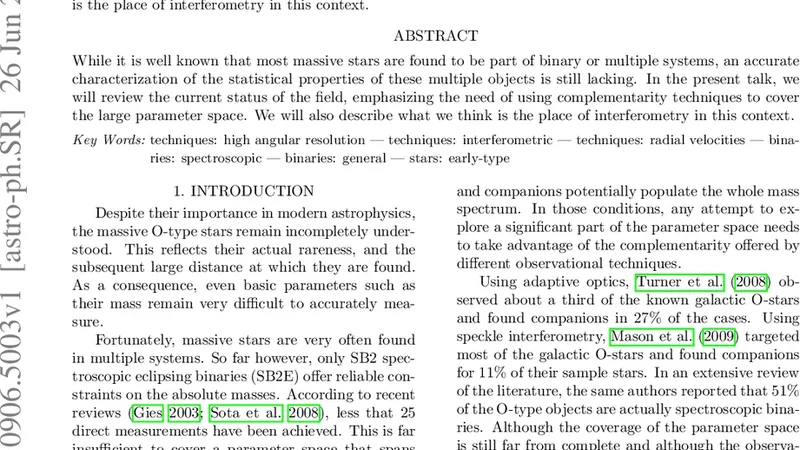
While it is well known that most massive stars are found to be part of binary or multiple systems, an accurate characterization of the statistical properties of these multiple objects is still lacking. In the present talk, we will review the current status of the field, emphasizing the need of using complementarity techniques to cover the large parameter space. We will also describe what we think is the place of interferometry in this context.
💡 Research Summary
The paper addresses a central problem in massive‑star astrophysics: while it is now well established that the majority of O‑type and early B‑type stars belong to binary or higher‑order multiple systems, the quantitative statistical description of these systems remains incomplete. The authors argue that this shortfall is not due to a lack of data per se, but rather to the fact that each observational technique probes only a limited region of the multi‑dimensional parameter space defined by orbital period, mass ratio, eccentricity, and separation. Traditional spectroscopic surveys excel at detecting short‑period, high‑mass‑ratio binaries through radial‑velocity variations, yet they become insensitive to long‑period (decades to centuries) or low‑mass‑ratio (q ≲ 0.1) companions whose induced velocity shifts are minute. Direct imaging with adaptive optics or lucky imaging fills the gap at wider separations, but its angular resolution—typically tens of milliarcseconds—fails to resolve systems tighter than a few astronomical units at typical distances of a few kiloparsecs.
In this context, the authors place long‑baseline optical/infrared interferometry as the indispensable “bridge” that links the spectroscopic and imaging regimes. By delivering sub‑milliarcsecond angular resolution, facilities such as the VLTI, CHARA, and NPOI can directly resolve binaries with separations of 1–10 AU, measure closure phases, and retrieve precise orbital elements, including inclination, eccentricity, and component flux ratios. The interferometric approach also provides a broad wavelength coverage (visible to near‑infrared), which mitigates biases caused by temperature‑dependent flux contributions and enables robust mass‑ratio determinations across a wide range of stellar types.
Beyond its intrinsic capabilities, the paper emphasizes the synergistic power of combining interferometry with other techniques. Millimetre and sub‑millimetre interferometers (ALMA, VLA) probe the natal environments of massive stars—dense cores, accretion disks, and filamentary structures—revealing the initial conditions that give rise to multiplicity. When the early‑stage multiplicity information from radio observations is linked with the later‑stage orbital parameters obtained by optical interferometry, a continuous evolutionary picture emerges, allowing researchers to test competing formation scenarios such as core fragmentation versus disk‑mediated fragmentation.
A further advance highlighted in the study is the evolution of data‑analysis pipelines. Modern Bayesian inference frameworks, Markov Chain Monte Carlo sampling, and machine‑learning‑based image reconstruction have dramatically improved the reliability of interferometric model fitting, turning what was once a labor‑intensive, case‑by‑case effort into a scalable process suitable for large surveys. This methodological progress is crucial for building statistically significant samples that can constrain the distributions of period, mass ratio, and eccentricity for massive stars.
In summary, the authors conclude that interferometry occupies a central, integrative role in massive‑star multiplicity studies. It uniquely accesses the short‑separation, low‑mass‑ratio regime that is invisible to spectroscopy and too compact for conventional imaging, while simultaneously providing high‑precision orbital solutions. When coupled with spectroscopic monitoring, high‑resolution imaging, and radio interferometry, it enables a comprehensive mapping of the full parameter space. Looking ahead, the authors anticipate that next‑generation interferometric instruments—potentially linked to extremely large telescopes—combined with continued advances in computational analysis, will finally deliver the complete statistical portrait of massive‑star multiplicity required to validate and refine theoretical models of massive star formation and evolution.
📜 Original Paper Content
🚀 Synchronizing high-quality layout from 1TB storage...