The Breaking Strain of Neutron Star Crust and Gravitational Waves
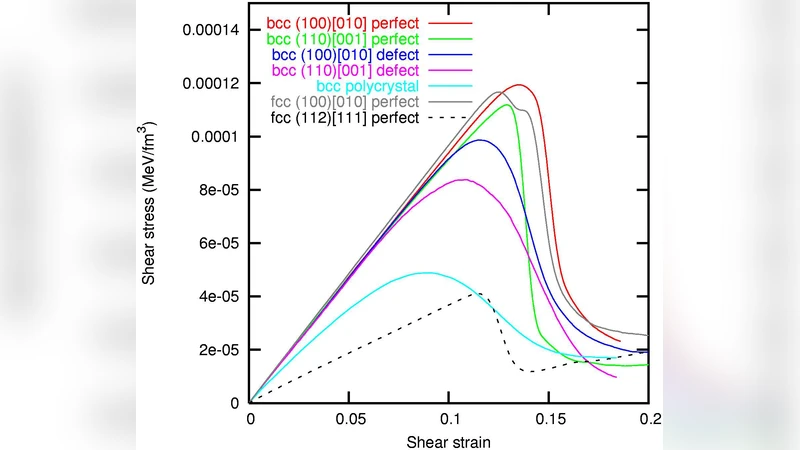
Mountains on rapidly rotating neutron stars efficiently radiate gravitational waves. The maximum possible size of these mountains depends on the breaking strain of neutron star crust. With multi-million ion molecular dynamics simulations of Coulomb solids representing the crust, we show that the breaking strain of pure single crystals is very large and that impurities, defects, and grain boundaries only modestly reduce the breaking strain to around 0.1. Due to the collective behavior of the ions during failure found in our simulations, the neutron star crust is likely very strong and can support mountains large enough so that their gravitational wave radiation could limit the spin periods of some stars and might be detectable in large scale interferometers. Furthermore, our microscopic modeling of neutron star crust material can help analyze mechanisms relevant in magnetar giant and micro flares.
💡 Research Summary
The authors investigate the mechanical strength of neutron‑star crust by performing large‑scale molecular‑dynamics simulations of Coulomb crystals that represent the ion lattice in the outer layers of a neutron star. Using systems containing up to several million ions, they apply shear deformation to pure single‑crystal lattices and to lattices that contain realistic imperfections such as charge‑heterogeneous impurities, vacancies, and grain boundaries. For the pristine crystal the stress‑strain curve remains essentially linear up to failure, and the breaking strain (σ_break) reaches values of 0.1–0.2, an order of magnitude larger than previous astrophysical estimates (∼10⁻³) and far above the strength of terrestrial materials. When impurities, defects, or polycrystalline grain boundaries are introduced, the breaking strain is only modestly reduced, staying in the range 0.08–0.12. The failure mode is collective: thousands of ions move cooperatively, allowing the charge distribution to rearrange smoothly rather than producing a localized crack. This collective behavior explains why the macroscopic strength is insensitive to microscopic disorder.
By inserting the obtained breaking strain into models of rapidly rotating neutron stars, the authors show that the crust can support “mountains” with heights of order 10⁻⁶–10⁻⁵ R_NS (R_NS≈10 km). Such deformations correspond to mass quadrupoles that generate continuous gravitational‑wave emission with strain amplitudes h≈10⁻²⁶–10⁻²⁵ for sources at 1 kpc. These amplitudes are at the threshold of the current Advanced LIGO/Virgo detectors and well within the reach of planned third‑generation interferometers (Einstein Telescope, Cosmic Explorer). Consequently, gravitational‑wave back‑reaction could limit the spin frequencies of the fastest pulsars, potentially explaining observed spin clustering around a few hundred hertz.
The paper also connects crustal strength to magnetar activity. A strong, yet brittle, crust can store large elastic stresses; when the stress exceeds the collective breaking threshold, a rapid rearrangement of the ion lattice releases both elastic and magnetic energy, producing giant flares or smaller bursts. The collective failure mechanism suggests that such events could be accompanied by short gravitational‑wave bursts, offering a multimessenger signature.
In summary, the study provides the first quantitative, microscopic estimate of neutron‑star crust breaking strain, demonstrating that it is surprisingly high (≈0.1) and only weakly affected by realistic imperfections. This result has three major implications: (1) neutron‑star mountains can be large enough to generate detectable continuous gravitational waves; (2) gravitational‑wave emission may play a significant role in the spin evolution of rapidly rotating neutron stars; and (3) the same strong crustal physics underlies magnetar flare mechanisms, opening the possibility of joint gravitational‑wave and high‑energy electromagnetic observations. Future work should incorporate temperature, magnetic‑field, and superfluid effects, and compare the predicted waveforms with data from current and next‑generation detectors.
Comments & Academic Discussion
Loading comments...
Leave a Comment