Gravitational Wave Detection Using Redshifted 21-cm Observations
A gravitational wave traversing the line of sight to a distant source produces a frequency shift which contributes to redshift space distortion. As a consequence, gravitational waves are imprinted as density fluctuations in redshift space. The gravit…
Authors: Somnath Bharadwaj, Tapomoy Guha Sarkar (IIT, Kharagpur)
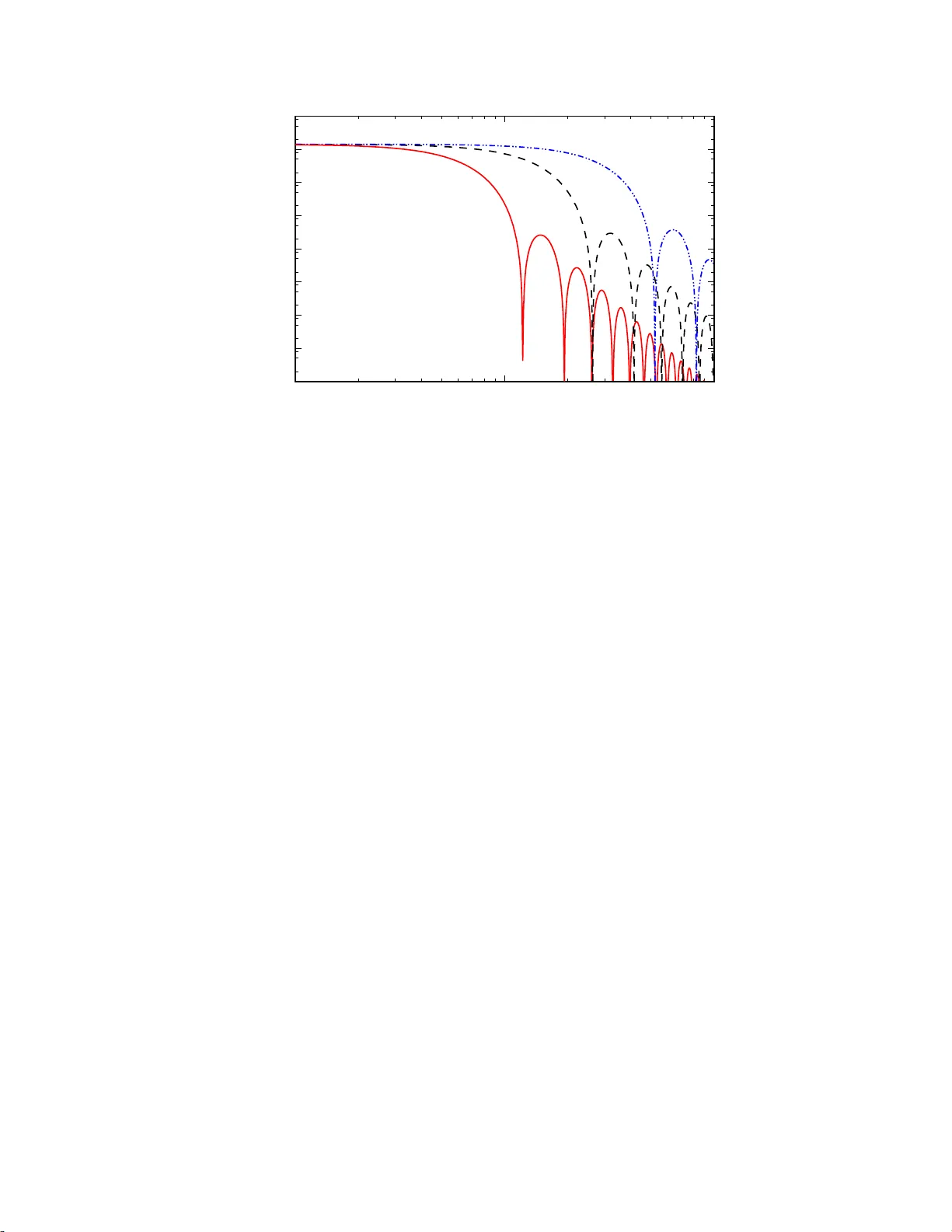
Gra vitational W a v e Detecti on Using Redshifted 21 -cm Observ ations Somnath Bh ar a dw a j 1 , 2 ∗ and T apomoy Guha Sark ar 2 † 1 Dep artment of Physics and Mete or olo gy I .I.T. Khar agpur, 721302, I ndia and 2 Centr e for The or etic al Studies, I.I.T. Khar agpur, 721302, Ind ia Abstract A gra vitational wa ve tra v ersin g the line of sigh t to a distant source pro du ces a frequen cy sh ift whic h con tributes to redshift space distortio n. As a consequence, gra vitational w av es are imp rint ed as densit y fluctuations in redshift space. The gra vitational wa v e con trib ution to the r edshift space p o wer sp ectrum has a differen t µ d ep endence as compared to the dominant co ntribution from p eculiar v elocities. This, in principle, allo ws the t w o signals to b e se p arated. The p rosp ect of a detec tion is most fa v ourable at the highest obs erv able redshift z . Ob serv ations of redshifted 21-cm radiation from neutral hydrogen (HI) h old the p ossibilit y o f probing v ery high redshifts. W e consider the p ossibilit y of detecting pr imordial gra vitatio nal w a ves using the redshift space HI p o wer sp ectrum. Ho wev er, we fin d that the gra vitational w a ve signal, though pr esen t, will not b e detectable on sup er-h orizon scales b eca us e of cosmic v ariance and on sub-horizon scales where the signal is highly supp ressed. P ACS n umbers: 98.8 0.-k, 04.30 .-w, 98.7 0.Vc ∗ Electronic address: somnathb@ iitkg p.ac.in † Electronic a ddress: tapomoy @cts. iitkgp.ernet.in 1 I. INTR ODUCT ION Primordial gravitational w a ve s are a robust prediction of inflation [1, 2]. These sto c hastic tensor p erturbations are generated b y the same mec hanism a s the matter de nsity fluctua- tions, t he ratio of the tensor p erturbations to scalar p erturbations b eing quan tified through the tensor-to-scalar ratio r . Detecting the s to c hastic gra vitational w av e bac kground is of considerable in terest in cosmology since it carr ies v aluable infor mation ab out the v ery early univ erse. The cosmological bac kground of gravitational w a ve has its signature imprin ted on the CMBR tempera t ur e [3 ] and p olarizatio n [4] anisotropy maps. Curren t CMBR observ a- tions (WMAP-5 Y ear data) imp o se an upper b ound ( r < 0 . 43) whic h is further tighten ed ( r < 0 . 22) if com bined CMBR, BA O and SN dat a is used [5]. Detecting the gravitational w a ve ba c kground is one of the imp ortant aims of up coming PLANCK [6 ] mission and future p olarization based exp eriments like CMBPOL [7]. A g ra vitational w a ve t r a v ersing the line o f sigh t to a distan t source will contribute to its redshift in addition to that caused b y Hubble expansion and its p eculiar v elo city . This will pro duce a redshift space distortion in a manner similar to that caused by p eculiar v elo cities [8]. The effect arises due to the fa ct t ha t dis ta nces are inferred from the spectroscopically measured redshifts. As a consequence, a g r avitational wa v e will ma nif est itself as a densit y fluctuation in redshift space. In this pap er w e prop ose this as a p ossible tec hnique to detect the primordial gravitational w av e ba c kground. While one could consider the p ossibilit y of detecting this at lo w redshifts ( z ∼ 1) us- ing galaxy and quasar redshift surv eys, w e shall show that the prosp ects are m uch more fa vourable if the redshift is pushed to a v alue as high as p ossible. Observ ations of redshifted 21-cm radiation from neutral h ydrogen (HI) can b e used to measure the p ow er sp ectrum of densit y fluctuations a t v ery high redshifts extending all the w a y to the D ark Ages (30 < z < 200) [9]. Redshift space dis tortio ns make an imp orta n t con tribution to this signal [10]. W e in ve stigate the p ossibilit y of using this to detect pri- mordial gra vitational w av es. W e note that the imprint of gra vitationa l w a ves on the 21-cm signal fr o m the Dark Ages has a lso b een considered in an ealier work [11]. 2 I I. FORMULA TION The radial comp onent of p eculiar v elo city in tro duces a redshift z v = v /c in excess of the cosmological redshift w hich arises due to the expansion of the univers e. This distorts our view of the matter distribution in the three dimensional redshift space, where the ra dia l distance is inferred fro m the measured redshift. As a consequence the density con trast δ = δ ρ/ρ measured in redshift space δ s is differen t from the actual densit y contrast δ r , and [12] δ s = δ r − c aH ( a ) ∂ z v ∂ x (1) where H ( a ) is the Hubble parameter and x the como ving distance to the source. W e see that an y coheren t v elo cit y pa t tern (in- f all or outflow ) manifests itself as a densit y fluctuation in redshift space. This takes a pa rticularly con v enien t form in F o urier space if w e assume that the p eculiar v elo cities are pro duced b y the densit y fluctuations δ r . W e t hen ha ve ∆ s ( k ) = (1 + f µ 2 )∆ r ( k ) (2) where ∆ s and ∆ r are the F ourier transforms o f δ s and δ r resp ectiv ely , f = d ln D /d ln a ≈ Ω 0 . 6 m , D b eing the grow ing mo de of densit y p erturbations and µ = ˆ n · k /k is the cosine of the angle b etw een t he line o f sight ˆ n and the w av e vec to r k . It f o llo ws that the p ow er sp ectrum of densit y fluctuations in redshift space P s ( k ), is related to its real space coun terpart P r ( k ) as [8] P s ( k ) = (1 + f µ 2 ) 2 P r ( k ) (3) A gravitational w av e h ab ( ~ x, η ) whic h is a tensor metric p erturbation ds 2 = a 2 c 2 dη 2 − ( δ ab + h ab ) dx a dx b (4) mak es an a dditio nal con tributio n [13 ] z h = 1 2 n a n b Z η 0 η e h ′ ab ( ~ x, η ) dη (5) to the redshift along the line of sight of the unit v ector ˆ n . Here prime denotes a partia l deriv ative with respect to η , η e and η 0 resp ectiv ely refer to the photon b eing emitted and the prese nt epo c h when the photon is observ ed, and ~ x = ˆ n ( η 0 − η ) is the photon’s spatial tra jectory . Considering z h the gra vitational w av e c ontribution to the reds hift, w e hav e an additional con tribution δ s h = − c aH ∂ z h ∂ x (6) 3 to δ s the densit y contrast in redshift space (eq. 1). Simplifying this using x = c ( η 0 − η e ) w e ha v e δ s h = 1 2 aH n a n b h ′ ab (7) W e consider the primor dia l gravitational wa ves whic h we expand in F ourier mo des as h ab ( ~ x, η ) = Z ˜ h ab ( k , η ) e i k · ~ x d 3 k (2 π ) 3 (8) and decomp o se ˜ h ab ( k , η ) in terms of the t wo p olarization tensors e + ab and e × ab as [14] ˜ h ab ( k , η ) = h ( k , η ) e + ab a + ( k ) + e × ab a × ( k ) p (2 π ) 3 P h ( k ) 2 . (9) Here h ( k , η ) quan tifies the temp oral evolution, and h ( k , η ) = 3 j 1 ( k cη ) / ( k cη ) in a matter dominated univ erse, j 1 b eing the spherical Bessel function of order unit y . The p olarization tensors are nor malized to e + ab e + ab = e × ab e × ab = 2 and e + ab e × ab = 0, P h ( k ) is the primordial gra vitationa l w a ve p ow er sp ectrum [5] and a × ( k ) , a + ( k ) are Gaussian random v ariables suc h that h ˜ h ∗ ab ( k , η ) ˜ h ab ( k ′ , η ) i = (2 π ) 3 δ 3 ( k − k ′ ) h 2 ( k , η ) P h ( k ) (10) Let us first consider a single F ourier mo de of g ra vitational w a v e with k along the z direction, and represen t the line of sigh t as ˆ n = sin θ (cos φ ˆ i + sin φ ˆ j ) + cos θ ˆ k . (11) W e can than express eq. (7) as ∆ s ( k , η ) = h ′ 4 aH sin 2 θ cos 2 φ a + ( k ) + sin 2 φ a × ( k ) p (2 π ) 3 P h ( k ) . (12) This can be e quiv alen tly in terpreted with ˆ n fixed and the direction of k v arying. W e us e this to calculate P s h ( k ) the gravitational wa v e con tribution t o the p ow er spectrum of densit y fluctuations in redshift space P s h ( k ) = sin 4 θ ( h ′ 4 aH 2 P h ( k ) ) (13) Th us the tota l p ow er sp ectrum of densit y fluctuatio ns in redshift space is P s ( k ) = (1 + f µ 2 ) 2 P r ( k ) + (1 − µ 2 ) 2 P r h ( k ) (14) 4 k Mpc −1 200 50 z=10 ~ r __ r 1e−08 1e−07 1e−06 1e−05 0.0001 0.001 0.01 0.1 1 0.0001 0.001 0.01 FIG. 1: This sh o ws the ratio ˜ r /r at different z . This is p redicted to hav e a constan t v alue ∼ 0 . 16 on sup er-horizon scales in the Ω m = 0 . 3 LC DM mo del considered her e. where P r h ( k ) refers to the terms in { } in eq. (13). Here P r ( k ) and P r h ( k ) are resp ective ly the matter and gra vitational wa v e contributions t o the p o w er sp ectrum of densit y fluctuations in redshift space. Both P r ( k ) and P r h ( k ) are to b e ev aluated at the ep o ch corresp onding to the redshift under observ ation. The contributions from P r ( k ) and P r h ( k ) hav e differen t µ dep endence. This, in principle, can b e used to separately estimate the gravitational w av e and the matter con tributions from the observ ed redshift space pow er sp ectrum. While the matter c ontribution is ma ximum when k and ˆ n are parallel, t he grav itatio nal w av e con tribution p eaks when the t w o are m utually p erp endicular. I I I. RESUL TS W e use ˜ r = P r h ( k ) /P r ( k ) to quan tify the ratio of tensor p erturbations to sc alar p ertur- bations in t he redshift space pow er sp ectrum. Assu ming n s = 1, n T ≪ 1, the v alue of ˜ r is constan t on sup er- horizon scales ( k cη ≪ 1). This v alue is ˜ r = r / 4 if Ω m = 1, and somewhat smaller (Figure 1) with ˜ r = 0 . 16 r f or Ω m = 0 . 3 in the LCDM mo del. Gravitational wa v es deca y inside the ho rizon whereas matter p erturbations grow on these scales. The ratio ˜ r ( k ) is oscillatory and is sev erely suppressed on sub-horizon scales ( k c η ≪ 1). 5 The pr o sp ect of detecting the gra vitational w a v e signal is most fav o urable on sup er- horizon scales ( k ≤ k H = ( cη ) − 1 ). The k range amenable for such obse rv ations (Figure 1) increases with redshift z (smaller horizon cη ). Observ ations of redsh ift ed 21-cm radiation hold the p oten tial of measuring the redshift space p o w er sp ectrum in the z range (30 − 200)[9, 10], where the pre-reionization HI signal will b e seen in absorption against the CMBR. Gra vitational w a ves will mak e a ∼ r × 1 6 % contribution to the HI signal on scales k ≤ k H . IV. FEASIBILITY O F DETEC TION The cosmological HI signal will b e buried in foregrounds [15– 19] whic h are exp ected to b e orders o f magnitude larger than the signal. The foregrounds are con tin uum sources wh ose sp ectra are exp ected to b e correlated o v er large frequency separatio ns, whereas the HI signal, a line emiss ion, is exp ected to b e uncorrelated b ey o nd a frequency separation. While t his, in principle, can b e used to separate the HI signal from the foregr o unds, it should b e noted that the frequency s eparatio n b eyond whic h the HI signal becomes unc orr elat ed increase s with z and angular scale. This is a p otential problem for the detection of the gr avitational w a ve signal. In the subseque nt discuss ion w e hav e assumed that the fo regrounds ha ve b een remo v ed from the HI signal. The distinctly differe nt µ dep endence of the scalar and gra vitational wa v e components of the redsh ift space p ow er sp ectrum can in principle b e used to se para te the t w o signals. Expressing the µ dep endence [20] as P s ( k , µ ) = P 0 ( k ) + P 2 ( k ) µ 2 + P 4 ( k ) µ 4 , the gra vitational w a ve comp onen t can b e estimated us ing P r h ( k ) = [ P 0 ( k ) − P 2 ( k )] / 2. F or a cosmic v ariance limited experiment, the error in P 2 ( k ) and P 0 ( k ) w ould b e δ P ( k ) /P ( k ) ∼ 1 / p N ( k ) [17, 2 1 – 24], where N ( k ) denotes the n um b er of k mo des within the como ving volume of the surv ey . Th us N ( k ) > ˜ r − 2 ∼ 10 4 mo des w ould b e needed for a detection of the gra vitational w av e signal. The n um b er of mo des with a comoving w a v e n um b er betw een k and k + dk is dN ( k ) = k 2 dk V / (2 π ) 2 , where V is the como ving surv ey v olume. Assuming a surv ey b et w een z = 20 to z = 20 0 , and using a k bin dk = k / 10, w e hav e N ( k ) = 1 0 for k = k H ∼ 0 . 0 02 Mp c − 1 . It is, in principle, p ossible to carry out HI observ ations in the entire z range z = 0 to z = 200 [15] and thereb y increase t he volume . Of the en tire surv ey v olume V 0 , for a mo de k 6 only a v olume V ( k ) = V 0 − (4 π / 3)( cη 0 − k − 1 ) 3 where the mo de is sup er- ho rizon con tributes to the signal. F urther, the largest mo de k max is the one that en tered the horizon at z = 200, and the smallest mo de k min has w av elength comparable to the radius of the surv ey volume. W e t hen hav e, assuming a full sky surv ey , N = (2 π 2 ) − 1 Z k max k min V ( k ) k 2 dk (15) whic h give s N ∼ 100. The n umber o f independent mo des is to o small for a measuremen t at a lev el of precision that will allow the gra vitational w av e componen t to be dete cted. In conclusion, we note that the gravitational wa ve signal, though presen t, will not b e detectable on sup er-horizon scales b ecause o f cosmic v ariance and on sub-horizon scales where the signal is highly suppressed . [1] Grishch uk, L.P .. So v. Phys. JETP , 40, 409 (1975) [2] Starobinsky , A. A., Phys. Lett. B 91, 99 (1980) [3] Rub ako v, V. A., S azhin , M. V., & V ery askin, A. V., Phys. Lett., B115 , 189 (1982); F abb ri, R., & P ollo c k, M. d., Phys. Lett., B125, 445 (1983) ; Ab ott, L. F., & Wise, M. B., Nucl. Ph ys., B244, 541 ( 1984) ; Starobinsky , A. A., Sov. Astron. Lett., 11, 133 (1985); Souradeep, T., & Sahni, V., Mo dern Ph ysics Letters A, 7, 3541 (1992); Crittenden, R., Bond, J. R., Da vis, R. L., E f stathiou, G., & Steinhardt, P . J., Phys. Rev. Lett., 71, 324 (1993) [4] Bask o, M. M., & Polnarev, A. G., MNRAS, 191, 207 (1980) ; Bond, J. R., & Efstathiou, G., ApJ, 285, L4 (1984 ); C rittenden, R., Bond, J. R., Da vis, R. L., Efstathiou, G., & Steinh ardt, P . J., Ph ys. R ev. Lett., 71, 324 (1993); Coulson, D., Cr ittenden , R . G., & T urok, N. G., Ph ys. Rev. Lett., 73, 2390 (1994) [5] Komatsu, E., et al., arXiv:0803.0 547 (2008) [6] URL h ttp://www.rssd .esa.in t/index.php?p ro ject=planc k [7] Baumann, D., et al., arXiv:0811.3 919 (2008) [8] Kaiser, N., MNRAS, 227, 1 (1987) [9] Lo eb, A., & Zaldarriaga, M., Ph ysical Review Letters, 92, 211301 (2004) [10] Bharadwa j, S., & Ali, S. S., MNRAS, 352, 142 (2004) [11] Lewis, A., & Challinor, A. PRD, 76, 08300 5 (2007) 7 [12] Hamilton, A. J . S. 1998, Th e Evo lving Un iv erse, 231, 185 [13] Mukhanov, V., P hysical f oundations of cosmology , C am bridge Univ ersit y Pr ess, pp 392 (2005) [14] Bharadwa j, S., Mun shi, D., & Souradeep, T ., PRD, 56, 4503 (1997) [15] Bharadwa j, S., & Ali, S. S., MNRAS, 356, 1519 ( 2005) [16] Sant os, M. G., C o ora y , A., & Kno x, L. ApJ, 625, 575 (2005) [17] McQuinn, M., Zahn, O., Zaldarriaga, M., Hernqu ist, L., & F ur lanetto, S. R. ApJ, 653, 815 ( 2006) [18] Datta, K. K., Ch oudhury , T. R., & Bharadwa j, S. MNRAS, 378, 119 (2007) [19] Ali, S . S., Bharadwa j, S., & Ch engalur, J. N. MNRAS, 385, 2166 (2008) [20] Bark ana, R., & L o eb, A. ApJ L, 624, L65 (2005) [21] Seo, H.-J., & Eisenstein, D. J . , ApJ, 598, 720 (2003) [22] Mao, Y., T egmark, M., McQuinn , M., Zaldarriaga, M., & Zahn, O. PRD, 78, 02352 9 (2008) [23] Lo eb, A., & Wyithe, J. S . B. Physic al Review Letters, 100, 161301 (2008) [24] Pritc hard , J . R., & L o eb, A. , PRD, 78, 103511, (2008 ) 8
Original Paper
Loading high-quality paper...
Comments & Academic Discussion
Loading comments...
Leave a Comment