Transfer maps and nonexistence of joint determinant
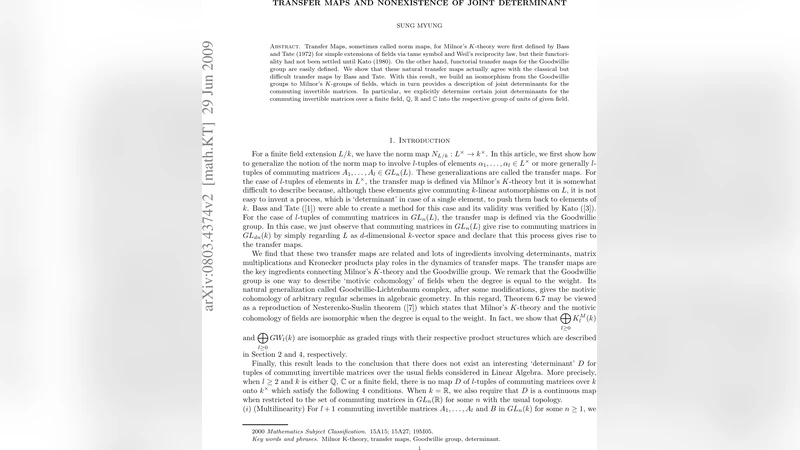
Transfer Maps, sometimes called norm maps, for Milnor’s $K$-theory were first defined by Bass and Tate (1972) for simple extensions of fields via tame symbol and Weil’s reciprocity law, but their functoriality had not been settled until Kato (1980). On the other hand, functorial transfer maps for the Goodwillie group are easily defined. We show that these natural transfer maps actually agree with the classical but difficult transfer maps by Bass and Tate. With this result, we build an isomorphism from the Goodwillie groups to Milnor’s $K$-groups of fields, which in turn provides a description of joint determinants for the commuting invertible matrices. In particular, we explicitly determine certain joint determinants for the commuting invertible matrices over a finite field, the field of rational numbers, real numbers and complex numbers into the respective group of units of given field.
💡 Research Summary
The paper investigates two seemingly different notions of transfer (or norm) maps: the classical ones defined by Bass and Tate for Milnor K‑theory and the more straightforward functorial transfer maps that arise naturally in the Goodwillie groups. After recalling the definition of Milnor K‑groups Kⁿᴹ(k) and establishing basic identities for Milnor symbols (multilinearity, skew‑symmetry, {a,−a}=0, etc.), the authors describe the higher tame symbol ∂ᵥ and the Bass‑Tate transfer Nₖᵥ/k. Kato’s work is invoked to guarantee that these transfers are functorial for arbitrary finite extensions.
In parallel, the Goodwillie groups GWₗ(k) admit a very concrete transfer: viewing a finite field extension L/k as a k‑vector space of dimension d, a commuting l‑tuple of invertible matrices in GLₙ(L) yields a commuting l‑tuple in GL_{dn}(k) via the Kronecker product and block‑diagonal embedding. This construction automatically satisfies the required functoriality.
The central technical achievement of the paper is to prove that the two transfer maps coincide. This is done by a careful analysis of Milnor symbols, especially the intricate relations captured in Proposition 2.4 and Lemma 2.3, which allow the authors to rewrite transfer images as sums of symbols of the form {−1,…,−1} (2‑torsion elements). Consequently, the graded rings ⨁ₗKⁿᴹ(k) and ⨁ₗGWₗ(k) are shown to be isomorphic as graded rings with compatible product structures (Theorem 6.7). This result can be viewed as a concrete incarnation of the Nester‑enko‑Suslin theorem that identifies Milnor K‑theory with motivic cohomology in the weight‑equal‑degree case.
Armed with this isomorphism, the authors turn to the problem of defining a “joint determinant’’ D for l‑tuples of commuting invertible matrices over a field k. The desired map D : (GLₙ(k))ˡ → k× should satisfy four natural axioms:
- Multilinearity – inserting a product of two commuting matrices in any slot splits the value of D multiplicatively.
- Block‑diagonal property – D of a block‑diagonal tuple equals the product of the D‑values of the blocks.
- Similarity invariance – D is unchanged under simultaneous conjugation by any invertible matrix.
- Polynomial homotopy invariance – for matrices depending polynomially on a parameter t, the values at t=0 and t=1 coincide.
Using the Milnor‑Goodwillie isomorphism, the authors translate these axioms into statements about Milnor K‑theory. For l ≥ 2, the Milnor groups Kⁿᴹ(k) have very restrictive structures: over ℚ, ℝ, ℂ and finite fields they are either uniquely divisible (ℂ) or contain non‑trivial 2‑torsion (ℝ, finite fields). By examining the consequences of the four axioms on the image of D in Kⁿᴹ(k), they prove that no such map can exist for any of these fields. In the real case, continuity with respect to the usual topology on GLₙ(ℝ) is also required, and the argument still rules out a continuous joint determinant. The non‑existence results are recorded as Corollaries 7.3, 7.4, 7.5 and follow from Theorem 7.2 together with the known structure of Milnor K‑groups in the respective settings.
Thus the paper achieves two major goals: it establishes the precise compatibility between the classical Bass‑Tate transfer for Milnor K‑theory and the elementary Goodwillie transfer, and it uses this compatibility to settle a natural question about the existence of a multi‑matrix determinant. The negative answer for the usual fields underscores deep connections between algebraic K‑theory, motivic cohomology, and linear algebra, and suggests that any meaningful generalisation of the determinant to several commuting matrices must either abandon one of the natural axioms or work in a more exotic algebraic context.
Comments & Academic Discussion
Loading comments...
Leave a Comment