Collisional and Rotational Disruption of Asteroids
Asteroids are leftover pieces from the era of planet formation that help us understand conditions in the early Solar System. Unlike larger planetary bodies that were subject to global thermal modification during and subsequent to their formation, these small bodies have kept at least some unmodified primordial material from the solar nebula. However, the structural properties of asteroids have been modified considerably since their formation. Thus, we can find among them a great variety of physical configurations and dynamical histories. In fact, with only a few possible exceptions, all asteroids have been modified or completely disrupted many times during the age of the Solar System. This picture is supported by data from space mission encounters with asteroids that show much diversity of shape, bulk density, surface morphology, and other features. Moreover, the gravitational attraction of these bodies is so small that some physical processes occur in a manner far removed from our common experience on Earth. Thus, each visit to a small body has generated as many questions as it has answered. In this review we discuss the current state of research into asteroid disruption processes, focusing on collisional and rotational mechanisms. We find that recent advances in modeling catastrophic disruption by collisions have provided important insights into asteroid internal structures and a deeper understanding of asteroid families. Rotational disruption, by tidal encounters or thermal effects, is responsible for altering many smaller asteroids, and is at the origin of many binary asteroids and oddly shaped bodies.
💡 Research Summary
The paper provides a comprehensive review of the processes that modify and ultimately destroy asteroids, focusing on two dominant mechanisms: collisional disruption and rotational disruption. It begins by emphasizing that asteroids are the surviving remnants of the planet‑formation epoch, preserving primitive solar‑nebula material that larger bodies have largely lost through global thermal evolution. Despite this, asteroids have undergone extensive alteration over the age of the Solar System, as evidenced by the remarkable diversity observed in shape, bulk density, surface morphology, and internal structure from spacecraft encounters such as OSIRIS‑REx (Bennu), Hayabusa2 (Ryugu), Dawn (Ceres, Vesta), and others.
Collisional Disruption
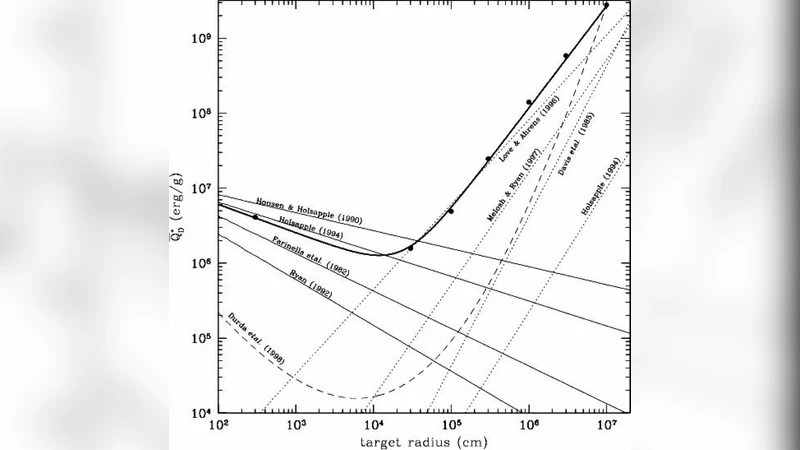
The review revisits the classic concept of the catastrophic disruption threshold, Q*D, and clarifies the transition between the strength‑dominated regime (small bodies where material strength controls breakup) and the gravity‑dominated regime (large bodies where self‑gravity governs fragment re‑accumulation). Recent advances in high‑resolution Smoothed Particle Hydrodynamics (SPH) combined with N‑body gravity codes have enabled the inclusion of realistic material properties: porosity, internal fractures, heterogeneous composition, and even laser‑induced weakening. These sophisticated models reproduce the observed size‑frequency distributions of asteroid families, the velocity dispersion of family members, and the prevalence of “rubble‑pile” remnants that re‑accumulate after a catastrophic impact. The paper highlights that the internal architecture—solid core versus fragmented mantle—strongly influences the outcome, and that the new models provide tighter constraints on family ages and the original impact conditions.
Rotational Disruption
The second major pathway discussed is rotational breakup, driven primarily by the YORP (Yarkovsky–O’Keefe–Radzievskii–Paddack) effect, which can spin up small asteroids over million‑year timescales. When the spin period drops below a critical value (typically 2–3 h for km‑scale bodies), the centrifugal stress exceeds the material’s shear strength, leading to surface shedding, internal rearrangement, or complete fission. The review details how shear strength, internal friction angle, and cohesion determine the exact critical spin rate, and it presents numerical simulations that capture mass loss, shape evolution, and the formation of binary systems. Tidal encounters with planets are also examined as a rapid spin‑up mechanism that can trigger immediate disruption or enhance YORP‑induced spin rates. Rotational disruption is identified as the primary driver behind the high fraction of binary asteroids, contact binaries, and oddly shaped objects such as “dog‑bone” or “spinning top” morphologies.
Observational Validation
Spacecraft data provide crucial validation for both disruption pathways. Bennu’s low bulk density and high macroporosity support the rubble‑pile re‑accumulation scenario after a collisional event, while Ryugu’s equatorial ridge and surface boulders are consistent with YORP‑driven spin‑up and mass shedding. Dawn’s observations of Vesta’s large impact basins and Ceres’ cryovolcanic features illustrate the spectrum of collisional outcomes across size scales. High‑resolution lidar and photometric monitoring have enabled direct measurement of spin‑rate changes, confirming YORP predictions for several near‑Earth asteroids.
Future Directions
The authors argue that progress will hinge on three fronts: (1) laboratory microgravity experiments that directly measure material strength and fragmentation thresholds under asteroid‑like conditions; (2) in‑situ laser‑impact experiments from orbiting platforms to replicate realistic impact energies and validate numerical scaling laws; and (3) the integration of machine‑learning techniques to predict fragment size distributions and to classify disruption signatures across large asteroid datasets. Such interdisciplinary efforts will refine our understanding of asteroid internal structures, improve age estimates for asteroid families, and inform planetary‑defense strategies as well as future resource‑extraction missions.
In summary, the paper synthesizes current knowledge on how collisions and rotational forces reshape the asteroid population, demonstrates how recent modeling and spacecraft observations have converged to reveal the underlying physics, and outlines a roadmap for the next generation of research that will deepen our insight into these small but scientifically vital Solar System bodies.
Comments & Academic Discussion
Loading comments...
Leave a Comment