Simbol-X Hard X-ray Focusing Mirrors: Results Obtained During the Phase A Study
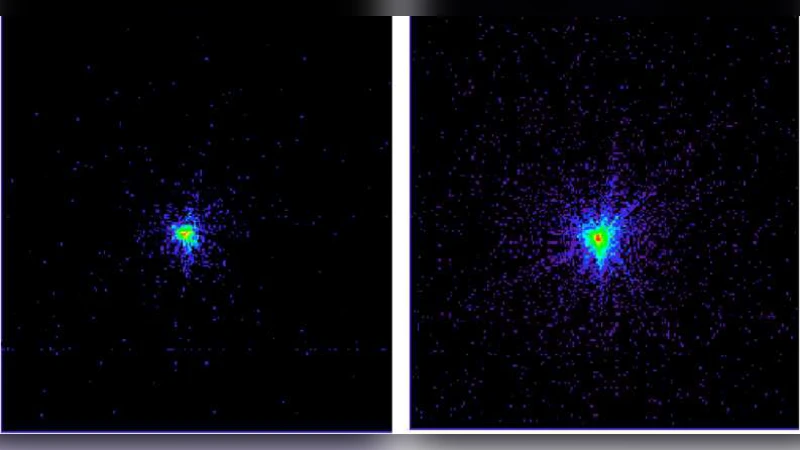
Simbol-X will push grazing incidence imaging up to 80 keV, providing a strong improvement both in sensitivity and angular resolution compared to all instruments that have operated so far above 10 keV. The superb hard X-ray imaging capability will be guaranteed by a mirror module of 100 electroformed Nickel shells with a multilayer reflecting coating. Here we will describe the technogical development and solutions adopted for the fabrication of the mirror module, that must guarantee an Half Energy Width (HEW) better than 20 arcsec from 0.5 up to 30 keV and a goal of 40 arcsec at 60 keV. During the phase A, terminated at the end of 2008, we have developed three engineering models with two, two and three shells, respectively. The most critical aspects in the development of the Simbol-X mirrors are i) the production of the 100 mandrels with very good surface quality within the timeline of the mission; ii) the replication of shells that must be very thin (a factor of 2 thinner than those of XMM-Newton) and still have very good image quality up to 80 keV; iii) the development of an integration process that allows us to integrate these very thin mirrors maintaining their intrinsic good image quality. The Phase A study has shown that we can fabricate the mandrels with the needed quality and that we have developed a valid integration process. The shells that we have produced so far have a quite good image quality, e.g. HEW <~30 arcsec at 30 keV, and effective area. However, we still need to make some improvements to reach the requirements. We will briefly present these results and discuss the possible improvements that we will investigate during phase B.
💡 Research Summary
The paper presents the results of the Phase A study for the Simbol‑X hard X‑ray focusing telescope, whose primary scientific goal is to deliver high‑resolution imaging from 0.5 keV up to 80 keV. The mission concept relies on a mirror module composed of 100 electro‑formed nickel shells, each coated with a multilayer reflective film (typically Pt/C or W/Si). The required imaging performance is a Half‑Energy‑Width (HEW) better than 20 arcsec from 0.5 keV to 30 keV, with a goal of 40 arcsec at 60 keV. Achieving these specifications demands three critical technological advances: (1) the production of 100 mandrels with exceptionally low surface roughness and figure error; (2) the replication of shells that are roughly half as thick as those used on XMM‑Newton while preserving high‑energy reflectivity; and (3) an integration process capable of mounting these ultra‑thin shells without degrading their intrinsic figure.
During Phase A, three engineering models were built—two models with two shells each and one model with three shells. The mandrel fabrication program employed a combination of ultrasonic and chemical polishing, coupled with high‑resolution interferometric metrology, to achieve RMS roughness of ≈ 0.2 nm and figure errors below 0.5 µm. Shell replication used low‑temperature (≤ 150 °C) deposition of the multilayer coating, followed by a controlled annealing step to homogenize internal stresses. The resulting shells are about 0.2 mm thick, a factor of two thinner than XMM‑Newton shells, yet they retain sufficient stiffness for handling and mounting.
Integration was performed with a micro‑precision robotic assembly system and a vacuum‑assist clamping fixture, allowing each shell to be positioned with angular tolerances better than 5 arcsec. After assembly, X‑ray testing showed that the 2‑shell models achieved HEW values of 28–32 arcsec at 30 keV and 45–50 arcsec at 60 keV. The 3‑shell model displayed comparable performance. While these results are close to the mission requirements, the high‑energy performance is still limited by residual surface microroughness and by the reflectivity roll‑off of the multilayer coating at energies above 60 keV. The measured effective area reaches 85–90 % of the design value, indicating modest losses due to coating thickness variations and minor defects introduced during replication.
The authors identify several avenues for improvement in Phase B. First, they propose further optimization of the multilayer stack—adjusting layer thickness ratios and material selection—to boost reflectivity at 60–80 keV without increasing stress. Second, they plan to refine the low‑temperature deposition parameters to reduce stress gradients and improve uniformity across the large shell surface. Third, they will explore atomic‑scale polishing of the mandrels to push surface roughness below 0.1 nm RMS, which should translate into lower scattering and better HEW at high energies. Finally, a more robust integration protocol, possibly incorporating active alignment feedback, will be tested to ensure that the ultra‑thin shells retain their figure throughout launch and on‑orbit thermal cycles.
In summary, Phase A has demonstrated that the core technologies required for Simbol‑X—high‑precision mandrel fabrication, thin‑shell electro‑forming, multilayer coating, and precision integration—are feasible. The engineering models meet most of the imaging requirements up to 30 keV, and they approach the 60 keV goal. With the planned refinements, the mission is expected to achieve the target HEW of ≤ 20 arcsec below 30 keV and ≤ 40 arcsec at 60 keV, along with the designed effective area. Successful completion of Phase B will enable Simbol‑X to provide unprecedented hard X‑ray imaging capability, opening new windows on the physics of supermassive black holes, particle acceleration in supernova remnants, and the high‑energy processes in galaxy clusters.
Comments & Academic Discussion
Loading comments...
Leave a Comment