Feedback from central black holes in elliptical galaxies. I: models with either radiative or mechanical feedback but not both
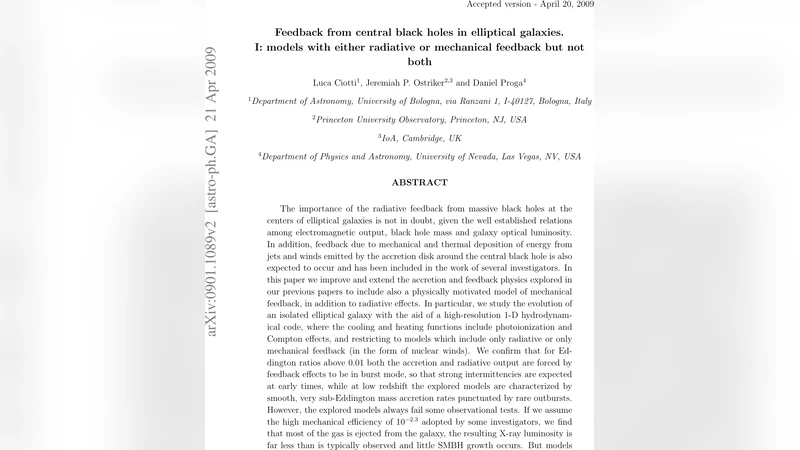
The importance of the radiative feedback from SMBHs at the centers of elliptical galaxies is not in doubt, given the well established relations among electromagnetic output, black hole mass and galaxy optical luminosity. In addition, feedback due to mechanical and thermal deposition of energy from jets and winds emitted by the accretion disk around the central SMBH is also expected to occur. In this paper we improve and extend the accretion and feedback physics explored in our previous papers to include also a physically motivated mechanical feedback. We study the evolution of an isolated elliptical galaxy with the aid of a high-resolution 1-D hydrodynamical code, where the cooling and heating functions include photoionization and Compton effects, and restricting to models which include only radiative or only mechanical feedback. We confirm that for Eddington ratios above 0.01 both the accretion and radiative output are forced by feedback effects to be in burst mode, so that strong intermittencies are expected at early times, while at low redshift the explored models are characterized by smooth, very sub-Eddington mass accretion rates punctuated by rare outbursts. However, the explored models always fail some observational tests. If we assume the high mechanical efficiency of 10^{-2.3}, we find that most of the gas is ejected from the galaxy, the resulting X-ray luminosity is far less than is typically observed and little SMBH growth occurs. But models with low enough mechanical efficiency to accomodate satisfactory SMBH growth tend to allow too strong cooling flows and leave galaxies at z=0 with E+A spectra more frequently than is observed. We conclude that both types of feedback are required. Models with combined feedback are explored in a forthcoming paper [abridged]
💡 Research Summary
The authors investigate how feedback from super‑massive black holes (SMBHs) shapes the evolution of isolated elliptical galaxies by constructing high‑resolution one‑dimensional hydrodynamic simulations that treat radiative and mechanical feedback separately. The study builds on earlier work that emphasized radiative heating, photo‑ionization, and Compton effects, but now adds a physically motivated mechanical component representing energy and momentum deposition by jets and winds launched from the accretion disk. The galaxy model is initialized with realistic stellar mass, dark‑matter halo, and gas density profiles, and the cooling–heating functions include both line cooling and the radiative processes mentioned above. SMBH accretion follows a Bondi‑like prescription modulated by the instantaneous Eddington ratio, and the black‑hole mass grows self‑consistently.
In the “radiative‑only” runs, the authors find that whenever the Eddington ratio exceeds ~0.01 the system enters a burst mode. Gas accumulates near the nucleus, is heated by intense radiation, and then is expelled in violent outbursts. This bursty behaviour dominates at high redshift (early cosmic times) and produces strong intermittency in the accretion rate. As the universe ages and the Eddington ratio drops below ~10⁻⁴, the accretion settles into a quiescent, sub‑Eddington regime punctuated by rare, low‑amplitude flares. Such models reproduce the low X‑ray luminosities observed in present‑day ellipticals but over‑predict the frequency and intensity of early‑time bursts, conflicting with constraints from stellar population ages and metallicities.
In the “mechanical‑only” runs, two regimes of mechanical efficiency (ε_mech) are explored. With a high efficiency of ~10⁻²·³, the jet/wind power is sufficient to eject the bulk of the interstellar medium from the galaxy. Consequently, the simulated X‑ray luminosity falls far below typical observed values, and SMBH growth is severely curtailed because little gas remains to feed the black hole. Conversely, when ε_mech is reduced to ≤10⁻³, the mechanical energy is insufficient to prevent a classic cooling flow. Cold gas builds up in the central kiloparsec, leading to sustained star formation and the emergence of post‑starburst (E+A) spectral signatures. The frequency of such E+A spectra in the simulated z = 0 galaxies exceeds that seen in real elliptical samples, indicating that low‑efficiency mechanical feedback alone cannot match observations.
The key insight is that neither feedback channel alone can satisfy the full suite of observational constraints: radiative feedback alone yields realistic SMBH masses and X‑ray output at late times but fails to regulate early cooling flows, while mechanical feedback alone either over‑ejects gas (high ε_mech) or leaves too much cooling gas (low ε_mech). The authors therefore argue that a hybrid model, in which radiative heating dominates during high‑accretion phases and mechanical energy provides long‑term regulation of the hot halo, is required. They note that such combined‑feedback simulations are the subject of a forthcoming companion paper, where they will test whether the synergy of the two mechanisms can simultaneously reproduce the observed SMBH mass–σ relation, the X‑ray luminosity function of ellipticals, and the low incidence of E+A spectra at low redshift.
Comments & Academic Discussion
Loading comments...
Leave a Comment