The Pattern Matrix Method (Journal Version)
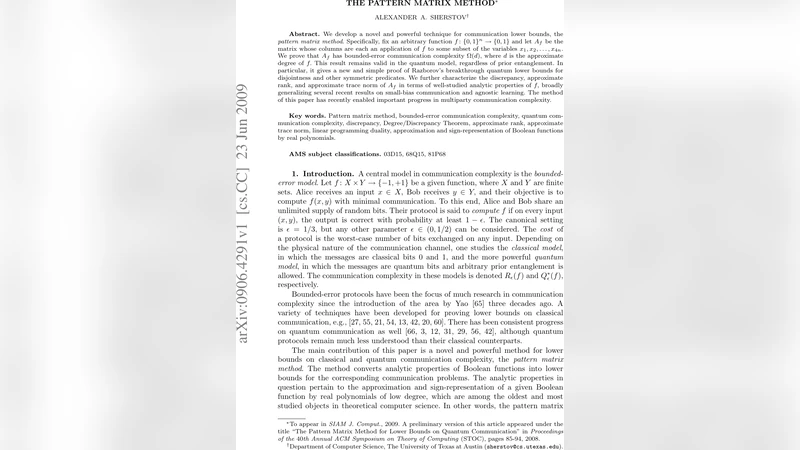
We develop a novel and powerful technique for communication lower bounds, the pattern matrix method. Specifically, fix an arbitrary function f:{0,1}^n->{0,1} and let A_f be the matrix whose columns are each an application of f to some subset of the variables x_1,x_2,…,x_{4n}. We prove that A_f has bounded-error communication complexity Omega(d), where d is the approximate degree of f. This result remains valid in the quantum model, regardless of prior entanglement. In particular, it gives a new and simple proof of Razborov’s breakthrough quantum lower bounds for disjointness and other symmetric predicates. We further characterize the discrepancy, approximate rank, and approximate trace norm of A_f in terms of well-studied analytic properties of f, broadly generalizing several recent results on small-bias communication and agnostic learning. The method of this paper has recently enabled important progress in multiparty communication complexity.
💡 Research Summary
The paper introduces the “pattern matrix method,” a versatile technique for proving lower bounds in communication complexity. The authors fix an arbitrary Boolean function f : {0,1}ⁿ → {0,1} and construct a matrix A_f whose columns correspond to evaluations of f on all possible n‑subsets of a larger set of 4n variables. Each column therefore encodes a “pattern” of f, and the entire matrix inherits analytic properties of f.
The central theorem states that the bounded‑error communication complexity of A_f is Ω(d), where d is the approximate degree of f (the minimum degree of a real polynomial that approximates f within a constant error). The proof proceeds by (1) showing that any low‑communication protocol for A_f induces a low‑degree polynomial approximation of f, contradicting the definition of d, and (2) extending this argument to the quantum setting. Remarkably, the Ω(d) lower bound holds even when the parties share arbitrary prior entanglement, because the method relies on the trace norm of A_f, which is lower‑bounded by the approximate degree irrespective of quantum resources. This yields a streamlined re‑derivation of Razborov’s quantum lower bounds for Disjointness and other symmetric predicates.
Beyond communication complexity, the authors give a precise analytic characterization of three important matrix measures: discrepancy, approximate rank, and approximate trace norm. They prove that each of these quantities can be expressed in terms of well‑studied Fourier‑analytic parameters of f such as the L₁‑norm of its spectrum, its total influence, and its symmetry class. Consequently, known results on small‑bias communication and agnostic learning become immediate corollaries of the pattern matrix framework.
The paper also discusses extensions to the multiparty “Number‑On‑The‑Forehead” (NOF) model. By arranging pattern matrices across multiple partitions, the method yields Ω(d) lower bounds for a broad class of multiparty functions, improving on several prior bounds and enabling new separations between deterministic, randomized, and quantum NOF complexities.
In summary, the pattern matrix method provides a unifying bridge between the approximate degree of a Boolean function and a suite of communication‑theoretic quantities. Its robustness across classical, quantum, and multiparty settings makes it a powerful tool for future research in complexity theory, learning theory, and distributed computation.
Comments & Academic Discussion
Loading comments...
Leave a Comment