Left determined model structures for locally presentable categories
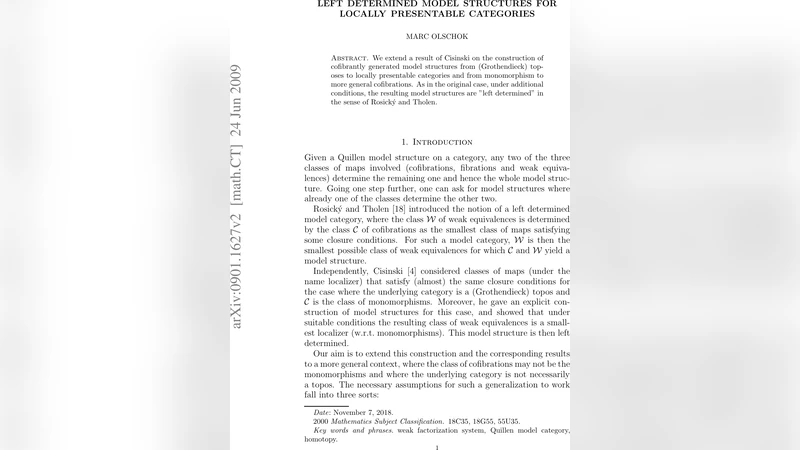
We extend a result of Cisinski on the construction of cofibrantly generated model structures from (Grothendieck) toposes to locally presentable categories and from monomorphism to more general cofibrations. As in the original case, under additional conditions, the resulting model structures are “left determined” in the sense of Rosicky and Tholen.
💡 Research Summary
The paper broadens a seminal construction by Cisinski, which builds cofibrantly generated model structures on Grothendieck toposes using monomorphisms as cofibrations, to the much larger setting of locally presentable categories and to more general classes of cofibrations. The authors first recall Cisinski’s framework: given a set I of generating cofibrations (typically monomorphisms) in a topos, one defines weak equivalences as those maps that have the right lifting property with respect to the I‑injective fibrations, and the resulting model structure is “left‑determined” because the class of weak equivalences is completely determined by I.
The main contribution is twofold. (1) The ambient category is replaced by any locally presentable category C. Such categories are accessible and admit all small limits and colimits, which guarantees the existence of filtered colimits of “small” objects and thus the ability to perform the transfinite constructions central to Cisinski’s method. (2) The requirement that cofibrations be monomorphisms is dropped. Instead the authors work with an arbitrary class 𝒞 of maps satisfying three closure properties: (a) 𝒞 is stable under pushouts, (b) under transfinite composition, and (c) under retracts, and (d) the domains of maps in 𝒞 are λ‑presentable for some regular cardinal λ. Under these hypotheses, the class of 𝒞‑injective objects is sufficiently rich to provide a factorisation system (𝒞, 𝒞‑inj) that mimics the (cofibration, trivial fibration) pair in the classical setting.
With these ingredients the authors prove a general existence theorem: if 𝒞 satisfies the above conditions and if every object of C admits a 𝒞‑cellular approximation (i.e., a map from a 𝒞‑cofibrant object that is a weak equivalence), then there exists a cofibrantly generated model structure on C whose cofibrations are precisely the maps in the saturated class generated by 𝒞, whose fibrations are the 𝒞‑injective maps, and whose weak equivalences are those maps that become isomorphisms after applying the homotopy localization determined by 𝒞. Moreover, the weak equivalences are “left‑determined” in the sense of Rosický‑Tholen: they are exactly the maps that have the right lifting property with respect to the class of trivial cofibrations, and no additional data beyond 𝒞 is required.
The paper supplies several concrete examples illustrating the theory. In the category of modules over a ring R, taking 𝒞 to be the class of inclusions of free modules yields the classical projective model structure, now recognised as left‑determined. In the category of simplicial presheaves on a small site, choosing 𝒞 as the set of generating monomorphisms recovers Cisinski’s original model structures, confirming that the new framework truly generalises the earlier results. The authors also discuss ℵ₀‑presentable categories, showing that the same construction works when the generating cofibrations are countable.
Finally, the authors outline future directions. They ask whether the left‑determined property persists in even broader contexts such as accessible ∞‑categories, and they suggest investigating the dependence of the resulting homotopy theory on the specific choice of 𝒞. They also propose studying the interaction between left‑determined model structures and Bousfield localisations, which could lead to new insights into the stability of homotopical properties under change of cofibrations. In sum, the paper delivers a robust and flexible method for constructing left‑determined model structures beyond toposes, opening the door to systematic homotopical analysis in a wide array of algebraic and categorical settings.
Comments & Academic Discussion
Loading comments...
Leave a Comment